
With a population that surpasses 4 million people and continues to rise, available land for farming inside and around the city is shrinking rapidly, making it increasingly impractical for most urban residents.
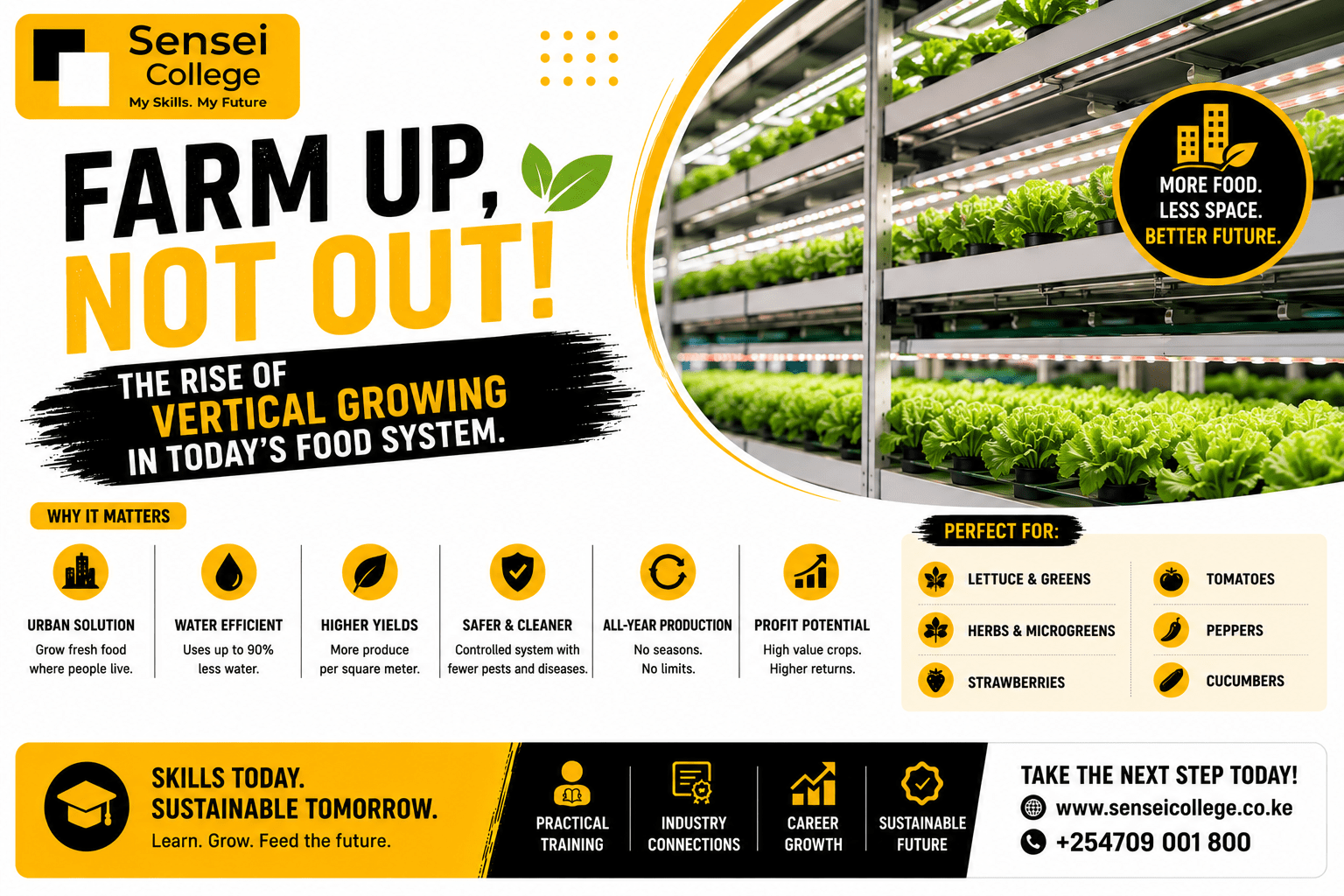
Vertical farming is emerging as one of the most practical answers to this challenge. By growing crops upward, stacking plants in layers instead of spreading them across wide flat fields, farmers can produce large amounts of fresh food in surprisingly small spaces. And when combined with hydroponic systems, production is more impressive.
What is Vertical Farming?
Vertical farming is a method of growing crops in vertically stacked layers, like shelves or towers, rather than on flat, horizontal ground. Instead of one plant taking up one square metre of ground space, you can grow 5, 10, or even 20 plants in that same square metre by stacking them upward.
Vertical farms can be set up indoors, in warehouses or rooms with artificial lighting, in greenhouses with natural light, or even outdoors using specially designed tower and wall systems. The key idea is simple: grow upward, not outward.
Why Vertical Farming is Ideal for Cities
- Limited and expensive land – Even a small plot in Nairobi’s outskirts costs millions of shillings. Vertical farming allows production on a fraction of that land
- Year-round mild climate – Nairobi’s altitude (1,795 metres above sea level) and equatorial climate provide moderate temperatures ideal for many vegetable crops
- Strong urban food market – Nairobi’s supermarkets, restaurants, and fresh produce markets offer ready buyers for locally grown vegetables
- High water costs – Vertical hydroponics uses up to 95% less water than soil farming, cutting costs significantly
- Rising middle class – Urban Nairobians are increasingly demanding premium, pesticide-free vegetables – a market that vertical hydroponic farms are perfectly positioned to serve
How Hydroponics Supports Vertical Farming
Vertical farming and hydroponics work naturally. Traditional soil is heavy. You cannot stack soil-based growing beds vertically without major engineering challenges. Hydroponic growing media, such as coco coir, perlite, rockwool, or simply water, are far lighter and easier to arrange in vertical configurations.
Hydroponic systems also deliver water and nutrients directly to plant roots through pipes, tubes, and drip emitters. This makes them ideal for vertical setups where gravity and plumbing can be used to move nutrient solution efficiently from top to bottom or bottom to top.
Additionally, hydroponics allows faster growth cycles up to 30 to 50% faster than soil, meaning vertical hydroponic farms in Nairobi can harvest more frequently and generate consistent income throughout the year.
Types of Vertical Hydroponic Systems
Tower Systems
Tower systems are one of the most popular forms of vertical hydroponics in Nairobi. A vertical tower is a tall cylindrical or square column with planting holes cut at regular intervals around its surface. Nutrient solution is pumped up to the top and trickles down through the column, feeding plant roots as it goes.
Each tower can hold 20 to 50 plants, depending on its height. A single square metre of floor space can accommodate 2 to 4 towers, effectively multiplying your growing capacity 4 to 8 times. Towers are ideal for growing leafy greens like kale, spinach, lettuce, coriander, and herbs.
Wall Systems
Wall systems fix planting pockets or panels to a vertical surface, such as a wall or fence. Each pocket holds growing media and a plant, and nutrient solution is delivered through drip lines or a recirculating system at the top.
Wall systems are particularly popular in Nairobi’s urban homes and restaurants, where they double as decorative features while producing fresh herbs and salad greens. A single 2-metre by 3-metre wall panel can grow over 50 plants.
Benefits of Vertical Farming
Space Saving
- Grow 5 to 10 times more food per square metre compared to traditional farming
- Turn unused rooftops, balconies, garages, and walls into productive growing areas
- Ideal for apartments, small plots, schools, hotels, and restaurants
Water Efficiency
- Hydroponic vertical systems use up to 95% less water than soil-based farming
- Recirculating systems mean water and nutrients are continuously reused
- Particularly important in Nairobi, where water costs and scarcity are a growing concern
Challenges and Solutions
- High initial setup cost – Start small with a 2 to 4 tower system, then reinvest profits to scale up
- Power dependency for pumps and lighting – Use solar panels to power water pumps, reducing electricity dependence
- Technical knowledge required – Take a professional hydroponics training course before setting up
- Pest and disease risk in humid vertical systems – Maintain good airflow, monitor plants daily, and use organic pest management
Cost and Setup Considerations
The cost of setting up a vertical hydroponic farm varies depending on scale and system type:
| Setup Scale | Plants | Estimated Cost |
| Small home tower system (4 towers) | 80–100 plants | KES 15,000 – 40,000 |
| Medium rooftop setup (20 towers) | 400–600 plants | KES 100,000 -250,000 |
| Commercial vertical greenhouse | 1,000+ plants | KES 500,000+ |
Key recurring costs include nutrient solution (approximately KES 3,000 to 8,000 per month), water, electricity for pumps, and growing media replacement every 2 to 3 crop cycles.
Most small vertical hydroponic setups recover their investment within 6 to 12 months when selling to local markets, hotels, or restaurants.
Conclusion
Land scarcity does not have to mean food scarcity. Vertical farming, powered by hydroponic technology, is giving urban farmers a powerful way to produce large volumes of fresh vegetables from very small spaces.
Whether you have a rooftop, a balcony, a spare room, or a wall, you have enough space to start growing. The combination of hydroponic efficiency and vertical design means that every square metre you have becomes more productive.
As Nairobi continues to grow, vertical farming is not just an option, it is an essential part of how cities will feed themselves.