
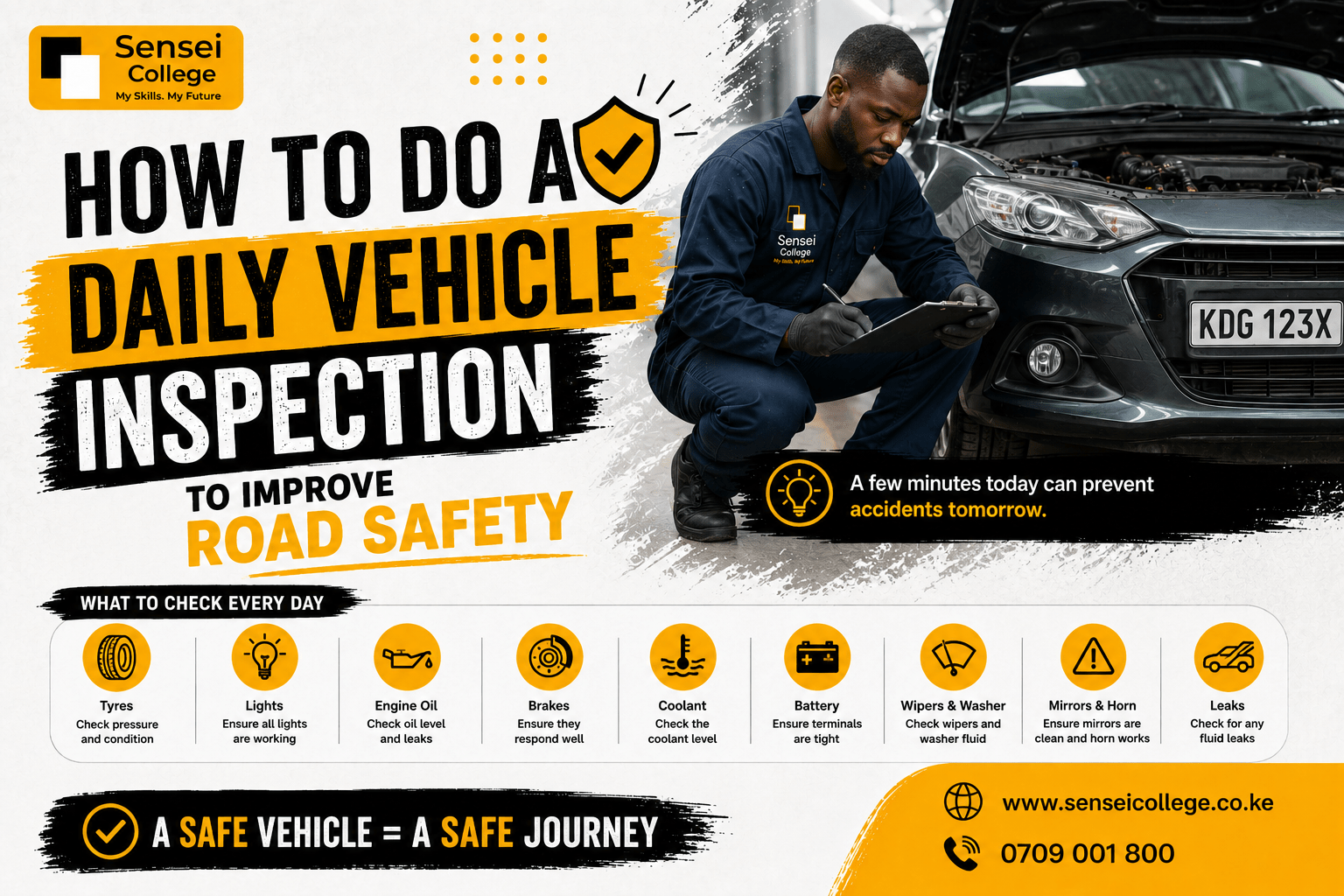
In Kenya, many road accidents are caused not by bad driving, but by poorly maintained vehicles. Bald tyres, faulty brakes, non-working lights, and low fluid levels are all preventable. A vehicle that has not been checked can fail at the worst possible moment: on a highway, in heavy rain, or on a steep descent.
Whether you drive a personal car, a matatu, a lorry, or a company vehicle, doing a quick check before every trip is one of the most professional habits you can develop.
Engine and Under The Bonnet
(i). Engine Oil Level
- Make sure the engine is cold (or wait 10 minutes after switching off)
- Pull out the dipstick, wipe it clean with a cloth
- Re-insert it fully, then pull it out again
- The oil should be between the MIN and MAX marks
Low oil causes engine overheating and can destroy the engine completely a repair that is expensive. If low, top up with the correct grade of oil. If the oil is very dark or thick, it needs to be changed.
(ii). Coolant/Radiator Water Level
- Look at the plastic coolant reservoir beside the radiator
- The level should be between MIN and MAX when the engine is cold
- Never open the radiator cap when the engine is hot, it is pressurised and will burn you
Low coolant causes the engine to overheat. An overheated engine can seize and fail completely.
Top up with coolant or clean water if low. If it keeps dropping, suspect a leak and have it checked by a mechanic.
(iii). Brake Fluid Level
- Find the brake fluid reservoir on the driver’s side of the engine bay
- The level must be between MIN and MAX
Low brake fluid is usually due to spongy or unresponsive brakes. This can cause total brake failure.
If low, top up with the correct type of brake fluid, either DOT 3 or DOT 4, and check the cap. If it is consistently low, there is a leak. Stop driving and fix it immediately.
(iv). Power Steering Fluid
Find the power steering fluid reservoir and check the level against the markings.
Low power steering fluid makes the steering stiff and unpredictable, especially at low speeds or while parking.
(v). Windscreen Washer Fluid
Look at the washer fluid reservoir, which usually has a windscreen/water symbol on the cap.
Dusty Kenyan roads coat your windscreen quickly. You need washer fluid to see clearly, especially on highways. Top up with water or a proper washer fluid mix.
(vi). Fan Belt/Drive Belt
Look at the belts running from the engine pulley. They should look firm and uncracked.
A snapped fan belt can disable your alternator, power steering, and cooling system all at once, leaving you stranded.
Ensure you replace before driving long distance.
TYRES
Tyres are the only part of your vehicle that touches the road. They deserve serious attention.
(i). Tyre Pressure
Use a tyre pressure gauge or visit a petrol station.
| Vehicle Type | Recommended Pressure |
| Small car | 30–33 PSI |
| Medium car | 32–36 PSI |
| SUV / 4WD | 35–42 PSI |
| Matatu/minibus | 45–55 PSI |
| Truck/lorry | Varies – check manual |
Underinflated tyres overheat and are a leading cause of blowouts. Overinflated tyres have less grip and can burst over bumps.
(ii). Tyre Tread Depth
To check the tread depth, place a matchstick in the main groove. If the groove is shallower than the match head, the tyre is worn out and dangerous. Worn tyres cannot grip the road in the rain. This causes skidding, longer stopping distances, and accidents.
Tyres must have at least 1.6mm of tread across the full width.
(iii). Tyre Condition
Walk around the vehicle and look for:
- Cuts, bulges, or cracks on the tyre sidewall
- Nails, stones, or screws embedded in the tread
- Uneven wear patterns (sign of alignment or suspension problems)
Bulge tyres should be replaced immediately. Nails on tyres should be taken care of with immediate effect.
(iv). Spare Tyre
Ensure:
- The spare tyre is in place either under the vehicle or in the boot
- It is inflated to the correct pressure
- The tyre iron and jack are present and accessible
A flat tyre with no spare leaves you stranded, and on a Kenyan highway, this is dangerous.
BRAKES
(i). Brake Pedal Feel
Press the brake pedal firmly before moving. It should feel firm and resistant, not soft or spongy. A soft pedal indicates low brake fluid or air in the brake lines; both are dangerous.
Do not drive when the brake pedal is soft. Check brake fluid and have the system inspected.
(ii). Handbrake/Parking Brake
To check, apply the handbrake and try to push the vehicle forward gently. It should hold firm.
A faulty handbrake means the vehicle can roll when parked on a slope, which causes many accidents in Kenya.
(iii). Brake Warning Light
When you start the engine, all dashboard warning lights flash briefly and then go off. The brake warning light, which looks like an exclamation mark in a circle, should go off.
If it stays on, your brake fluid is low, or there is a fault. Do not ignore it.
LIGHTS AND SIGNALS
Walk around the vehicle and test each of the following
| Light | What To Check |
| Headlights (low beam) | Both working, properly aligned |
| Headlights (high beam) | Both working |
| Tail lights | Both red lights are visible at the rear |
| Brake lights | Flash when the brake pedal is pressed (ask someone to watch) |
| Indicators (left & right) | Flash correctly, front and rear |
| Hazard lights | All four corners flash together |
| Reverse lights | Come on, when the gear is in reverse |
| Dashboard warning lights | Should all go off after starting (except any active faults) |
| Numberplate light | The rear plate must be illuminated at night |
In Kenya, driving with faulty lights is a traffic offence. More importantly, lights prevent accidents, especially at night or in the rain.
WINDSCREEN AND WIPERS
(i). Windscreen Condition
- No major cracks that obstruct your view
- No heavy dust or mud on the outside
- No smearing or streaking on the inside
A cracked windscreen weakens vehicle’s structure and can shatter in an accident. Dirty glass reduces visibility dangerously.
(ii). Windscreen Wipers
- Test both wipers; they should sweep cleanly without streaking
- Check the wiper rubber; if it is cracked or torn, it will not clear rain effectively.
Kenya has heavy rains. Without working wipers, you cannot see during a downpour. This is when many accidents happen.
INSIDE THE VEHICLE
| Item | Check |
| Seatbelts | All work and lock properly when pulled sharply |
| Mirrors | Adjusted correctly left, right, and rear |
| Horn | Works when pressed |
| Doors | All close and latch properly |
| Floor area | No loose items that can roll under the pedals |
| Warning triangle | Present in boot |
| First aid kit | Present and stocked |
| Fire extinguisher | Present (required for PSVs) |
| Fuel gauge | Enough fuel for the journey planned |
Special Tips for Commercial and PSV Drivers
If you drive a matatu, bus, lorry, or fleet vehicle, these extra checks are mandatory:
- Speed governor: Must be functional and set to the correct limit
- CCTV cameras: Must be working inside the PSV
- Passenger seatbelts: Check that all passenger belts are in place and working
- Tyre condition: PSV vehicles carry more weight, check tyres daily without fail
- Vehicle capacity: Never carry more passengers than your licensed capacity
- Fire extinguisher: Must be mounted and accessible, not buried in the boot
- Driver fitness: Do not drive if you have slept less than 6 hours, are unwell, or have taken any medication that causes drowsiness
For Fleet Managers
- Create a logbook for each vehicle. Drivers sign the checklist each day
- Schedule monthly professional inspections even if no problems are reported
- Ensure drivers are trained to report faults immediately.
- Keep a maintenance record of all repairs, oil changes, and tyre replacements
Conclusion
A professional driver is not just someone who can drive well; it is someone who ensures safety on every trip.
This level of safety does not happen by chance; it comes from deliberate precaution with the driver’s responsibility to carry out thorough vehicle inspections before every journey, identifying and addressing potential risks to ensure the safety of both the driver and other road users.