
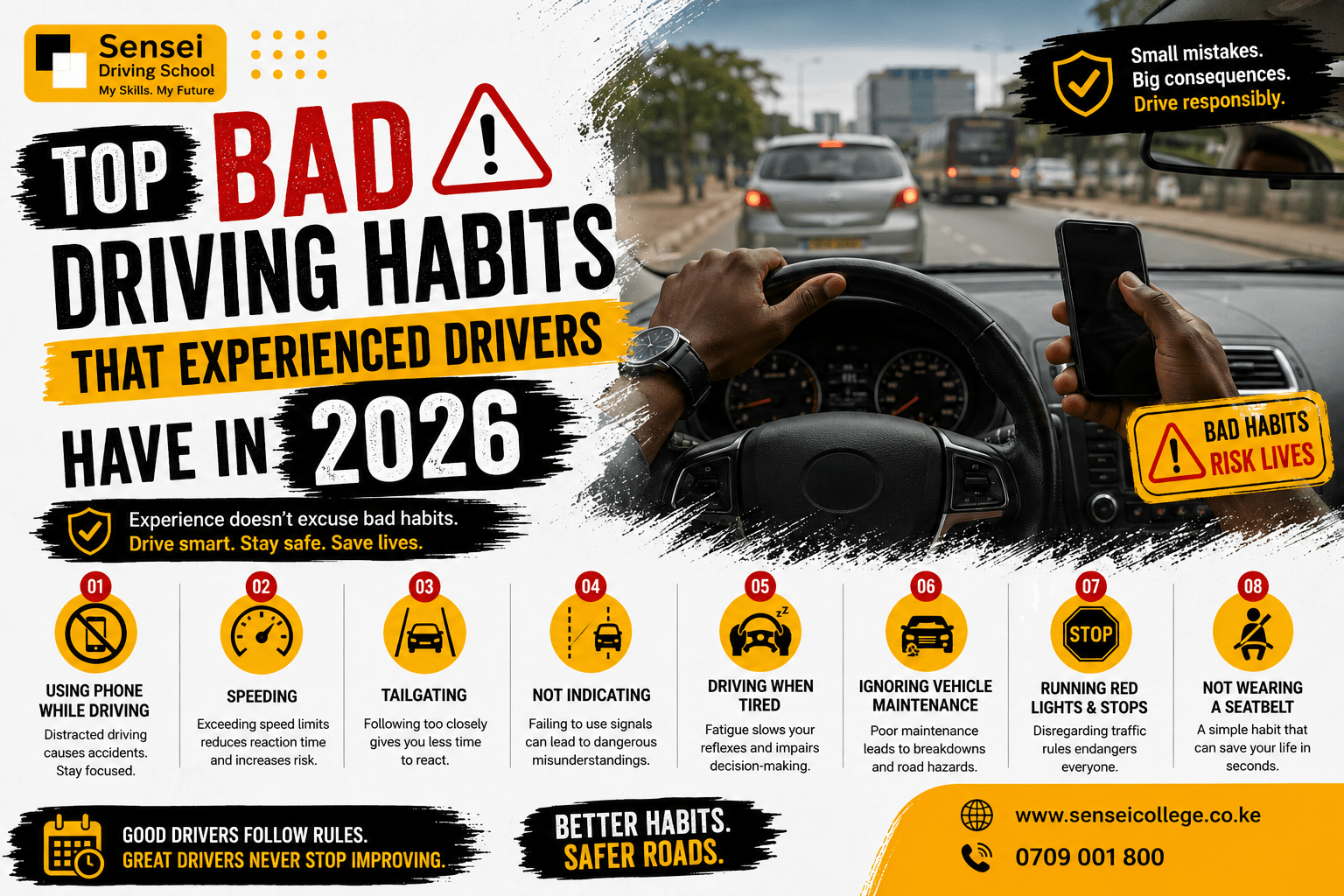
When you do something for a long time, your brain automates it to conserve energy. The automation is efficient, but it also means you stop consciously evaluating whether you are doing it correctly.
Bad Habits developed by drivers over time
- Reducing following distances – Drivers are taught the 3-second rule. Experienced drivers, after years of high-density Nairobi traffic, often reduce this to 1 second or less, not because it is safe, but because it has become habitual and nothing bad has happened yet.
- Mirror checking frequency drops – Studies show that experienced drivers check their mirrors significantly less frequently than they should. Experience creates the illusion that peripheral awareness replaces active checking.
- Speed creep – Long-haul drivers particularly develop this. The 80 km/h speed governor feels restrictive, and on a clear stretch of the A109 at 4 am, drivers often unconsciously seek ways around the limitation.
- Phone use normalization – This has gotten worse with smartphones. Research from NTSA shows that phone use while driving reduces reaction time by an equivalent of 0.05% blood alcohol, similar to mild intoxication.
- Pre-trip inspection shortcuts – After years of driving the same vehicle with no obvious problems, the daily inspection checklist becomes a formality or disappears entirely. Experienced drivers who skip this eventually encounter a preventable failure.
What is a Refresher Course?
A modern refresher driving course is a structured skills audit and recalibration.
They include:
1. Driving Behavior Assessment
An instructor rides with you while you drive your normal route. They observe real while documenting:
- Mirror check frequency
- Following distances
- Speed compliance
- Intersection approach behavior
- Mobile phone behavior
- Pre-trip inspection completeness
At the end of the session, you receive a detailed behavioral report. This is often the most confronting part of refresher training for experienced drivers because the data is specific and undeniable.
2. Targeted Skills Correction
Based on the Phase 1 assessment, the program targets your specific deficiencies rather than repeating everything. This makes refresher training far more time-efficient than starting from scratch.
Common focus areas include:
- Following distance recalibration
- Night driving habits, particularly relevant for long-haul drivers
- Emergency braking at different speeds with modern vehicle systems (ABS behavior is often misunderstood)
- Fatigue Management: Practical Strategies for long routes
- Telematics compliance: how to interpret and improve your GPS fleet scoring
3. Updated Knowledge
Road laws, NTSA regulations, and vehicle technology change. A refresher course updates you on:
- 2024–2026 NTSA regulatory changes affecting your license class
- New speed enforcement technologies (digital speed cameras, point-to-point speed averaging)
- EV and hybrid vehicle interaction: what happens when a fuel vehicle driver encounters electric vehicles on the highway
- Updated first aid protocols for road accident response
4. Certification
Upon completion, you receive an updated certificate with the course date, which resets your “last trained” clock for employer compliance purposes.
Drivers Who Need a Refresher Course
1. Drivers returning from a gap period of 6+ months off the road
Whether from illness, travel, or a career pause, motor skills and habits need resetting before professional deployment.
2. Corporate drivers approaching their 2–3 year renewal threshold
Many NGO and corporate fleet policies require refresher training every 2–3 years. Do not wait for your employer to mandate it; proactively doing it makes you look professional.
3. Drivers who have had a recent incident
An accident, near-miss, or series of traffic fines is a clear signal that something in your driving behavior needs professional evaluation. The sooner this happens, the sooner bad patterns are corrected.
4. Drivers upgrading to a new vehicle class
A PSV driver moving to truck driving, or a C1 driver upgrading to C2, even if technically licensed for the new vehicle, a refresher specifically on the new vehicle class’s handling characteristics is valuable.
5. Any driver over 50
Physical changes – reaction time, night vision, and hearing affect driving performance gradually. Refresher training at this stage is not an admission of decline; it is intelligent adaptation.
6. Drivers targeting new employment
A recent refresher certificate (within 12 months) on your CV signals to corporate employers that you are current, professional, and self-motivated about safety.
Importance of Refresher Training
1. Employed – A refresher course costs KSh 10,000 – 25,000 typically.
The income return comes in two forms:
-Avoiding the income loss from a serious incident (potentially months of unemployment after a dismissible accident).
-Improving your telematics score (which affects bonuses and route assignments at companies that use fleet scoring).
2. Job-seekers – A refresher course done within the past 12 months appears on your CV as a strong differentiating signal. In a competitive corporate driver market, it is one of the fastest ways to stand out.
3. Self-employed – Insurance renewal rates are influenced by your claims history and, increasingly, by documented training compliance. Some Kenyan insurers offer discounts for fleet operators who document driver refresher training.
Frequently Asked Questions
1. How often should a professional driver do a refresher course in Kenya?
The recommended frequency is every 2–3 years for corporate and fleet drivers, and annually for drivers in high-risk categories, such as petroleum tankers, long-haul, and VIP transport.
2. Does a refresher course give me a new certificate?
Yes, completing an accredited refresher course results in a new certificate with the current date of completion. This is what employers and insurance companies look for when verifying training currency.
3. Is refresher training available at Sensei Driving School?
Yes, Sensei offers refresher training programs for licensed drivers at both the Nakuru and Kitengela campuses. Programs are tailored to the driver’s license class and employment context.
4. Can my employer pay for my refresher course?
Many corporate employers cover the cost of mandatory refresher training as part of their fleet management budget. Approach your HR or fleet manager with the proposed course details and cost.