

Kenya’s real estate and infrastructure sectors are booming, driven by population growth, urbanisation, affordable housing initiatives, and private investment. New homes, apartments, malls, offices, hospitals, and roads are going up at a pace this country has never seen before.
Today, there is a consistent problem slowing these projects down: a serious shortage of skilled construction workers.
Site managers struggle to find trained plumbers, qualified tilers, experienced masons, and reliable site supervisors. This shortage is not just a headache for contractors, it is a massive opportunity for anyone willing to invest a few months learning a practical trade.
Building and construction courses in Kenya open doors to employment on major projects, self-employment as a specialist contractor, or even starting your own construction business. In this guide, we cover everything you need to know about construction skills training in Kenya, including what Sensei College offers, what you can earn, and how to turn your training into a sustainable income.
Building Construction Technology Courses at Sensei College
Sensei College is one of Kenya’s recognised institutions in practical technical training.
Their building and construction programme is not a traditional classroom-heavy course. It is a hands-on, workshop-based programme designed to produce graduates who can walk onto a real construction site and contribute from day one.

What the Programme Covers
The Sensei College construction courses cover a broad range of construction skills, giving students a solid foundation across multiple trades while also allowing deeper specialisation. The curriculum is structured around what Kenyan employers and clients actually need, which is why Sensei graduates are consistently hired by construction firms and private clients alike.
Core areas covered include:
- Fundamentals of construction technology: reading drawings, understanding site plans, and knowing materials
- Site preparation, excavation, and foundation work
- Brick and block laying techniques
- Concrete work: mixing ratios, formwork, and structural basics
- Roofing systems; timber trusses, iron sheets, tiles
- Safety on construction sites: PPE, hazard identification, and site regulations
- Basic supervision and site coordination skills
- Finishing work: plastering, screeding, and painting
The practical approach means you spend real time on real construction tasks. By the time you graduate, you understand not just how to do the work, but why each step matters for the quality and safety of the finished building.
How to Become a Site Foreman in Kenya
The site foreman is one of the most important people on any construction project. They are the person who stands between the engineer’s plan and what actually gets built.
They supervise workers, coordinate deliveries, ensure quality is maintained, and make sure safety rules are followed.
What Does a Site Foreman Do?
A site foreman manages day-to-day operations on a construction site. They assign tasks to workers in the morning, monitor progress throughout the day, troubleshoot problems as they arise, and report back to the project manager or engineer. They also take responsibility for materials, making sure the right amount of cement, sand, steel, or timber is on site when it is needed.
To become a site foreman in Kenya, you need a combination of technical knowledge and leadership ability. You must understand construction processes well enough to spot mistakes before they become expensive problems, and you must be able to communicate clearly with both workers and supervisors above you.
Career Progression: From Trainee to Supervisor
The path to becoming a site foreman follows a predictable and achievable pattern:
- Year 1–2: You start as a construction artisan, laying blocks, doing concrete work, or assisting on finishing tasks while learning how a site operates.
- Year 2–4: With growing experience, you become a trusted, skilled worker. Supervisors start giving you responsibility for small teams or specific tasks.
- Year 4–6: You move into junior supervision roles — leading a team of 5 to 10 workers, managing a specific section of a project.
- Year 6 and beyond: You qualify as a full-site foreman, commanding respect and a significantly higher salary.
Construction skills training in Kenya at Sensei College specifically includes supervision basics: planning work schedules, managing workers, and understanding how to coordinate multiple trades on a site simultaneously.
This gives graduates a head start on the path to foreman-level work compared to those who learn purely from informal on-site experience.
Plumbing and Drainage
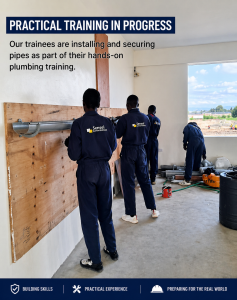
Plumbing stands out as one of the fastest route to self-employment. Every building needs water supply and drainage systems; residential homes, commercial buildings, schools, hospitals, and government facilities. Unlike some construction trades where work only happens on large sites, a good plumber gets call-outs every single day, from homeowners, landlords, and property managers dealing with leaks, blockages, or new installations.
What do they teach in plumbing training?
A plumbing course in Kenya at Sensei College covers both the theoretical and practical sides of the trade:
- Water supply systems: pipes, fittings, pressure, and flow
- Cold and hot water installations
- Drainage and sewerage systems; proper gradients, inspection chambers, and septic tank installation
- Fixing leaks, burst pipes, and faulty joints
- Installing sanitary fittings: sinks, toilets, showers, and bathtubs
- Reading plumbing blueprints and specifications
- Water harvesting and tank installation, which is increasingly important in Kenya
The Business Case for Trained Plumbers
Here is a simple reality: a qualified plumber in Nairobi can charge between KSh 2,000 and KSh 10,000 per job for routine work, and significantly more for full installation projects. The Property owners always need plumbing work, whether it is a new home being fitted out, a rental apartment needing a repair, or a commercial building with a blocked drainage system. A plumber with a good reputation and a basic set of professional tools can build a stable client base within their first year out of training.
The Art of Tiling and Masonry
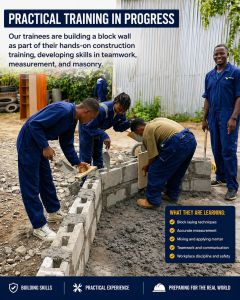
Tiling and masonry training in Kenya teaches some of the most visible and valued finishing skills in construction.
When a building is complete, the quality of the tiling on the floors, walls, and bathrooms is often the first thing a buyer or tenant notices. Skilled tilers are in constant demand from property developers, home renovators, and commercial fit-out contractors.
What Tiling and Masonry Training Covers
- Surface preparation: getting floors and walls clean, level, and ready for tiling
- Mixing adhesives and grouts to the correct consistency
- Laying floor tiles with correct spacing, alignment, and patterns
- Wall tiling; bathrooms, kitchens, and feature walls
- Cutting tiles accurately using wet saws and angle grinders
- Grouting and finishing for a professional result
- Stonework and decorative masonry for high-end projects
- Working with different tile materials: ceramic, porcelain, marble, and granite
Job Opportunities and Income Potential
Tiling is one of the most in-demand finishing skills in Kenya’s real estate sector right now. New apartment developments in Nairobi, Mombasa, and Kisumu require hundreds or thousands of square metres of tiling. A skilled tiler typically charges per square metre rates in 2026 range from KSh 300 to KSh 800 per square metre, depending on the material and complexity.
A tiler completing a medium-sized apartment bathroom and kitchen in a week can earn between KSh 15,000 and KSh 40,000 for that single job. Many experienced tilers work across multiple projects simultaneously, sub-contracting smaller jobs to their own teams. Like plumbing, tiling is also an excellent route to self-employment.
Interior Design and Gypsum Installation
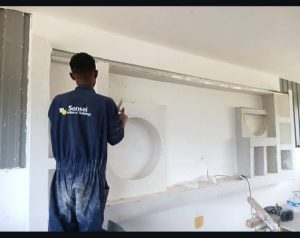
Walk into any modern office block, upmarket apartment, hotel, or restaurant in Nairobi, and you will see it immediately smooth, beautiful ceilings with recessed lighting, curved plasterboard walls, decorative cornices, and elegant partition systems.
This is the world of gypsum installation and interior design, and it is one of the fastest-growing trades in Kenya’s construction sector.
Why Gypsum and Interior Finishing Is Booming
Kenya’s middle class is growing. More Kenyans are buying or renting homes and wanting them finished to a higher standard than a generation ago. Developers building apartments, offices, hotels, and hospitals now almost always include gypsum board ceilings, partition walls, and custom interior features as standard. This has created explosive demand for workers trained in gypsum installation and interior finishing.
What Students Learn
The interior design and gypsum installation training at Sensei College covers:
- Understanding gypsum board and related materials: types, grades, and applications
- Installing ceiling frames and suspending gypsum boards
- Creating partition walls using metal stud framing
- Decorative ceiling designs; plain ceilings, coffered ceilings, and curved features
- Cornice and moulding installation
- Skim plastering for smooth wall finishes
- Painting and surface preparation techniques
- Basic interior design principles: space planning, colour use, and material selection
- Working with clients to deliver the finish they want
An interior design course in Kenya, combined with gypsum installation skills, gives you a very marketable combination.
Homeowners renovating their houses, real estate developers fitting out apartments, and businesses fitting out new offices all need these services. A skilled gypsum installer in Nairobi can earn between KSh 3,000 and KSh 8,000 per day, and project-based work often pays significantly more.
Career Opportunities and Earnings in Construction
One of the most practical questions anyone considering construction training asks is: What will I learn?
Here is a breakdown of what construction professionals in Kenya are currently earning:
Self-employment income varies significantly depending on how many clients you have, your location, and how you price your work.
| Trade / Role | Employment (Monthly KSh) | Self employed Monthly(KSh) |
| Construction artisan (entry level) | 20,000 – 40,000 | Variable |
| Plumber (trained, 2+ years) | 45,000 – 80,000 | 60,000 |
| Tiler / Mason (experienced) | 40,000 – 75,000 | 50,000 |
| Gypsum installer / Interior finisher | 45,000 – 90,000 | 60,000 |
| Site foreman | 70,000 – 130,000 | N/A(Usually employed) |
| Construction supervisor / Manager | 100,000 – 200,000+ | variable |
Trained construction workers are finding opportunities beyond Kenya, South Sudan, Ethiopia, Uganda, Rwanda, and the Gulf states. Short courses for self-employment in Kenya have always had a strong export value; your skills are transferable wherever construction is happening.
Why Choose Sensei College for Your Construction Training
- Practical Learning: You are not paying to sit in a classroom for months. You are paying to get on-site, get your hands dirty, and actually learn how to do the work. This is the type of training that produces graduates employers actually want.
- Target Market: The curriculum is designed around what the Kenyan construction market actually needs, not outdated syllabuses. Sensei College updates its training approach to reflect what is happening on real sites, which is why gypsum installation, diagnostics, and modern finishing techniques are part of the programme.
Graduates leave with a certificate that carries weight with construction companies, private clients, and government contractors. This makes the job search or client acquisition process significantly easier for new graduates.
Frequently Asked Questions
1. How much do construction courses cost in Kenya?
The cost of building construction courses in Kenya varies by institution, trade, and duration. At most reputable colleges, including Sensei College, you can expect to pay between KSh 30,000 and KSh 100,000 for a comprehensive programme covering one or more trade areas.
2. Which construction skill is most profitable in Kenya?
All construction trades can be profitable, but plumbing, gypsum installation, and tiling are widely considered among the most lucrative for self-employed tradespeople in Kenya’s current market.
This is because demand is consistent, clients are willing to pay well for quality work, and a skilled individual can work across multiple projects simultaneously.
3. Can I start a business after construction training?
Yes, and many people do. Construction trades are among the most accessible routes to self-employment in Kenya. After completing your training, you can start taking on jobs independently almost immediately. Most tradespeople begin by doing small jobs for individuals and families, build their reputation through quality work, and gradually scale into larger projects or even their own contracting company.
4. How long do construction courses take?
The duration depends on the trade and the depth of training. Most short, specialised trade courses, such as tiling, plumbing, or gypsum installation, can be completed in 3 to 6 months of intensive practical training. More comprehensive building construction technology programmes covering multiple trades and supervision skills typically take 6 months to 2 years.
5. Do I need any prior education or experience to enrol?
Most construction courses in Kenya, including those at Sensei College, require a basic education (KCSE certificate or its equivalent) but do not require prior construction experience. If you have never worked in construction before, you are still welcome to apply. The training is designed to take complete beginners through to a competency standard that makes them employable or self-sufficient.
6. Is construction a good career in Kenya in 2026?
Construction is one of the most resilient and growing career sectors in Kenya right now. The government’s affordable housing programme, private real estate investment, and ongoing infrastructure development guarantee sustained demand for skilled construction workers for the foreseeable future.
Conclusion: Build Your Future
Kenya is building faster than it ever has, and it needs skilled hands to get the work done. Whether your goal is a stable job with a reputable contractor, a self-employed income from your own plumbing business, a career path that leads to site foreman and beyond, or simply a practical skill that gives you financial independence, building and construction courses in Kenya offer you a clear, achievable route to all of these outcomes.
Sensei College’s construction training programme gives you the practical skills, the recognised certification, and the real-world readiness to succeed in this industry. You will not spend your training time watching videos or copying notes. You will be on site, learning by doing, building competence with every class.
Take the first step today!