
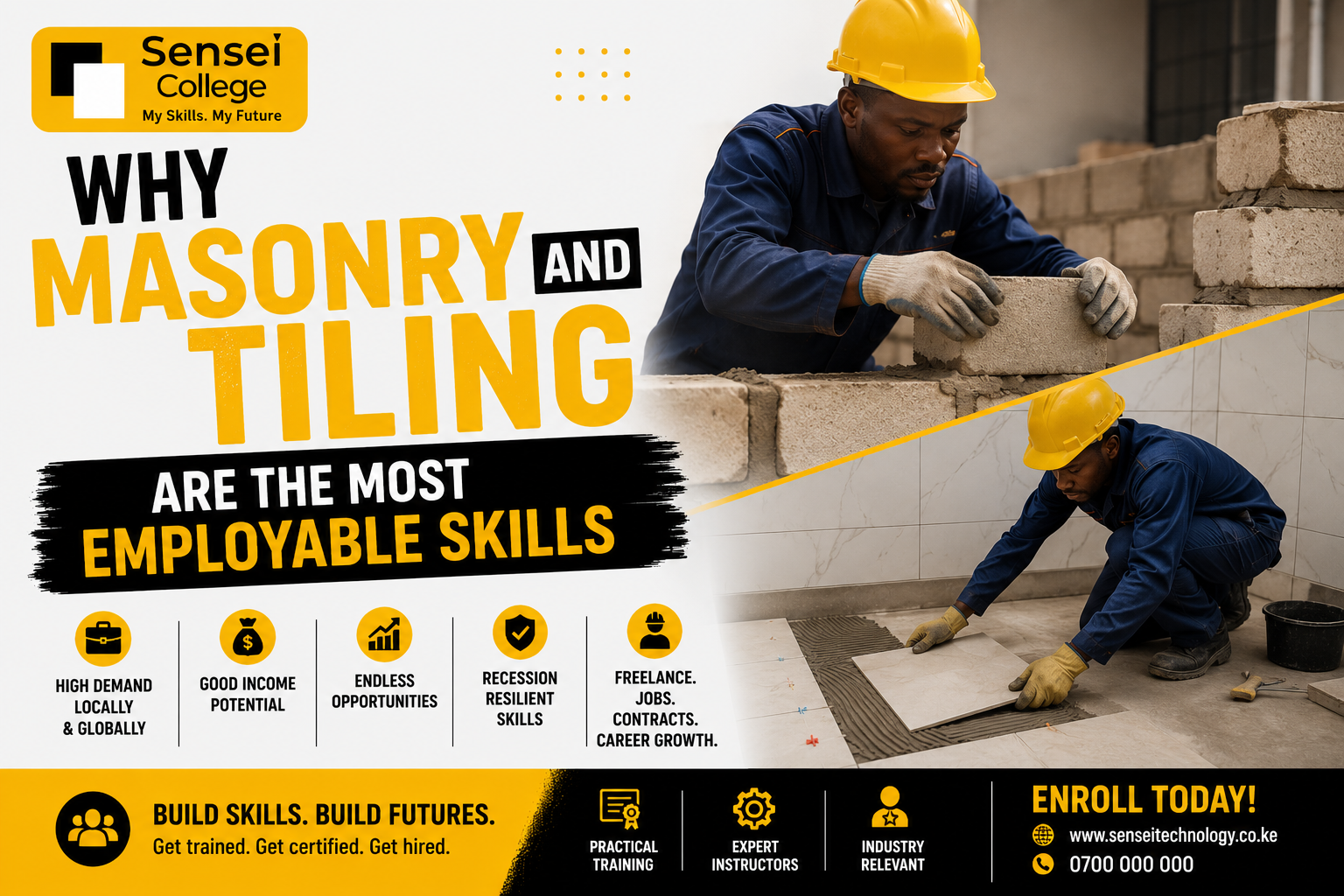
Behind every clean tile layout and perfectly aligned wall is a craft that demands patience, accuracy, and hands-on expertise. Masonry and tiling aren’t just tasks; they’re skills that separate average construction from truly professional work.
Tiling and Masonry
Masonry – is the structural and foundational side of construction. It involves working with bricks, concrete blocks, stones, mortar, and cement to build walls, columns, steps, and structural elements. A mason is concerned with strength, alignment, and permanence.
Tiling – is the finishing art. Once the walls and floors are up, the tiler applies ceramic, porcelain, marble, or terrazzo tiles, transforming a bare concrete surface into something polished, waterproof, and visually striking. In bathrooms, kitchens, outdoor patios, swimming pools, and commercial spaces, the tiler’s work is what the client actually sees and feels every day.
These skills cover the entire building’s surface, from the ground up to the final finish, making professionals who master both extremely versatile and highly sought after.
Tiling and masonry skills training is hands-on from the start. Students move between the classroom and the practical yard daily, working with real materials under the guidance of experienced instructors.
Masonry Skills
- Brick and block laying: Learning bond patterns, mortar consistency, and achieving perfectly level courses that hold up for decades.
- Mixing and applying mortar: Understanding the correct ratios of cement, sand, and water for different applications, structural mortar is very different from tile adhesive.
- Building walls and pillars: Progressing from single-skin walls to cavity walls, corners, openings for doors and windows, and reinforced structures.
- Plastering and rendering: Achieving smooth, flat wall surfaces ready for paint or tiling, a skill that requires both technique and patience.
- Formwork and concrete casting: Understanding how to construct moulds and pour concrete for beams, lintels, and slabs.
Tiling Skills
- Surface preparation: Before a single tile goes down, the surface must be level, clean, and properly primed. This determines whether tiles crack, lift, or last a lifetime.
- Tile cutting and fitting: Using angle grinders, tile cutters, and wet saws to cut tiles precisely around edges, outlets, and awkward corners.
- Layout and pattern planning: Calculating how to arrange tiles so patterns are symmetrical and waste is minimised. This is where artistry meets mathematics.
- Grouting and sealing: Applying grout evenly between tiles and sealing surfaces to create waterproof, easy-to-clean finishes.
- Specialized applications: Wall tiling in bathrooms, large-format floor tiles in commercial spaces, mosaic work, and decorative feature walls.
Applications of Masonry and Tiling Skills
- Hotels and resorts expanding along the Coast and in the Rift Valley all require high-quality tile finishes in guest rooms, lobbies, and pools.
- Shopping malls and commercial buildings in urban centres are demanding polished stone and large-format tile installations.
- Schools and hospitals being built under government programmes all require durable masonry and tile work.
- Middle-class homeowners renovating kitchens and bathrooms to meet modern standards, creating a constant stream of smaller but lucrative jobs.
Career paths available after completing tiling and masonry courses in Kenya
- Formal Employment – Large construction companies, building contractors, and fit-out firms hire skilled tilers and masons as permanent or contract staff. These roles offer regular income, site experience, and opportunities to progress into supervisory positions.
- Subcontracting – Many experienced artisans work as subcontractors, hired by main contractors to handle the tiling or masonry on specific projects. This arrangement offers higher pay per project and more flexibility than full-time employment.
- Self-Employment and Direct Client Work – The most financially rewarding path for many graduates. A self-employed tiler working directly for homeowners and developers sets their own rates, manages their own schedule, and builds a business around their skills.
- Renovation and Remodelling – This is a fast-growing niche. As older housing stock ages, homeowners are investing in renovations. Kitchen and bathroom remodels are among the most popular, and they almost always involve tiling. Renovation work is ongoing, recession-resistant, and available everywhere.
Advantages of the Masonry and Tiling Industry
- No dress code, no office politics – you work with your hands, solve real problems, and see the results of your effort every day.
- Portable skills – masonry and tiling are needed in every country. Kenyan artisans have found work in Rwanda, Uganda, Tanzania, South Africa, and even in the Gulf States.
- Low startup costs -starting a tiling business requires a relatively modest investment in tools compared to many other businesses.
- Recession-resistant demand – people always need their roofs fixed, their bathrooms tiled, and their cracked walls repaired, regardless of the economic climate.
Tools of the Trade
What makes Sensei College training valuable is student graduate being familiar with professional tools:
- Trowels and floats – spreading mortar and adhesive
- Spirit levels and laser levels – ensuring perfectly flat, aligned surfaces
- Tile cutters and angle grinders – precision cutting
- Rubber mallets – setting tiles without cracking them
- Grout floats and sponges – finishing
- Plumb bobs and builder’s lines – masonry alignment
How to navigate the Technical market
- Obsess over the details. A tile that is 2mm out of alignment might not look serious during installation, but it is immediately obvious in a finished bathroom. Clients notice. Take the extra minute to get it right.
- Build a portfolio. Photograph your work at every job. Before-and-after photos on a WhatsApp Business profile or a simple Facebook page are powerful marketing tools that cost nothing.
- Treat every job as a reference. In artisan trades, your reputation travels faster than any advertisement. A client whose floor you laid perfectly will tell ten neighbours. A client who is unhappy will tell twenty.
Difference Between Tiling and Masonry
| Aspect | Masonry | Tiling |
| Main Purpose | Provides strength and structure | Provides finishing and aesthetics |
| Materials Used | Bricks, concrete blocks, stones, mortar | Ceramic tiles, porcelain, marble, adhesive |
| Stage in Construction | Early stage (structural work) | Final stage (finishing work) |
| Skill Focus | Alignment, bonding, structural integrity | Precision, spacing, surface levelling |
| Tools Used | Trowel, level, hammer, mortar mixer | Tile cutter, spacers, adhesive trowel, level |
| Durability Role | Determines building strength and stability | Protects surfaces and improves lifespan |
| Common Work Areas | Walls, foundations, columns | Floors, bathrooms, kitchens, walls |
| Error Impact | Can weaken the entire building | Affects appearance and usability |
| Time to Learn | Takes longer (more technical and structural) | Faster to learn but requires precision |
| Cost Factor | Often higher due to structural importance | Depends on tile type and finishing quality |
Conclusion
Kenya’s real estate boom shows no signs of slowing. The apartments being planned today will need masons to build them and tilers to finish them. or watching from the sidelines.
Tiling and masonry training at Sensei College gives you the skills, the certificate, and the confidence to work on any site and deliver professional results.
Take the first step by enrolling today!