
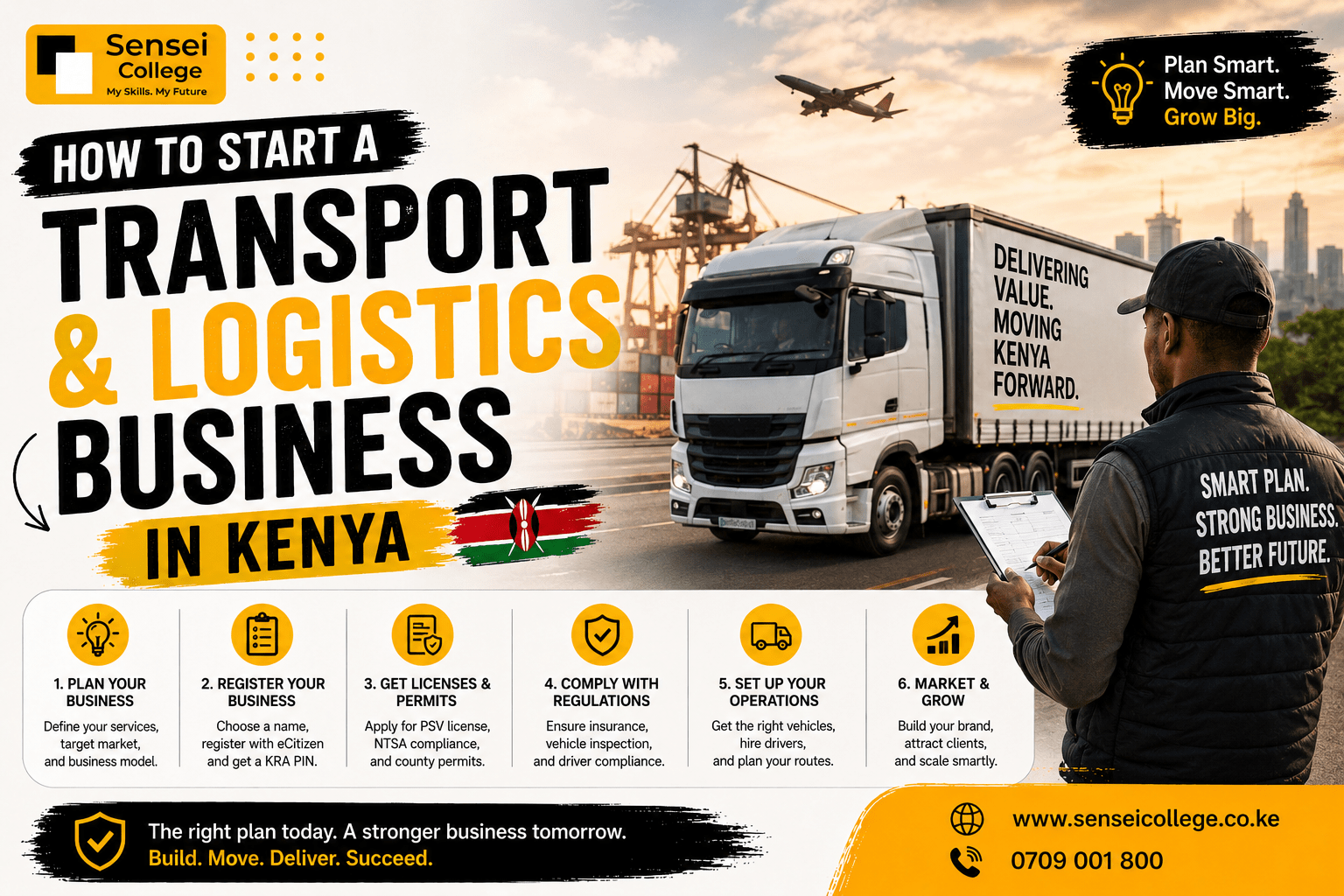
Kenya’s transport and logistics sector generates approximately KSh 300 billion annually. It is the circulatory system of the country’s economy, moving food, fuel, building materials, people, and commerce across 47 counties and beyond. And unlike many sectors, it remains accessible to individuals who start small, scale smart, and know their operations from the inside out.
How to start a transport logistics business
1). Choose Your Business Model Before Choosing Your Vehicle
One of the most common mistakes new transport entrepreneurs make is starting with buying a vehicle without first deciding what it will do, who will pay for it, and how often.
core transport business models
i). Ride-Hailing Uber/Bolt Owner-Driver
Startup Capital Required: KSh 400,000 – 1,500,000 (vehicle)
License Needed: Class B + D1 (PSV)
Monthly Revenue Potential: KSh 80,000 – 180,000 (gross)
You own and drive a vehicle registered on the Uber or Bolt platform. After platform commission (25–30%) and fuel costs, net take-home is KSh 50,000–120,000/month for an active driver.
Faster entry option: If you cannot buy a vehicle outright, partner with a vehicle owner through the Uber/Bolt leasing model, you drive their car for a daily fee and keep the rest of the earnings. Build capital, then buy your own.
Realistic timeline to own your first vehicle: 18–36 months of disciplined saving from leasing income.
ii). School Transport Contractor
Startup Capital Required: KSh 800,000 – 2,500,000 14–33 seater vehicle
License Needed: Class D2 or D3
Monthly Revenue Potential: KSh 90,000 – 250,000 (gross, depending on capacity)
Sign a contract with a school to transport students to and from home daily. This is one of the most financially stable transport business models in Kenya; you have a fixed client and a predictable monthly income.
How to get started:
- Identify schools within 5–10 km of your base area (private schools are better clients than public schools for revenue)
- Approach the school administration or Parents’ Association with a proposal
- Quote per-child per-month KSh 2,500–6,000 depending on distance and vehicle quality
- With 25 children at KSh 4,000/month = KSh 100,000 gross monthly income
Vehicle financing: Equity Bank, KCB, and NCBA offer school bus financing. Schools often provide a contract letter that helps secure the loan.
iii). Last-Mile Delivery Contractor – E-Commerce/Courier
Startup Capital Required: KSh 200,000 – 600,000 (motorcycle or small van)
License Needed: Class A (motorcycle) or Class C1 (van)
Monthly Revenue Potential: KSh 40,000 – 120,000 (net)
Partner with Sendy, Glovo, Jumia Logistics, or DHL as an independent delivery contractor. Or take a direct approach to FMCG distributors, pharmacies, and supermarkets to handle their last-mile deliveries.
This model has exploded since 2020 due to the growth of e-commerce in Kenya. Nairobi’s delivery demand currently outpaces the supply of reliable contractors.
Differentiation: Offer temperature-controlled delivery for pharmacies, medical labs, and food businesses. This niche commands premium rates.
iv). General Cargo Hire Truck
Startup Capital Required: KSh 1,500,000 – 4,000,000 (light or medium truck)
License Needed: Class C1 or C2
Monthly Revenue Potential: KSh 150,000 – 400,000 (gross)
You own a light or medium truck and offer it for hire, moving building materials, furniture, agricultural produce, retail goods, or anything else that needs transporting within Kenya.
The hire truck market in Kenya operates through:
- Direct contracts with businesses are consistent, lower rate, predictable
- Spot market via WhatsApp groups, Sendy Trucking platform, or direct approach to construction sites (higher rate, less predictable)
Best strategy: secure 1–2 anchor contracts (e.g., with a building materials supplier or agricultural cooperative) for 60% of your capacity, and take spot jobs for the remaining 40%.
v). Articulated Truck Owner-Operator (CE Class)
Startup Capital Required: KSh 5,000,000 – 15,000,000 (articulated unit)
License Needed: Class CE
Monthly Revenue Potential: KSh 300,000 – 700,000 (gross, before costs)
Net after fuel, driver wages, maintenance, and loan: KSh 80,000 – 200,000/month
This is the largest and highest-earning model, but also the most capital-intensive and operationally complex. Most successful CE owner-operators start as employed drivers, build their capital and relationships, then move to ownership.
A confirmed transport contract (cement company, petroleum distributor, port cargo handler) is typically required before any bank will finance an articulated truck.
2. Register Your Business
Running a transport business without proper registration in Kenya is both legally risky and commercially limiting. Companies, NGOs, and government agencies will not give you contracts unless you are a registered entity with a KRA PIN and VAT certificate.
Minimum required registrations for a transport business:
| Registration | Where | Cost | Time |
| Business Name (sole trader) | eCitizen – Business Registration Service | KSh 950 | 1–2 days |
| Company (Pvt Ltd) for larger operations | eCitizen – Business Registration Service | KSh 10,650 | 3–5 days |
| KRA PIN (business) | iTax | Free | Same day |
| VAT Registration (if turnover >KSh 5M/year) | iTax | Free | 1–3 days |
| NTSA Vehicle Inspection Certificate | NTSA portal | Per vehicle | Varies |
| Goods Carriage License (for trucks) | NTSA | Per vehicle/year | 1–2 weeks |
| PSV License (for passenger vehicles) | NTSA | Per vehicle/year | 1–3 weeks |
Register as a company (not just a business name) if you plan to:
- Seek bank financing
- Sign contracts with corporates or NGOs
- Apply for tenders
- Eventually have more than one vehicle
3. Secure Financing
- Personal Savings: The cleanest financing option, no interest, no obligations. Build your savings discipline while employed as a driver, targeting your vehicle purchase as a specific financial goal.
- SACCOs and Chamas: Kenya has excellent transport SACCOs, Matatu SACCOs, FOSA (Front Office Service Activities) SACCOs that offer asset financing to members. Interest rates are often lower than those of commercial banks, and the member community provides business support.
- Asset Finance (Bank)
- NCBA Asset Finance: Strong in commercial vehicle financing
- KCB Asset Finance: Flexible terms, up to 72 months
- Equity Bank: Known for first-time borrower accessibility
- Stanbic Bank: Preferred by larger fleet operators
Typical terms: 20–30% down payment, 48–72 month repayment, 14–18% annual interest. Your employment payslips from your driving career become your credit evidence.
- Vehicle Hire-Purchase from Dealers
Some vehicle dealers offer direct hire-purchase without going through a bank. Terms vary; assess carefully against bank rates.
- The Partner Model
Find a vehicle owner willing to put the vehicle into your operation under a revenue-sharing arrangement. You manage the business; they provide the capital. This is a higher risk if poorly documented. Always use a written partnership agreement reviewed by a lawyer.
4. Manage Your Business
The single biggest differentiator between transport entrepreneurs who scale and those who struggle is business discipline. Many drivers who buy their first vehicle run it like a personal asset, mixing business and personal finances, skipping maintenance schedules, and not tracking income and expenses.
Non-negotiable business practices:
-Separate bank accounts: One personal, one business. Every transport-related income goes into the business account. Every business expense comes out of it. Your “salary” as owner-driver is a fixed transfer from business to personal, not random withdrawals.
-Track every expense: Fuel, tyres, servicing, driver wages, loan repayment, insurance, licensing. Use a simple Excel sheet or a free accounting app like Wave Accounting (free) or QuickBooks (paid). Know your cost-per-kilometre for your vehicle; this determines whether any given contract is profitable.
-Build a maintenance reserve: Set aside KSh 10,000–30,000 per month, depending on vehicle size, specifically for maintenance. A truck tyre alone costs KSh 20,000–40,000. A gearbox overhaul can cost KSh 150,000–400,000. These are not surprises; they are scheduled costs.
-Invoice properly: Every job should have a delivery note and an invoice. This protects you legally, helps you file accurate tax returns, and looks professional to corporate clients.
-Get properly insured: Comprehensive motor vehicle insurance for commercial vehicles is not optional. The cheapest option at renewal is never the right one. Understand your policy cover before signing.
5. Grow Intentionally
Many successful Kenyan transport entrepreneurs use a structured growth model:
Vehicle 1 (Year 1–3): Owner-driver. You drive it yourself, keeping driver wages at zero. Build income, pay down loan, build credit history.
Vehicle 2 (Year 3–5): You hire a driver for Vehicle 1 (ideally a Sensei-trained, NTSA-certified driver you know what good training looks like). You drive Vehicle 2 yourself. Income from Vehicle 1 covers its driver’s wages and contributes to Vehicle 2’s loan.
Vehicle 3+ (Year 5–8): You transition from driver to fleet manager. You are now a transport entrepreneur managing drivers, contracts, maintenance, and finance, not just steering a truck.
This is the trajectory of hundreds of Kenya’s most successful transport business owners. Many of them started with a driving license from a reputable school, a job with a logistics company, and a plan.
Frequently Asked Questions
1. How much money do I need to start a transport business in Kenya?
It depends entirely on your business model. The lowest entry point is a motorcycle delivery business (from KSh 150,000–300,000 for a good second-hand motorcycle). A ride-hailing business requires KSh 400,000–1,500,000 for a car. A light truck business requires KSh 1,500,000–4,000,000. Articulated truck ownership starts at KSh 5,000,000+. All of these can be partially financed through bank asset finance or SACCO loans.
2. How do I register a transport company in Kenya?
Register through the eCitizen portal. Select “Business Registration Service” and choose between a Business Name (for sole traders, costs KSh 950) or a Private Limited Company (KSh 10,650). After registration, get a KRA PIN for the business through itax.kra.go.ke. Commercial vehicles also need NTSA goods carriage or PSV licenses, depending on what they carry.
3. Which Kenyan bank is best for truck financing?
NCBA Bank, KCB, and Equity Bank are the three most commonly used by Kenyan transport entrepreneurs for vehicle financing. Each has asset finance products with different terms. NCBA is particularly known in commercial vehicle financing. Get quotes from at least two banks before committing. Interest rates and deposit requirements vary significantly.
4. Can I run a transport business and still keep my driving job?
In the early stages, yes, and many entrepreneurs do this deliberately. They keep their employment income stable while their business vehicle generates additional income and builds its credit history. Only when the business income exceeds the employment income comfortably do they quit the employed role. This is the lower-risk entrepreneurial path.
5. Does Sensei Driving School help graduates who want to start transport businesses?
Sensei’s primary focus is driver training and certification. However, the school’s network of alumni, employer contacts, and instructors is a practical resource for graduates building transport businesses. Graduates who are open about their entrepreneurial goals often receive informal mentorship and introductions through Sensei’s professional community. Ask directly when enrolled.