
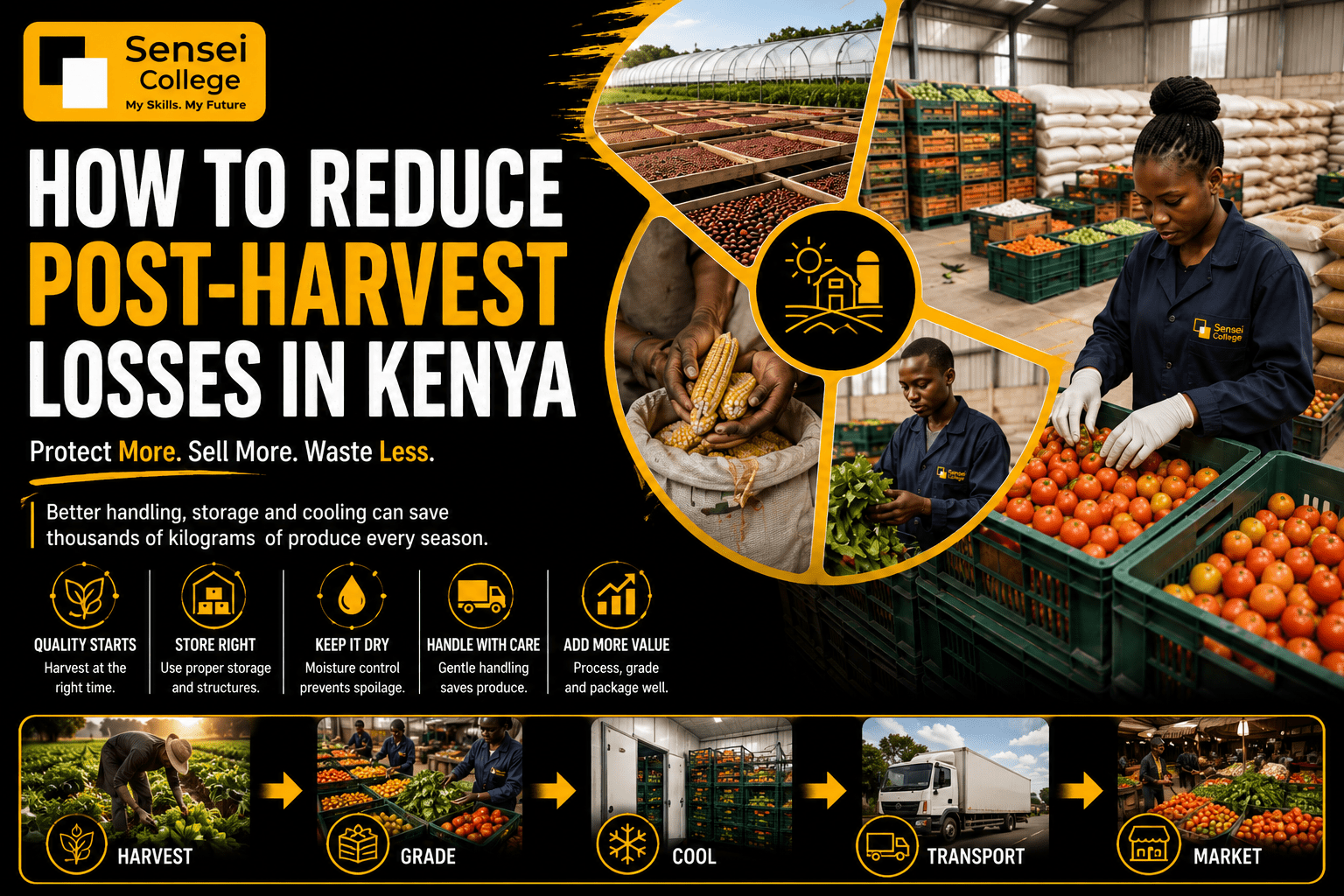
Every year, Kenyan farmers pour their sweat, money, and time into growing food and then watch a significant portion of it rot, spoil, or get eaten by pests before it ever reaches the market. This devastating problem is called post-harvest loss, and it is costing Kenya’s agricultural sector billions of shillings annually.
The good news is that most of these losses are preventable. With the right knowledge, tools, and infrastructure, farmers can protect their produce, extend its shelf life, and earn significantly more from their harvest.
This guide covers what you need to know about post-harvest loss prevention
What Is Post-Harvest Loss?
Post-harvest loss refers to the measurable qualitative and quantitative decrease in food supply that occurs between harvest and consumption.
It is simply all the food that goes to waste after it leaves the farm.
Types of Post-Harvest Losses
- Physical losses: Produce that is physically damaged, crushed, spilled, or eaten by rodents.
- Quality losses: Produce that becomes discolored, wilted, bruised, or changes in flavor, reducing its market value.
- Nutritional losses: Degradation of vitamins, minerals, and other nutrients during poor storage.
- Economic losses: Income not earned because produce was sold cheaply to avoid spoilage, or was not sold at all.
What Causes Post-Harvest Losses?
- Biological causes: Fungal infections, bacterial rot, insect pests, and rodents.
- Chemical causes: Improper use of pesticides, reactions causing discoloration or off-flavors.
- Mechanical causes: Rough handling, poor packaging, and bad roads that damage produce during transport.
- Physiological causes: Natural processes like respiration, ripening, and wilting that happen inside the produce even after harvest.
- Environmental causes: High temperatures, high humidity, and poor ventilation that speed up spoilage.
Key Terms
- Cold chain: The uninterrupted series of refrigerated environments through which perishable goods pass from farm to consumer.
- Silo: A tall, airtight structure used to store dry grain safely for long periods.
- Hermetic storage: Airtight storage that deprives insects of oxygen, preventing infestation without chemical pesticides.
- Ripening: The natural process by which fruit softens, sweetens, and changes color which continues after harvest.
- Respiration rate: The speed at which a harvested crop consumes its own energy cooling slows this down.
Why Post-Harvest Loss Prevention Matters
-
For Farmers
Preventing post-harvest losses directly increases income. A farmer who saves 30% more produce for sale earns 30% more revenue without planting a single extra seed. This is one of the most cost-effective ways to improve farm profitability.
-
For National Food Security
Food lost after harvest is food that does not feed Kenya’s growing population. Reducing post-harvest losses by just 25% could significantly reduce food insecurity in the country.
-
For the Economy
Post-harvest losses mean wasted inputs: seeds, fertilizer, water, labor, and fuel used to grow food that never gets eaten. Reducing losses improves the return on investment for the entire agricultural value chain.
-
For the Environment
Growing food requires land, water, and energy. Wasting food means wasting these resources unnecessarily. Reducing post-harvest loss is also an environmental sustainability measure.
How It Works and How to Build It
How Cold Storage Prevents Post-Harvest Losses
When temperature is reduced, the biological processes that cause spoilage slow down dramatically:
- Respiration slows: The crop uses its own nutrients more slowly, extending freshness.
- Microbial growth slows: Bacteria and fungi that cause rot need warmth to grow.
- Ripening slows: Fruits and vegetables stay at the optimal stage of ripeness longer.
- Insect activity stops: Most insects become inactive or die at low temperatures.
Types of Cold Storage in Kenya
1. Evaporative Coolers – Zeer Pot/Brick Coolers
The simplest form of cold storage that is affordable and buildable without electricity. Based on the principle of evaporative cooling.
How it works: Water evaporates from wet sand placed between two containers (or from wet burlap on a brick structure), drawing heat away from the inside and reducing temperatures by 10–20°C.
Best for: Small-scale farmers storing leafy vegetables, tomatoes, carrots, and fruits for 1–2 weeks.
Cost: KES 500 – KES 5,000 (very low-cost to build)
2. Shade Houses with Ventilation
Simple structures with shade netting and good airflow can significantly reduce temperature and humidity stress on stored produce.
Best for: Onions, potatoes, and other semi-dry produce.
Cost: KES 5,000 – KES 50,000 depending on size.
3. Insulated Cold Rooms – Mechanical Refrigeration
These are proper cold rooms with insulated walls, refrigeration units, and temperature controls. They are the backbone of commercial post-harvest management.
How to build a basic cold room:
Step 1 – Design and Planning
- Determine the capacity needed (how many tonnes of produce you need to store).
- Decide on the target temperature (0–5°C for vegetables; 8–12°C for tropical fruits like mangoes and avocados; -18°C for frozen goods).
- Draw a simple floor plan. Common small commercial sizes: 3m × 4m × 3m or 6m × 6m × 3m.
Step 2 – Choose Your Insulation
Insulation is the most important component; it keeps cold in and heat out.
- Polyurethane foam (PUF) panels: The industry standard. Lightweight, strong, excellent insulation. Available in prefabricated sandwich panels.
- EPS (expanded polystyrene) panels: Cheaper but less efficient.
- Panel thickness: Typically 75mm–150mm. Thicker panels = better insulation = lower energy bills.
Step 3 – Build the Structure
- Lay a concrete floor or install insulated floor panels.
- Assemble walls using interlocking insulated panels (no gaps, cold air must not escape).
- Install an insulated ceiling.
- Fit an insulated door with magnetic seals to prevent air leakage.
Step 4 – Install the Refrigeration System
- Choose a condensing unit (compressor + condenser, usually mounted outside) matched to the room size.
- Install the evaporator unit inside the cold room (this cools the air inside).
- Connect the refrigerant pipework between the two units.
- Add a thermostat/temperature controller to maintain the target temperature.
- Connect to a reliable power source. For off-grid areas, solar-powered cold rooms are now viable.
Step 5 – Install Shelving and Air Circulation
- Use slatted shelves or pallets so air circulates around produce.
- Ensure airflow is not blocked, as overcrowding reduces cooling efficiency.
Step 6 – Test and Commission
- Run the system empty and check it reaches the target temperature.
- Test the door seals and thermostat.
- Load produces and monitors temperature for 24–48 hours.
4. Solar-Powered Cold Rooms
A rapidly growing solution in Kenya, especially for off-grid farming communities. Uses solar panels connected to a battery bank to power a DC-powered refrigeration unit.
Advantages: No electricity bills, usable in remote areas, eligible for green energy financing. Challenges: Higher upfront cost, requires battery maintenance.
Why Silos Are Essential
Grains like maize, wheat, sorghum, and beans are the staple foods of most Kenyan households. Without proper storage, they are attacked by:
- Weevils and grain borers – insects that eat grains from inside.
- Aflatoxin-producing molds – extremely dangerous to human health.
- Rodents – rats and mice can destroy entire stores.
- Moisture – causes mold growth and germination.
Types of Grain Silos for Kenyan Farmers
1. Metal Hermetic Silos
PICS (Purdue Improved Crop Storage) bags are triple-layer hermetic bags that seal grain airtight.
Insects suffocate without oxygen.
- Capacity: 50kg–1,000kg bags available.
- Cost: KES 300–KES 2,000 per bag.
- Effectiveness: Can keep grain pest-free for 6–12 months without chemicals.
- Best for: Individual farmers or small groups.
2. Fabricated Metal Silos
These are cylindrical metal tanks, usually made from galvanized steel sheets, built by local artisans.
How to Build a Metal Silo
Step 1 – Gather Materials
- Galvanized iron sheets (26 gauge)
- Sheet metal tools (snips, folders, seamers)
- Solder or pop rivets
- Lid and base materials
- Paint for sealing (optional)
Step 2 – Cut and Shape the Body
- Cut GI sheets to the desired height and width.
- Roll them into a cylinder.
- Join the edges with a tight lock seam (a folded joint that is then sealed with solder or a seam roller).
Step 3 – Fabricate the Base
- Cut a circular base panel.
- Attach it to the body with a lock seam.
- A small outlet hole at the bottom (with a lid) allows grain to be removed easily.
Step 4 – Fabricate the Lid
- Create a conical or flat lid that fits tightly.
- Ensure it seals the top completely; an airtight closure is critical.
Step 5 – Seal All Joints
- Use solder, epoxy, or sealant on all seams to ensure the silo is airtight.
- This is what makes it hermetic; insects inside will die from lack of oxygen.
Step 6 – Test for Airtightness
- Fill with water briefly and check for leaks or use a simple air pump to pressurize and listen for hissing.
Step 7 – Prepare for Use
- Dry and clean grain properly before storage (moisture content must be below 13%).
- Fill the silo completely, leaving minimal air space.
- Seal the lid tightly.
- Place on a raised platform away from walls to prevent moisture absorption and rodent access.
Silo Capacity: Common sizes range from 100kg to 3,000kg.
3. Concrete Silos
Larger, permanent structures used for community or commercial grain storage. More expensive but very durable.
4. Underground Pits – Traditional Hermetic Storage
Traditional in many Kenyan communities, grain is stored in pits lined with grass or ash. When modernized with sealed plastic liners, these can be quite effective and very low-cost.
Tools and Equipment for Post-Harvest Management
For Cold Storage
- Insulated wall panels (PUF or EPS)
- Condensing unit and evaporator
- Refrigerant and refrigerant tools
- Thermostat/temperature controller
- Shelving, pallets, and crates
- Thermometers and data loggers
- Sealant and insulating tape
For Silo Building
- Sheet metal hand tools – aviation snips, seamers, folders
- Hammer and mallet
- Measuring tape and markers
- Solder and soldering iron (for metal silos)
- Drill and rivets
- Moisture meter (for testing grain moisture)
For Post-Harvest Handling in General
- Sorting tables and grading equipment
- Packaging materials – crates, sacks, nets, cartons
- Weighing scales
- Fumigation equipment – where chemical control is used
- Hydrometers – to measure air humidity
Insights for Experienced Practitioners
-
Modified Atmosphere Storage
Beyond simple hermetic sealing, advanced cold storage facilities use controlled atmosphere (CA) storage, modifying the levels of oxygen, carbon dioxide, and nitrogen inside the store.
This dramatically extends the shelf life of apples, avocados, and other high-value fruits.
-
Ethylene Management
Ethylene is a natural gas produced by ripening fruits that speeds up ripening of nearby fruits. Advanced cold storage facilities use ethylene scrubbers or 1-MC(1-methylcyclopropene) treatment to block ethylene action and dramatically extend shelf life.
-
Pre-Cooling Techniques
Getting produce cold quickly after harvest is critical; every hour at room temperature costs days of shelf life.
Advanced facilities use:
- Hydro-cooling: Immersing produce in cold water.
- Vacuum cooling: Rapid pressure reduction causes water to evaporate, cooling leafy vegetables in minutes.
- Forced air cooling: Blowing cold air through packed boxes.
Cold Chain Management
No cold room works in isolation. True post-harvest excellence requires managing the entire cold chain from harvest to consumer. This includes refrigerated transport, market cool rooms, and retail refrigeration.
Data Logging and Monitoring
Modern storage facilities use temperature and humidity data loggers that record conditions continuously, helping operators detect problems early and demonstrate compliance to buyers and exporters.
Common Challenges and Solutions
-
High Energy Costs for Cold Rooms
Solution: Invest in quality insulation to reduce the load on the refrigeration unit. Explore solar-powered cold rooms for off-grid locations. Insulation investment pays back quickly in lower electricity bills.
-
Grain Stored at High Moisture Content
Solution: Always measure moisture content with a moisture meter before storage. Dry grain to below 13% moisture using sun-drying or mechanical dryers before storing in silos.
-
Aflatoxin Contamination
Solution: Never store damaged, moldy, or wet grain. Dry quickly and thoroughly. Use hermetic storage. Conduct aflatoxin testing, especially for export or institutional sales.
-
Poor Produce Grading
Train harvesters to sort and grade produce at harvest. Damaged and diseased produce should be removed immediately, as it accelerates spoilage of the rest.
5. Cold Room Temperature Fluctuations
Avoid opening the cold room door frequently. Ensure door seals are tight. Pre-cool produce before placing it in the cold room so the unit does not have to work too hard.
6. Lack of Technical Maintenance Skills
Train at least one person at each facility in basic refrigeration and silo maintenance. Schedule routine checks monthly.
Cost Considerations
Small-Scale Cold Storage
| Type | Estimated Cost (KES) |
| Zeer pot / evaporative cooler | 500 – 5,000 |
| Shade house (small) | 10,000 – 50,000 |
| Solar cold room (3–5 tonne) | 500,000 – 1,500,000 |
| Standard cold room (10 tonne) | 1,000,000 – 3,000,000 |
Grain Storage
| Type | Estimated Cost (KES) |
| PICS hermetic bags (100kg) | 300 – 500 |
| Metal silo (500kg) | 5,000 – 15,000 |
| Metal silo (2,000kg) | 30,000 – 60,000 |
| Concrete silo (community) | 200,000 – 1,000,000+ |
Cost-Reduction Tips
- Access grants and subsidies from the government, AGRA, or NGOs for cold storage infrastructure.
- Form a farmers’ group or cooperative to share the cost of a cold room.
- Start with low-cost hermetic bags for grain and progress to metal silos as income grows.
- Solar cold rooms qualify for green energy loans from several Kenyan banks and microfinance institutions.
Career Opportunities and Business Potential
Employment Opportunities
- Cold storage technician: Installing, operating, and maintaining cold rooms for farms, cooperatives, and exporters.
- Refrigeration engineer: Designing and installing refrigeration systems for food storage.
- Post-harvest agronomist: Advising farmers on best practices to reduce losses.
- Quality control officer: Grading, sorting, and testing produce at collection centers.
Business Opportunities
- Cold storage as a service: Build a cold room and rent storage space to neighboring farmers, a growing and profitable business model in Kenya’s horticulture areas.
- Silo fabrication: Manufacture and sell metal silos to farmers. Demand is very high.
- Post-harvest consultancy: Help cooperatives, exporters, and processing companies optimize their storage and handling.
- Aggregation hubs: Collect, grade, cool, and sell produce from multiple farmers adding value at every step.
Tips for Success
- Harvest at the right time: Overripe or underripe produce spoils faster. Timing is everything.
- Handle with care: Bruising during harvest and transport opens the door to rot. Train harvest teams to handle produce gently.
- Cool fast: The faster you get produce into cold storage after harvest, the longer it lasts.
- Dry grain properly: Never store moist grain. A moisture meter is one of the best investments a grain farmer can make.
- Keep records: Track what goes in, at what condition, and what comes out. Records help you identify losses and improve.
- Work with the market: Understand what quality standards your buyers require and store accordingly.
- Maintain your equipment: A broken cold room in mango season can mean catastrophic losses. Maintain proactively.
Conclusion
Post-harvest loss is one of the most solvable problems in Kenyan agriculture. The solutions exist, cold storage units, hermetic silos, proper grading and handling and the skills to implement them can be learned.
Sensei College’s post-harvest management courses cover the practical skills needed to build, operate, and maintain cold storage units and silos. From silo fabrication to cold room installation, students are equipped to solve Kenya’s post-harvest loss crisis.
Enroll today at Sensei College and be among the few saving your community losses.