

Before any driver in Kenya gets behind the wheel professionally, whether driving a personal car, a matatu, a truck, or a boda boda, they must first pass the NTSA Theory Test (also called the Highway Code Test or Driving Theory Examination). This written test, conducted by the National Transport and Safety Authority, verifies that you understand road signs, traffic rules, road safety principles, and the Highway Code.
It sounds straightforward, but many candidates fail the theory test on their first attempt because they either underestimate it or do not study the right material.
Today, the NTSA theory test is taken digitally at NTSA offices, with multiple-choice questions answered on a computer screen.
Why is the NTSA Test important
- You cannot proceed to the practical driving test without passing the theory test
- It verifies that you can keep yourself, passengers, and other road users safe
- Employers verify your NTSA records because a clean pass record matters
- Understanding road signs and rules makes you a better, safer driver,which means a longer career
Requirements to sit the NTSA Theory Test
- National Identity Card or valid passport (original)
- KRA PIN certificate
- Valid driving school enrollment certificate (from an NTSA-licensed driving school)
- eCitizen account and login
- Theory test booking fee payment (check current fees on eCitizen — approximately KES 600–1,000)
- Minimum age: 18 years for Class B (private vehicles); 21+ for some professional classes
How to book the NTSA theory test
- Log into your eCitizen account at www.ecitizen.go.ke
- Navigate to NTSA services, then to Driving Licence, then Theory Test Booking
- Select your preferred test date, time, and NTSA examination centre
- Pay the fee via M-Pesa
- Arrive at the test centre with your original ID and your booking reference
What Is in the NTSA Theory Test?
The theory test consists of multiple-choice questions covering the following areas:
| Topic Area | Approximate Weight |
| Road signs and markings | 30–35% |
| Traffic rules and regulations | 25–30% |
| Road safety and responsible driving | 15–20% |
| Vehicle handling and basic mechanics | 10–15% |
| First aid for road accidents | 5–10% |
The pass mark is 70% or above. You have approximately 45–60 minutes to complete the test. Questions are displayed one at a time with 3–4 answer choices.
Study all categories, do not focus only on road signs. Many candidates who know their signs still fail because of gaps in their knowledge of traffic rules and road safety.
Step-by-Step Preparation Guide
Step 1: Get the Official Highway Code for Kenya
The primary study material for the NTSA theory test is the Kenya Highway Code, the official document covering all traffic rules and regulations applicable on Kenyan roads.
Obtain the Highway Code:
- Printed copy: Available at most driving schools, NTSA offices, and some bookshops (approximately KES 200–500)
- Digital copy: Click this to download “Kenya Highway Code “ PDF, the Kenya Roads Board and NTSA website have made it available online for free
- Driving school materials: Most NTSA-licensed driving schools provide study materials and past test questions as part of their training
Read the Highway Code from cover to cover at least once, then revisit specific sections for detailed memorisation.
Step 2: Master the Road Signs
Road signs are the largest single category in the test. Kenyan road signs follow the international convention and are divided into three main categories:
i). Regulatory Signs – Commands and Prohibitions
These signs tell drivers what they must do or must not do. They are the most important signs; ignoring them is a traffic offence.
Examples:
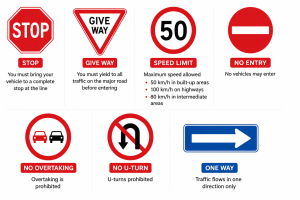
- STOP sign (octagonal, red border, white background): You must bring your vehicle to a complete stop at the line
- GIVE WAY sign (inverted triangle, red border): You must yield to all traffic on the major road before entering
- Speed limit signs (circle with red border, number inside): Maximum speed allowed (e.g., 50 km/h in built-up areas, 100 km/h on highways, 80 km/h in intermediate areas)
- No entry (red circle with white horizontal bar): No vehicles may enter
- No overtaking (circle with red border, two cars): Overtaking is prohibited
- No U-turn (circle with red border, U with cross): U-turns prohibited
- One way (rectangular, white arrow on blue): Traffic flows in one direction only
ii). Warning Signs – Hazard Alerts
These signs warn drivers of potential hazards ahead. They are typically diamond-shaped or triangular with a red border on a white background.
Examples:
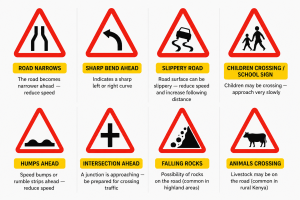
- Road narrows: The road becomes narrower ahead, reduce speed
- Sharp bend ahead: Indicates a sharp left or right curve
- Slippery road: Road surface can be slippery, reduce speed and increase following distance
- Children crossing / School sign: Children may be crossing, approach very slowly
- Humps ahead: Speed bumps or rumble strips ahead, reduce speed
- Intersection ahead: A junction is approaching, be prepared for crossing traffic
- Falling rocks: The possibility of rocks on the road (common in highland areas)
- Animals crossing: Livestock may be on the road (common in rural Kenya)
iii). Informational Signs
These signs provide helpful information and directions. They are typically rectangular with blue or green backgrounds.
Examples:
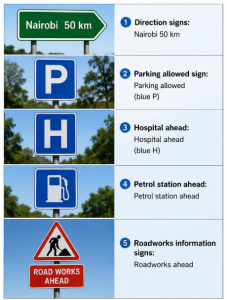
- Direction signs: Nairobi 50 km
- Parking allowed sign (blue P)
- Hospital ahead (blue H)
- Petrol station ahead
- Roadworks information signs
Step 3: Study Traffic Rules and Road Markings
Beyond signs, you must understand road markings and traffic rules:
Road Markings:
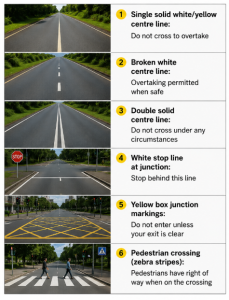
- Single solid white/yellow centre line: Do not cross to overtake
- Broken white centre line: Overtaking permitted when safe
- Double solid centre line: Do not cross under any circumstances
- White stop line at junction: Stop behind this line
- Yellow box junction markings: Do not enter unless your exit is clear
- Pedestrian crossing (zebra stripes): Pedestrians have right of way when on the crossing
Traffic Light Rules:
- Red: Stop before the line, do not proceed
- Amber (yellow) alone: Stop if safe to do so, the light is about to turn red
- Green: Proceed if the way is clear; green does not mean guaranteed safe passage
- Flashing amber: Proceed with caution, treat like a give way
- Green arrow: You may proceed in the direction of the arrow only
Right of Way Rules
- At an unmarked junction, vehicles on the right have priority
- At a roundabout, traffic already on the roundabout has the right of way
- Emergency vehicles, ambulance, fire, police with sirens always have the right of way – pull over and stop if necessary
- Pedestrians on a marked crossing have the right of way
- At a GIVE WAY sign – all vehicles on the main road have right of way
Step 4: Understand Speed Limits and Following Distance
Speed limits are heavily tested:
| Area | Speed Limit |
| Residential and built-up areas | 50 km/h |
| Intermediate roads (outside towns) | 80 km/h |
| Open highways | 100 km/h |
| Near schools (school hours) | 30–50 km/h |
| Learner driver / heavy vehicles | Usually lower — check specific regulations |
Safe following distance:
- The 2-second rule: pick a fixed point ahead; when the vehicle in front passes it, count 2 seconds — you should not reach that point before finishing counting
- In wet or slippery conditions: extend to 4+ seconds
- Behind heavy trucks: extend significantly due to longer stopping distances
Step 5: Study Basic Vehicle Roadworthiness and First Aid
The test includes questions on vehicle safety:
- What to check before a journey (oil, water, tyre pressure, lights, brakes)
- What to do when a warning light appears on the dashboard
- How to use hazard lights correctly (for breakdowns – not for driving in the rain)
- The legal requirement for carrying a fire extinguisher, first aid kit, and warning triangles in commercial vehicles
Basic first aid for road accidents:
- The order of priority: Safety, Call for help, Provide basic first aid
- Do not move an accident victim unless there is immediate danger (fire, flood)
- Recovery position for unconscious victims
- How to call the emergency numbers: Police 999, Private Ambulance 1199
Step 6: Practise with Sample Test Questions
Practise is the most effective way to prepare.
Sources of practice questions include:
- Your driving school – It should provide sample tests and past questions
- NTSA theory test apps: Search “Kenya driving test questions” on the Google Play Store; several apps are available with hundreds of practice questions
- Online resources: Various Kenyan driving school websites post free practice questions
- Flashcard study: Make flashcards of road signs; physical or digital (using an app like Anki)
Safety Tips and Best Practices for the Test Day
- Arrive 30 minutes early – late arrival can mean forfeiting your test slot
- Bring your original National ID – photocopies are not accepted
- Read each question carefully – some questions contain negative language like “Which of the following is NOT permitted”, a common trap
- Do not rush – you have enough time; rushing causes careless errors
- If unsure, eliminate wrong answers first – narrow down to the most likely correct choice
- Do not share answers with other candidates, it can result in disqualification
Common Problems and Troubleshooting
| Problem | Likely Cause | Solution |
| Failed the test on the first attempt | Insufficient study of all topics | Focus revision on specific weak areas identified from the test |
| Confused between similar signs | Nerves and exam pressure | Use visual flashcards; draw and label signs by hand |
| Forgot the rules at test time | Document details mismatch | Practise under timed conditions to reduce anxiety |
| Test booking keeps failing on eCitizen | Limited access to materials | Ensure your name on eCitizen exactly matches your ID |
| Cannot find the Highway Code | Cannot find the Highway Code | Ask your driving school; search online PDF version |
Frequently Asked Questions (FAQs)
-
How many questions are in the NTSA theory test in Kenya?
The test typically consists of 30–40 multiple-choice questions. The exact number can vary depending on your driving school or NTSA office, who can confirm the current format.
-
What happens if I fail the NTSA theory test?
You will need to book and pay for a re-test. There is no limit on the number of attempts, but each attempt requires a new booking fee. Use the feedback from your failed attempt to identify gaps and revise before retaking.
-
How long is the NTSA theory test pass certificate valid?
The theory test certificate is valid for a limited period, within which you must complete your practical driving test. This period is typically 6–12 months. Check with NTSA for the current validity period when you pass.
-
Are the theory test questions in Swahili or English?
The test is conducted in English. However, some NTSA test centres may offer a Swahili option on request. Confirm with your test centre when booking.
-
Do I need to study differently for a Class C/D truck licence theory test?
Yes. Professional licence classes have additional test content covering weight limits, dangerous goods regulations, tachograph rules, and PSV regulations (for Class F). Your driving school should provide class-specific study materials.
Conclusion
The NTSA theory test is not just a hurdle to clear; it is the foundation of safe driving. Every sign you memorise, every rule you understand, and every hazard you learn to anticipate make you a safer driver from your very first day on the road.
Study the Highway Code, practise with sample questions, and approach the test with confidence.
For structured driving theory preparation, including tutored sessions, sample tests, and full practical driving training, enrol in Sensei College, a certified, NTSA-approved driving school with qualified instructors.