
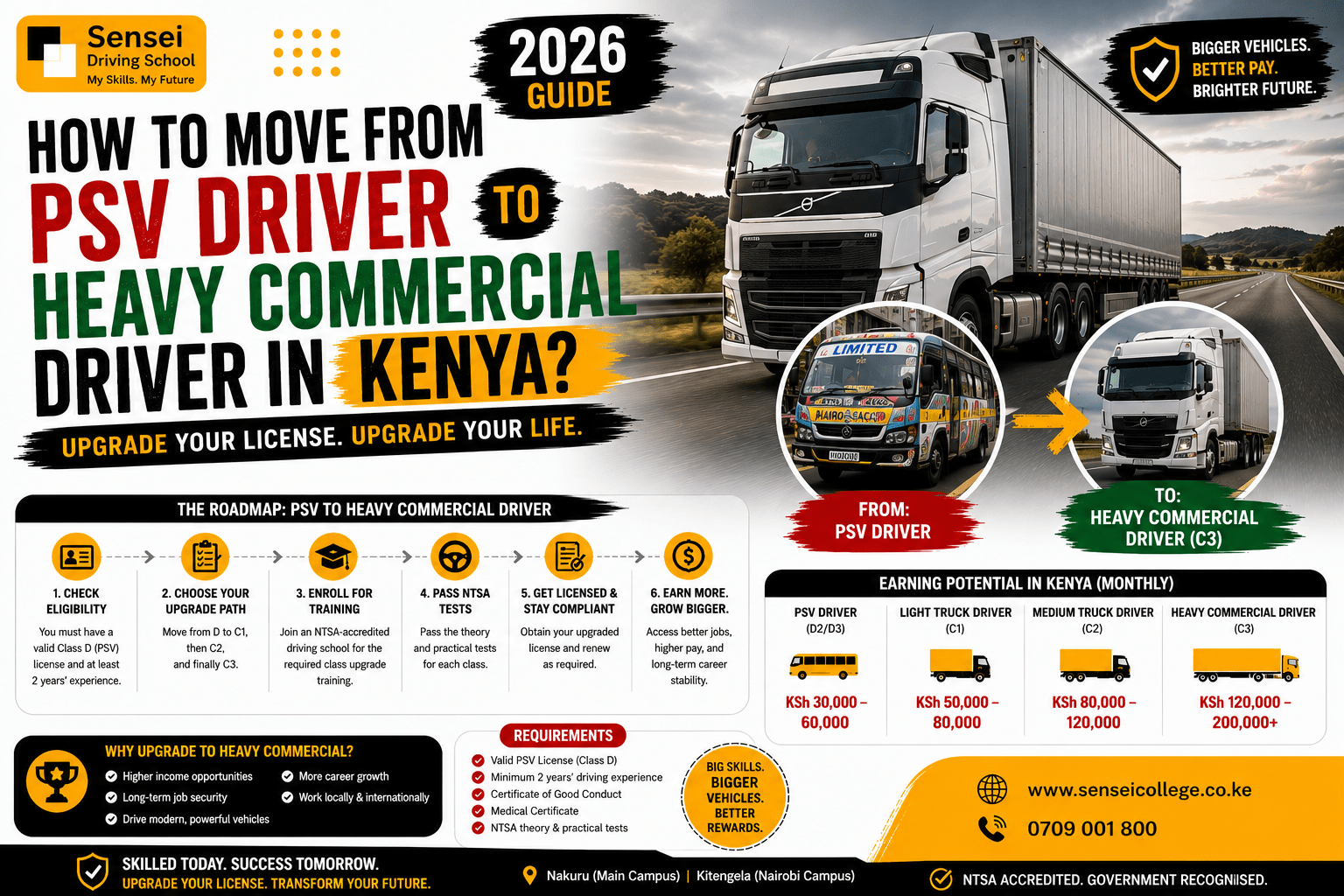
Transitioning from PSV to heavy commercial driving is one of the most practical and rewarding career moves a Kenyan driver can make. The demand for qualified truck and trailer drivers across East Africa is growing rapidly, and companies are willing to pay well for drivers who know their job.
This guide walks you through NTSA driving license classes in Kenya, to the cost of upgrading your driving license.
Driving License Classes in Kenya
PSV License Classes
Most matatu and bus drivers hold one or a combination of these:
- Class B – Motor vehicles up to 3,500 kg (saloon cars, small vans)
- Class C – Motor vehicles exceeding 3,500 kg (minibuses, larger vehicles)
- PSV Badge – Required separately for any driver carrying fare-paying passengers
Heavy Commercial License Classes
To drive trucks and trailers professionally, you need:
- Class B – Foundation for most vehicle licenses
- Class C – Covers rigid trucks and heavy goods vehicles
- Class CE – Articulated trucks, semi-trailers, and long-haul vehicles
- Class BCE – The gold standard: covers all categories, including trailers
The Class BCE Kenya requirements include: holding existing lower classes, meeting age and health criteria, and passing both theory and practical tests administered by NTSA. If you already hold a Class C PSV license, you are better positioned than most. You are essentially one upgrade away from operating some of the biggest vehicles on Kenyan roads.
Why Upgrade from PSV to Heavy Commercial Driving?
-
Higher and More Stable Earnings
A matatu driver’s income depends heavily on daily targets and passenger loads, which fluctuate with weather, public holidays, and competition. Truck drivers, on the other hand, typically earn a fixed monthly salary. Entry-level truck drivers in Kenya earn between KSh 30,000 and KSh 50,000 per month, while experienced long-haul and cross-border drivers can earn KSh 80,000 to KSh 150,000 or more, depending on the employer and route.
-
Broader Job Opportunities
The logistics and freight sector in Kenya is booming. With the Standard Gauge Railway, the Lamu Port-South Sudan-Ethiopia Transport (LAPSSET) corridor, and growing e-commerce, demand for heavy commercial drivers is not slowing down. Opportunities exist in:
- Manufacturing and FMCG distribution
- Construction and mining
- Cross-border transport (Uganda, Tanzania, Rwanda, South Sudan, DRC)
- Petroleum and gas transportation
- Cold chain and perishables logistics
-
Career Growth and Specialization
Unlike PSV driving, where career advancement is limited, heavy commercial driving opens doors to specialization. You can become a tanker driver, a specialized cargo handler, a fleet supervisor, or even a transport operations manager with enough experience and ambition.
Career Roadmap: From PSV to Heavy Commercial
Step 1: Confirm You Meet NTSA Requirements
To upgrade your driving license in Kenya, NTSA requires:
- Minimum age of 18 years (21 years for Class CE)
- A valid Kenyan driving license (Class B or C at minimum)
- A valid medical fitness certificate from an approved health facility
- A clear driving record traffic offenses can complicate your application
- A valid national ID or passport
If your current PSV license has expired or has pending fines on the NTSA TIMS portal, resolve those first. You can check your status at ntsa.go.ke or through the NTSA app.
Step 2: Choose a Certified Driving School
Not all driving schools offer heavy commercial training. You need a school that is:
- NTSA-accredited for Class BCE training
- Equipped with actual heavy trucks and trailers for practical sessions
- Staffed by certified instructors with commercial vehicle experience
Some of the best driving schools for heavy trucks in Kenya include institutions in Nairobi, Mombasa, Eldoret, and Nakuru. When evaluating schools, ask specifically about their pass rates for NTSA heavy commercial tests, the condition of their training vehicles, and whether they assist with the license application process.
Step 3: Enroll in Heavy Commercial Driver Training
Heavy commercial driver training in Kenya covers both theory and practical components:
Theory training includes:
- Traffic laws and road signs specific to heavy vehicles
- Load management and weight distribution
- Vehicle inspection procedures
- Hazard perception and defensive driving principles
- Regulations for cross-border transport
Practical training includes:
- Driving rigid trucks and articulated vehicles
- Reversing and parking large vehicles in confined spaces
- Hill starts with heavy loads
- Coupling and uncoupling trailers
- Emergency procedures
Training duration varies by school, but most full programs for Class BCE take 4 to 8 weeks of consistent practice.
Step 4: Pass the NTSA Driving Test
The NTSA driving test for heavy commercial vehicles is more demanding than the standard test. It includes:
- A theory (written) test at an NTSA examination center
- A practical driving test conducted by a licensed NTSA examiner
You will be tested on your ability to handle the vehicle safely, follow road rules, and demonstrate control in various driving scenarios.
Step 5: Apply for Your License Upgrade via NTSA TIMS
Once you pass your tests, you apply for the NTSA smart driving license upgrade through the Transport Integrated Management System (TIMS). The process involves:
- Logging into your NTSA TIMS account at tims.ntsa.go.ke
- Submitting your application for a license class upgrade
- Uploading required documents (test pass certificate, medical certificate, ID)
- Paying the applicable government fees
- Booking a collection date for your new smart driving license
Processing time can vary, typically 2 to 6 weeks, so plan accordingly if you have a job offer waiting.
Step 6: Gain Experience Through Entry-Level Roles
Getting your license is just the beginning. Most logistics companies prefer drivers with at least 1 to 2 years of heavy commercial driving experience. If you are starting fresh, consider:
- Applying for assistant driver or turn-boy positions to learn from experienced truck drivers
- Approaching smaller logistics firms and clearing agents who may be more open to newer license holders
- Looking for driving attachments or internship arrangements through your driving school
- Joining driver forums and WhatsApp groups where job leads are frequently shared
Costs Involved in Upgrading from PSV to Heavy Commercial
Budgeting properly will save you stress. Here is a rough breakdown of the cost of upgrading your driving license in Kenya to a heavy commercial:
| Item | Estimated Cost (KSh) |
| Heavy commercial training fees | 25,000 – 60,000 |
| Medical fitness certificate | 1,500 – 3,000 |
| NTSA theory test fee | 600 – 1,000 |
| NTSA practical test fee | 1,000 – 2,000 |
| License upgrade/issuance fee | 3,000 – 5,000 |
| Total Estimated Range | 30,000 – 70,000 |
Prices vary depending on location and driving school. Nairobi schools tend to be pricier, but some offer installment payment options.
Essential Skills for Heavy Commercial Drivers
- Defensive driving – Anticipating hazards and protecting your load, yourself, and other road users
- Vehicle inspection knowledge – Identifying mechanical issues before they become emergencies on the highway
- Load and weight management – Understanding legal axle weight limits and how improper loading affects braking and stability
- Route planning – Knowing road conditions, weighbridges, and fuel stops along major Kenyan corridors (Nairobi–Mombasa, Nairobi–Malaba, etc.)
- Basic mechanical skills – Changing tyres, checking fluid levels, and identifying warning signs in the engine
- Communication and reliability – Most logistics jobs require consistent communication with fleet managers and clients
Job Opportunities After Upgrading Your License
- Logistics and clearing companies: Siginon, Mitchell Cotts, Bollore Logistics, Freight Forwarders
- FMCG companies: Bidco, East African Breweries, Unilever Kenya
- Petroleum transporters: Vivo Energy, Rubis Energy, Hashi Energy
- Construction firms: Infrastructure projects along the LAPSSET corridor and road contracts
- International transport companies: operating on the Northern Corridor (Kenya–Uganda–Rwanda–DRC)
Where to Find Listings
- BrighterMonday Kenya
- Fuzu.com
- LinkedIn Kenya
- NTSA-registered transport company notice boards
- Driver WhatsApp networks and referrals
Cross-border transport jobs, in particular, offer significantly higher pay, especially routes into South Sudan, DRC, and Ethiopia, which are considered hardship routes with additional allowances.
Challenges of a Heavy Commercial Driver and How to Overcome Them
- Long hours and time away from family – Long-haul driving can mean days or weeks on the road. Plan your personal finances and family communication in advance. Many experienced drivers set aside a fixed portion of each trip’s earnings for home expenses.
- Road safety risks – Kenya’s highways, particularly the Nairobi–Mombasa and Nakuru–Eldoret roads, carry significant accident risk. Commit to a zero-tolerance policy on fatigue driving and never drive under the influence.
- Delays in NTSA processing – Government systems can be slow. Start your application process early, keep copies of every document submitted, and follow up regularly through the NTSA helpline or customer service desk.
- Finding your first employer without experience – Consider offering to work at reduced pay initially to build your record, or explore opportunities with smaller operators who are more flexible with experience requirements.
Tips for Success as a Heavy Commercial Driver in Kenya
- Always use NTSA-accredited schools – Your training quality directly affects your safety and your employability
- Maintain a clean driving record – Employers check your NTSA history; accumulated traffic fines are red flags
- Invest in a logbook – Track your trips, mileage, and maintenance records; it builds credibility with employers
- Join professional driver associations – Networks like the Kenya Long Distance Truck Drivers Association offer support, legal advice, and job referrals
- Stay updated on NTSA regulations – Rules around axle weights, speed governors, and driving hours change periodically; staying informed protects your license
- Learn basic Swahili and English documentation – Cross-border jobs often require basic written communication for customs and border documentation
Conclusion
The transition from PSV driving to heavy commercial is not just a license upgrade, it is a career transformation. For Kenyan drivers who are willing to invest time, money, and effort, the rewards are real and lasting: higher income, greater job security, professional respect, and the opportunity to contribute to one of East Africa’s most critical industries.