
.
Greenhouse farming in Kenya is a demanding enterprise. It is at the intersection of plant science, irrigation engineering, integrated pest management, and agribusiness and getting any one of these wrong can cost an entire crop cycle. Formal training does not eliminate every risk; it compresses the learning curve from years of costly trial and error into months of structured, supervised practice.
This article guides you on how you can secure a Certificate in Greenhouse Management from Sensei College, Kenya’s specialist institution in practical greenhouse training.
Reasons for a Formal Greenhouse Training
- Higher and more consistent crop yields – trained farmers manage fertigation, pruning, and IPM more effectively.
- Lower crop loss rates – early pest and disease identification prevents losses that untrained farmers often catch too late.
- Better market access – training institutions frequently have market linkage relationships that students can leverage.
- Easier access to agricultural finance – lenders and development organisations view certified farmers as lower-risk borrowers.
- Stronger business performance – trained farmers are more likely to keep records, calculate break-even, and make data-informed management decisions.
Who Should Enrol? Entry Requirements and Ideal Candidates
The Certificate in Greenhouse Management is deliberately designed to be accessible without sacrificing academic rigour. You do not need prior farming experience to join — the programme starts from first principles and builds progressively.
Minimum Entry Requirements
- Kenya Certificate of Secondary Education (KCSE) with a minimum mean grade of D+ or equivalent
- Basic literacy and numeracy in English or Kiswahili
- A genuine interest in farming, agribusiness, or the agricultural sector
Ideal Candidates Include
- Secondary school leavers seeking a practical, employable agricultural qualification
- Practising farmers who already operate or are planning to invest in a greenhouse and want to formalise and deepen their knowledge
- Agricultural extension officers seeking to update their technical expertise in controlled environment agriculture
- Agribusiness entrepreneurs and investors who want to understand the operational side of greenhouse farming before committing capital
- Development organisation field staff working with farming communities
- Career changers from non-agricultural backgrounds who want to enter the growing Kenyan agribusiness sector
Programme Duration and Study Modes
Full-Time Residential Programme
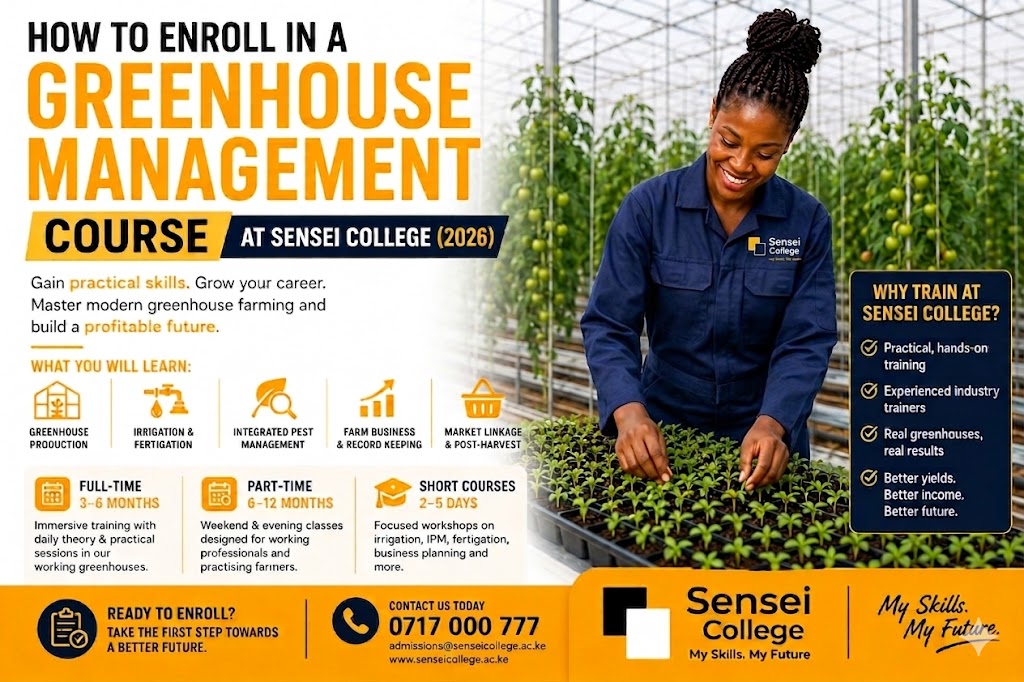
Duration: 3–6 months Daily theory sessions in the morning, practical greenhouse work in the afternoons. Students work in functioning greenhouses growing real crops under expert supervision. This is the most immersive option and delivers the fastest and deepest learning outcomes.
Part-Time Programme
Duration: 6–12 months Classes on Saturdays and selected weekday evenings. Practical sessions are condensed but cover the same competencies as the full-time programme. Designed for practising farmers and working professionals who cannot step away from their current obligations full-time.
Short Courses and Targeted Workshops
Duration: 2–5 days per course Intensive, topic-specific sessions covering areas such as:
- Drip irrigation design and installation
- Integrated pest management in greenhouses
- Fertigation and nutrient management
- Greenhouse business planning and ROI analysis
- Post-harvest handling and market linkage
Short courses are ideal for farmers who already have operational experience but want to strengthen their knowledge in a specific area.
Tuition, Fees, and Financial Support
Programme Fees (2026 Estimates)
| Programme | Estimated Fee Range (KES) |
| Full-time certificate (3–6 months) | 25,000 – 60,000 |
| Part-time certificate (6–12 months) | 20,000 – 45,000 |
| Short courses and workshops | 5,000 – 15,000 per course |
Fees typically cover tuition, practical session materials, and in some cases, accommodation for residential students. Confirm the specific fee structure and what is included directly with Sensei College at the time of application.
Financial Support Options
Sensei College periodically offers subsidised or sponsored places through partnerships with:
- County government agricultural development programmes
- NGO and development partner grants targeting youth, women, and smallholder farmers
- TVET Authority bursary schemes
- Private sector partnerships with agribusiness firms
Prospective students should proactively ask about available financial support when making their initial enquiry. Sponsored places often fill quickly.
Step-by-Step: How to Enrol at Sensei College
Step 1: Make Initial Contact and Confirm Intake Dates
Contact Sensei College through their official website, telephone line, email, or social media channels. Confirm the schedule of upcoming intakes. Intakes are typically offered in January, May, and September, but this may vary; always verify directly.
Step 2: Download or Collect Your Application Form
Application forms are available at the college campus or can be downloaded from the official website. Ensure you are using the current version of the form for the relevant academic year.
Step 3: Complete the Application Thoroughly
Fill in all sections of the application form clearly and accurately. Incomplete applications cause delays. Indicate clearly which study mode you are applying for and your preferred intake period.
Step 4: Gather Your Supporting Documents
Prepare certified copies of the following:
- KCSE certificate or result slip (or equivalent qualification)
- National ID card or birth certificate
- Two recent passport-size photographs
- Any supporting documents
Step 5: Submit Your Application and Pay the Registration Fee
Submit your completed application and supporting documents in person at the college admissions office, or by post/courier if the college accepts remote applications. Request and retain a receipt or payment confirmation.
Step 6: Await Admission Notification
The admissions office will review your application and notify you of the outcome within the stated processing period. If you are accepted, you will receive an admission letter outlining your reporting date, a list of items to bring, and any balance of fees to be paid before or at reporting.
Step 7: Attend Orientation
Attend the college orientation session on your reporting date. You will receive your class timetable, course materials, and an introduction to the college’s greenhouse facilities and safety procedures. This is also a good opportunity to meet fellow students and the teaching staff.
Step 8: Engage Fully – Theory and Practical
The students who get the most from the programme are those who participate actively in both classroom sessions and greenhouse practical work. Ask questions, take notes, handle the crops, operate the irrigation systems, and use the business planning tools. The practical hours in the training greenhouse are where the real learning happens.
Step 9: Complete Assessments and Practical Evaluations
Assessments include written theory examinations, practical demonstrations such as setting up a drip irrigation line, conducting a pest scouting exercise, preparing a crop management record, or developing a greenhouse business plan, and a final project or industry attachment.
Step 10: Graduate and Receive Your Certificate
Upon successfully meeting all assessment requirements, you graduate and receive your Certificate in Greenhouse Management from Sensei College. This credential is recognised by agribusiness employers, development organisations, lending institutions, and further education institutions across Kenya.
Purpose of the Certificate
The Certificate in Greenhouse Management from Sensei College opens several practical pathways:
-
Start Your Own Greenhouse Enterprise
Apply your knowledge directly. The business planning competencies from the programme, including ROI analysis, market linkage, and input management, give you a structured foundation for setting up and running a profitable greenhouse operation. Many graduates start with a single 8m × 30m unit and expand over subsequent seasons.
-
Employment in the Horticultural Sector
Kenya’s horticulture industry, including large commercial flower farms, vegetable export companies, and development-funded horticultural projects, actively recruits trained greenhouse technicians and farm supervisors. Certification significantly improves your employability and negotiating position on starting salary.
-
Agricultural Extension and Advisory Services
Trained graduates can establish themselves as paid greenhouse setup and management consultants, offering services to other farmers in their region. As greenhouse adoption grows across Kenya, demand for competent local technical advisors is expanding rapidly. This is a viable, growing, and relatively uncompetitive service niche.
-
Further Education
The certificate provides a recognised foundation for progression to a Diploma or Degree in Horticulture, Agricultural Engineering, Agribusiness Management, or a related field at institutions such as Egerton University, Jomo Kenyatta University of Agriculture and Technology (JKUAT), Kenya Agricultural and Livestock Research Organisation (KALRO) affiliated training centres, and other accredited universities and polytechnics.
Frequently Asked Questions
1. Do I need farming experience to join the Sensei College greenhouse programme?
No. The programme starts from first principles and is designed for learners at all experience levels. Complete beginners are fully accommodated, and the practical sessions provide hands-on experience from day one.
2. Is the Sensei College certificate recognised by employers and financial institutions?
Yes. The certificate is a verifiable, formal qualification that is recognised in Kenya’s agribusiness sector. Many agricultural lending institutions specifically look for documented training as part of their credit assessment for farm investment loans.
3. Can I do the programme if I am already running a greenhouse?
Absolutely, and many students are exactly in this situation. Practising farmers frequently find that the programme fills critical gaps in their knowledge of IPM, fertigation, and business management that they had been navigating through guesswork. The part-time and short course options are specifically structured to accommodate this group.
4. How do I find out about sponsored or subsidised places?
Contact the college admissions office directly and ask specifically about available bursaries, sponsored places, or partnerships with county governments or NGOs. You can also check with your county’s Department of Agriculture for any active programmes that sponsor technical training for farmers.
5. What is the best study mode for someone with a small farm to manage?
The part-time / weekend programme is designed precisely for this situation. It delivers the full curriculum across a longer timeframe, allowing you to manage your farm obligations during the week while attending college on weekends.
6. Can the certificate lead to Global GAP certification for my farm?
The programme includes a module on GlobalGAP requirements and food safety standards. While the certificate itself does not constitute GlobalGAP certification, it gives you a thorough understanding of what GlobalGAP requires and how to position your farm to pursue third-party certification, a valuable step for farmers targeting export markets.
Conclusion
Every farmer who has ever lost a crop cycle to a disease they did not recognise, a nutrient deficiency they did not understand, or a market they had no access to knows the cost of operating without adequate knowledge.
The Certificate in Greenhouse Management from Sensei College is not just a piece of paper. It is a structured investment in the skills, networks, and confidence that determine whether a greenhouse becomes a profitable business or an expensive lesson.