
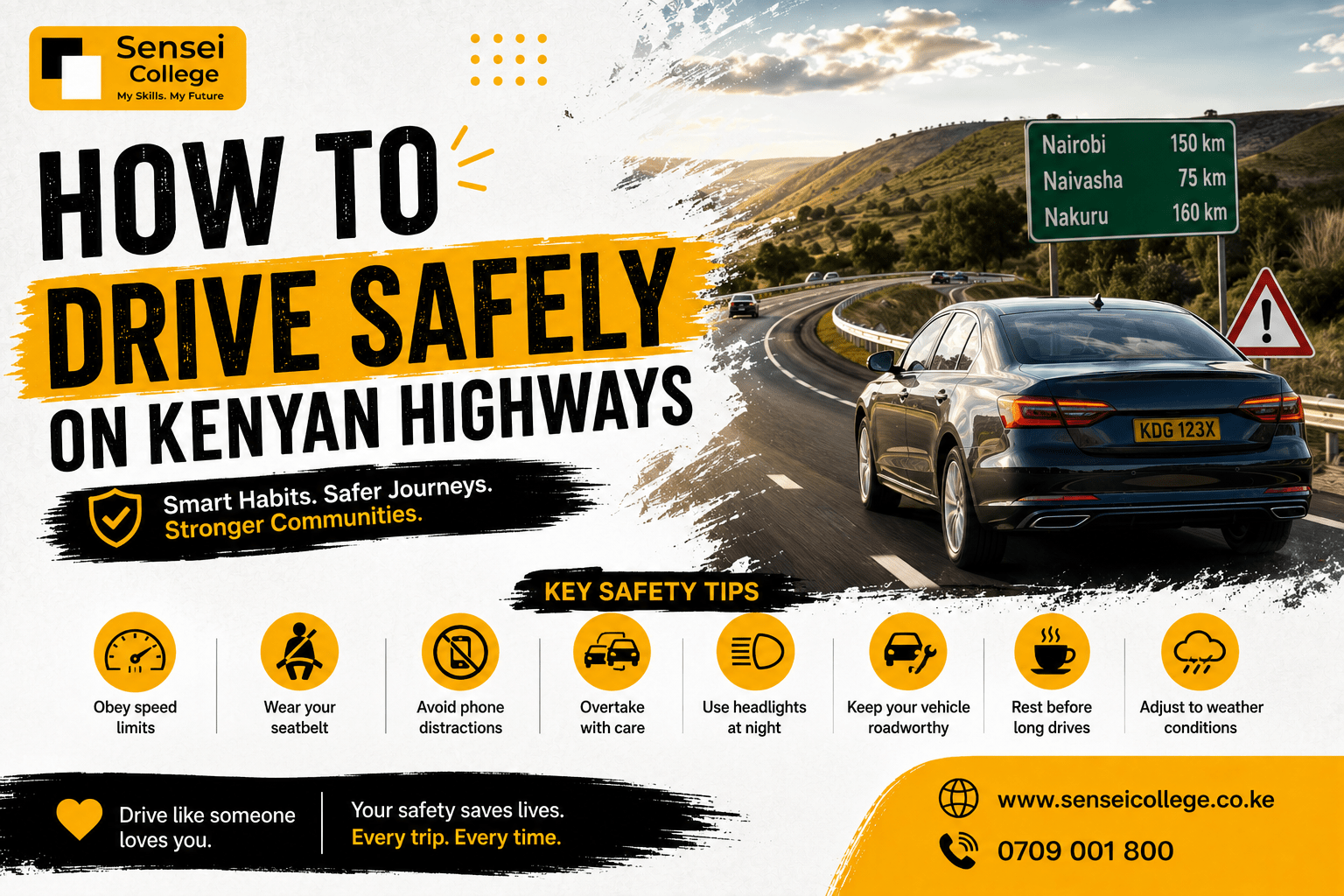
Driving on Kenyan highways is both efficient and challenging. From long-distance travel to heavy traffic and unpredictable road conditions, drivers must stay alert at all times. Two of the most critical skills every driver must master are safe overtaking and night driving. When done correctly, these skills not only prevent accidents but also save lives.
In this guide, we explore practical tips to help you navigate Kenyan highways safely, whether you are driving during the day or after dark.
Before You Even Start Driving
Before departure, ensure:
- Tyres have the correct pressure for a loaded vehicle
- Enough fuel for the journey
- Spare tyre, jack, and tyre iron present
- Engine oil, coolant, and brake fluid at correct levels
- Headlights, tail lights, and indicators all working
- You have slept enough – at least 7 hours
- Your phone is charged, and you have airtime for emergencies
- You know the route, download offline maps if going to a remote area
Safe Overtaking on Kenyan Highways
According to the National Transport Safety Authority (NTSA), overtaking is the most dangerous manoeuvre on a Kenyan highway. More fatal accidents happen during or immediately after an overtake than at any other time.
Only overtake when you are completely certain it is safe. If you have even a small doubt, hold back.
When it is Legal and Safe to Overtake
You may overtake when:
- The road ahead is straight, and you can see far enough to complete the manoeuvre safely
- There is a broken white or yellow centre line (not solid)
- No oncoming vehicle is approaching within your overtaking distance
- The vehicle ahead is significantly slower than your speed
- There is enough road ahead for you to pull back into your lane comfortably
When NOT To Overtake
| Situation | Why It Is Dangerous |
| On a bend or curve | You cannot see what is coming the other way |
| At the top of a hill or crest | Oncoming vehicle appears suddenly with no time to react |
| At a junction or intersection | A vehicle may be turning right or emerging unexpectedly |
| At a zebra crossing or pedestrian crossing | A pedestrian may step out |
| When there is a solid white or yellow centre line | It is illegal to use solid lines to mean the road ahead is restricted |
| When another vehicle is overtaking you | You would create a three-car situation in one lane |
| When you are being overtaken | Never accelerate, let the overtaking vehicle complete the manoeuvre |
| In fog, rain, or poor visibility | You cannot judge the distance or speed of oncoming vehicles |
How to Overtake Correctly
STEP 1 – Plan and Assess
- Check the road ahead – straight, clear, no junctions
- Check the centre line – when broken is allowed, when solid is forbidden
- Check mirrors – no vehicle directly behind you about to overtake too
- Make sure you have enough speed and power to complete the overtake quickly
STEP 2 -Check Blind Spots
- Briefly glance over your right shoulder before moving out
- Check right mirror one more time
STEP 3 – Signal Right
Put on your right indicator before you move. This gives vehicles behind time to react
STEP 4 – Move Out and Accelerate
- Move smoothly into the right lane
- Accelerate firmly to complete the overtake as quickly as possible
- The longer you spend alongside the other vehicle, the more danger you are in
STEP 5 – Signal Left and Move Back
- Once you can see the overtaken vehicle fully in your rear-view mirror, you have enough space
- Signal left and move back into the left lane
- Do not cut in too sharply; ease across gently
STEP 6 – Cancel Your Indicator
Check if it has cancelled some indicators do not self-cancel after lane changes
Overtaking
Trucks and buses:
- Are much longer than private cars, so you need much more road to get past
- Create a wind blast as you pass that can affect your steering
- May suddenly move left to avoid a pothole without indicating
- Block your view completely – you cannot see oncoming traffic when right behind them
How to overtake safely:
- Drop back to a larger following distance before overtaking (at least 4 seconds behind)
- Accelerate hard and fast – do not dawdle alongside a truck
- Do not overtake a truck at the same time as oncoming traffic approaching
Night Driving on Kenyan Highways
Night driving in Kenya is more dangerous than daytime for several reasons:
- Pedestrians and cyclists with no reflective clothing are almost invisible
- Stray animals cross the road unexpectedly
- Some vehicles drive with non-working lights, and you may not see them until it is too late
- Driver fatigue increases significantly after 10 pm
- Road surface problems (potholes, unmarked speed bumps) are harder to see
Night Driving: Rules and Best Practices
1. Use the Correct Headlight Setting
| Situation | Light to Use |
| Open highway with no oncoming traffic | Full beam (high beam) |
| When you see oncoming headlights approaching | Switch to low beam immediately |
| When following another vehicle | Low beam only – high beam blinds the driver ahead |
| In fog | Fog lights if fitted; low beam if not |
| In a town or built-up area | Low beam always |
Flash your high beam briefly to warn oncoming vehicles if they have left their full beam on, then switch back to low beam yourself.
2. Adjust Your Speed for Headlight Range
Your headlights on low beam typically illuminate about 60 metres ahead. At 100 km/h, you travel that distance in just over 2 seconds.
This means: if you need to stop in under 60 metres at night, you will not make it.
At night on a highway:
- Reduce speed to 80 km/h – do not drive at the maximum speed limit
- On winding or unfamiliar roads: reduce to 60 km/h
- In rain at night: reduce to 50–60 km/h
3. Watch the Left Verge, Not Just the Centre
Pedestrians, cyclists, and animals come from the left verge, not from the centre. Train yourself to scan the left edge of the road with your eyes while keeping direction with peripheral vision.
4. Manage Driver Fatigue
Fatigue is invisible; it creeps up without warning and then hits you hard.
Signs you are too tired to drive:
- You keep yawning repeatedly
- Your eyes feel heavy or dry
- You missed a sign you should have seen
- You realise you cannot remember the last few kilometres
- Your lane position drifts
When tired:
- Pull off the road completely into a petrol station, rest stop, or well-lit area
- Take a 20-minute nap. This is genuinely effective
- Drink water, not just coffee
- Walk around briefly to increase blood flow
- If sharing driving with someone, switch drivers
Never try to “push through” fatigue while on the road, it can be fatal.
Hazards Unique to Kenyan Nights
| Hazard | What To Do |
| Vehicle parked on the road without lights | Keep left; this is very common in Kenya |
| Stray animals on the road | Reduce speed as soon as you see any animal, more may follow |
| Cyclists with no lights | Drive with high beam where possible; reduce speed near villages |
| Unmarked speed bumps | Reduce speed entering all town centres and villages at night |
| Broken-down vehicle in the dark | Give maximum space; move right if the oncoming lane is clear |
Common Mistakes on Kenyan Highways and How to Avoid Them
Tailgating – Following Too Close
Drivers follow too close because they want to overtake but cannot yet find a gap. When the vehicle ahead brakes suddenly, there is no time to react.
Always maintain at least a 3-second gap. On highways at 100 km/h, which is about 83 metres.
Overtaking on a Rise
If the driver sees the road appears clear and overtakes, not realising that a vehicle on the other side of the hill is approaching fast and will appear suddenly at the crest.
Never overtake when you can see the road rising ahead of you. Wait until you are past the crest and can see the road ahead clearly.
Long Distance Without Breaks
Drivers push through a 6-hour journey without stopping, becoming dangerously fatigued by hour 4 and 5.
Always stop every 2 hours for at least 10–15 minutes. Stretch, drink water, walk briefly. Your reaction time and judgement improve significantly after a proper break.
Driving Too Slowly in the Fast Lane
Slow vehicles stay in the right lane, forcing faster drivers to make risky overtakes on the left.
Always keep left unless overtaking. The right lane is for overtaking, not cruising. If someone wants to pass you let them.
Not Indicating During Lane Changes
Highway drivers change lanes without signalling, surprising the vehicle behind or the vehicle in the lane they are moving into.
Always signal before moving, even if you think no one is there. On highways, vehicles approach quickly.
Using a Mobile Phone While Driving
Drivers who look down at their phone even for 3 seconds at 100 km/h cover over 83 metres of road without looking up; this can be fatal.
Always ensure your phone is on silent. Mount it on the dashboard if using navigation. Never hold it. If a call is urgent, pull off the road completely.
Conclusion
Safe driving always comes down to discipline, awareness, and good judgment.
Overtake only when it is necessary and safe, and approach night driving with extra caution. By applying these simple, effective tips, you not only protect yourself but also safeguard the lives of other road users.
Remember, every safe journey begins with responsible driving.