
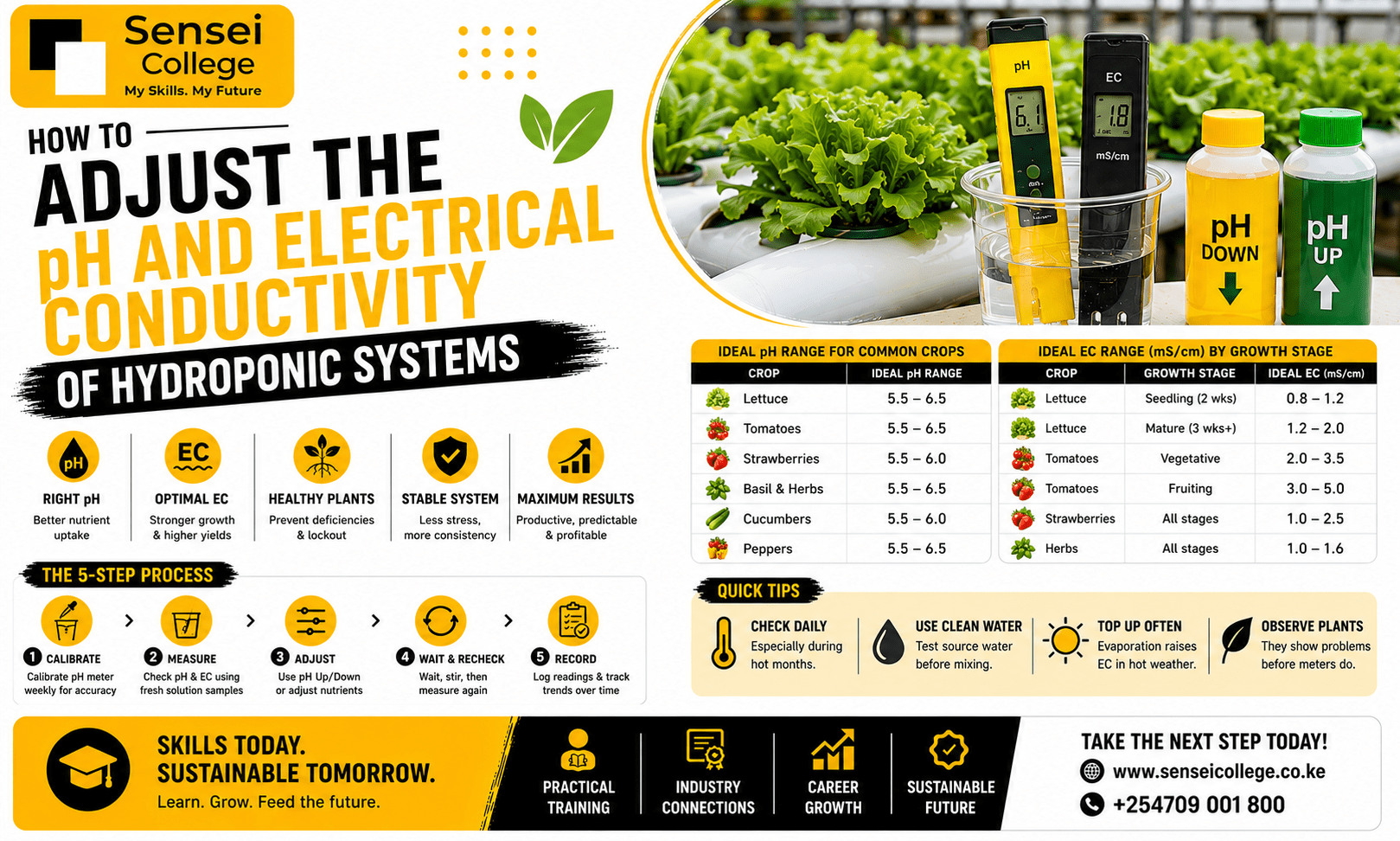
In hydroponics, what plants feed on largely determines how they grow, behave, and ultimately look. An imbalance in the nutrient solution can disrupt the entire system. In most cases, the pH or EC level has drifted outside the optimal range. These factors control how well your plants absorb nutrients, and when they’re off, even the best nutrients can become ineffective or even harmful.
This article will guide you on what pH and EC mean, how to measure them accurately, how to fix common issues, and how to make monitoring them part of your daily routine.
What Is pH and Why Does It Matter?
pH measures how acidic or alkaline your nutrient solution is. The scale runs from 0 (most acidic) to 14 (most alkaline), with 7.0 being neutral.
It controls whether your plants can absorb nutrients dissolved in water. Even if you add perfect amounts of nitrogen, phosphorus, and potassium, if the pH is wrong, the nutrients become chemically unavailable to the plant. This is called nutrient lockout.
Ideal pH Ranges for Common Kenyan Crops
| Crop | Ideal pH Range | Notes |
| Lettuce | 5.5 – 6.5 | Very tolerant; aim for 6.0 |
| Tomatoes | 5.5 – 6.5 | Lower end promotes fruit set |
| Strawberries | 5.5 – 6.0 | Sensitive to alkaline drift |
| Basil & Herbs | 5.5 – 6.5 | Wider tolerance range |
| Cucumbers | 5.5 – 6.0 | Prefer slightly acidic |
| Peppers | 5.5 – 6.5 | Aim for 6.0 – 6.2 |
pH too high (above 7.0): Causes iron, manganese, and zinc deficiency. You will see yellowing between leaf veins (interveinal chlorosis).
pH too low (below 5.0): Causes calcium and magnesium deficiency, plus toxic levels of some minerals.
Nairobi tap water typically runs at pH 7.0 to 7.5. Borehole water can be higher. Always measure your source water before mixing nutrients.
Electrical Conductivity(EC) and Why it Matters
EC is the measure of dissolved salts (nutrients) in water.
Nutrients are salts, and salts conduct electricity, so the more nutrients dissolved, the higher the EC reading.
EC is measured in milliSiemens per centimetre (mS/cm).
EC Ranges by Crop and Growth Stage
| Crop | Ideal EC (mS/cm) | Growth Stage |
| Lettuce (seedling) | 0.8 – 1.2 | First 2 weeks |
| Lettuce (mature) | 1.2 – 2.0 | Weeks 3 to harvest |
| Tomatoes (vegetative) | 2.0 – 3.5 | Pre-flowering |
| Tomatoes (fruiting) | 3.0 – 5.0 | Higher feeds bigger fruit |
| Strawberries | 1.0 – 2.5 | Keep lower to avoid burn |
| Herbs | 1.0 – 1.6 | Low EC = high quality |
EC too high: Causes nutrient burn, leaf tips turn brown and curl.
EC too low: Plants are underfed, with slow growth and pale, light green leaves.
In hot, dry seasons, water evaporates faster, and EC tends to creep upward. Regular monitoring is especially important during January, February, and July.
Tools You Need
pH Meter
- A digital pen-style pH meter is the most accurate and convenient option
- Look for models with automatic temperature compensation (ATC), this is important in Kenya’s variable climate
- Budget option: HM Digital pH-80 or similar, available on Jumia Kenya or in agricultural supply shops for KES 1,500 to 4,000
- Always buy calibration solution (pH 4.0 and pH 7.0 buffer sachets) at the same time these are essential
EC Meter
- A dedicated EC/TDS pen meter works well for most Kenyan growers
- Combo meters measuring both pH and EC are convenient but require more maintenance
- EC pens are available from KES 800 to 3,000 on Jumia or from Hortimax and other agricultural suppliers
pH Test Kits
- Liquid pH test kits (like those used for fish tanks or swimming pools) cost around KES 200 to 500
- Less precise than meters but useful for quick daily checks or as a backup
- Not recommended as your primary tool for commercial growing
Calibration and Storage Solutions
- Always have pH 4.0 and 7.0 buffer solutions on hand
- Store your pH electrode in storage solution (or 3M KCl solution), never in distilled water
Step-by-Step Guide to Measuring pH and EC
How to Calibrate Your pH Meter
Calibrate weekly for active systems or any time readings seem unusual.
- Rinse the electrode with distilled water and gently pat dry with a soft tissue.
- Place the electrode in a pH 7.0 buffer solution. Wait until the reading stabilizes, then press the calibrate button.
- Rinse again, then place in pH 4.0 buffer. Calibrate again.
- Rinse and store in storage solution until use.
How to Measure pH
- Remove your pH meter from storage and rinse with distilled water.
- Collect a small sample of your nutrient solution (100 to 200 ml) in a clean container.
- Submerge the electrode at least 2 cm into the sample. Do not let it touch the sides or bottom.
- Gently stir and wait 20 to 30 seconds for the reading to stabilize.
- Record the reading in a log book or phone app.
- Rinse the electrode and return it to storage solution.
How to Measure EC
- Rinse your EC meter with distilled water.
- Take a fresh nutrient solution sample, separate from the pH sample buffer, because contamination is a common mistake.
- Dip the EC meter into the solution, ensuring both sensor pins are fully submerged.
- Stir gently and wait for the reading to stabilize, usually 5 to 10 seconds.
- Record the reading and the date.
How Often to Check
| System Stage | pH Frequency | EC Frequency |
| First 2 weeks (seedlings) | Daily | Every 2 days |
| Active vegetative growth | Every 2 days | Every 2 days |
| Fruiting/Mature crops | Daily | Daily |
| After adding nutrients | Immediately after | Immediately after |
| After heavy rain/storm | Immediately after | Immediately after |
Adjusting pH and EC
Adjusting pH
- pH too high (alkaline): Use pH Down solution. In Kenya, phosphoric acid or citric acid-based pH Down products are available from hydroponics suppliers.
Add in small doses, half a millilitre at a time, stir well, and wait 10 minutes before re-measuring.
- pH too low (acidic): Use pH Up solution. Potassium hydroxide-based pH Up is standard. Add slowly and measure after each addition.
.
Adjusting EC
- If too low: Add more concentrated nutrient solution or additional nutrients according to your feeding schedule. Measure after each addition.
- If too high: Dilute with fresh, pH-adjusted water. Do this gradually; a sudden EC drop stresses plants. Aim to reduce by no more than 0.5 mS/cm per day.
In hot Kenyan weather, water evaporates from your reservoir, concentrating the nutrient solution and raising EC. During dry months, top up with plain pH-adjusted water to bring EC back to target.
Tips for Experienced Growers
Nutrient Balancing
Individual nutrient imbalances can occur even when EC is in the correct range. For example, your EC might read 2.5 mS/cm but be heavily skewed toward potassium if you are in the flowering stage. Experienced growers adjust individual element concentrations rather than chasing a total EC number alone; a technique that requires knowledge of your specific nutrient formulation and crop needs.
Variable-Ratio Feeding
Advanced growers adjust nutrient strength based on growth stage:
- Seedlings: 25% of full nutrient strength
- Vegetative plants: 50 to 75% of full strength
- Fruiting crops: Full strength or above, with increased potassium
Automation Systems
For larger farms, automated dosing systems called dosatrons or peristaltic pump systems can automatically adjust pH and EC based on continuous monitoring. Systems like the Bluelab Guardian or HANNA BL-1 Leap controller are used on commercial Kenyan farms. These add significant upfront cost (KES 150,000 to 400,000+) but eliminate manual monitoring at scale.
Common Mistakes and Troubleshooting
- Never calibrating your meter: An uncalibrated meter can give readings off by 0.5 pH units, enough to completely misguide your adjustments. Calibrate weekly.
- Measuring immediately after adding nutrients: Always wait 10 to 15 minutes after any addition before measuring. The solution needs time to equilibrate.
- Storing the pH electrode dry: This kills the glass electrode quickly. Always store in storage solution or pH 7.0 buffer.
- Confusing EC with TDS (ppm): EC meters in Kenya often display TDS in parts per million. The conversion is roughly 1 mS/cm = 500 to 700 ppm. Always note which scale you are using.
- Ignoring temperature: pH and EC readings shift with temperature. Use a meter with automatic temperature compensation (ATC), especially in Kenya where temperatures vary significantly between seasons.
Conclusion
Farmers should ensure consistent monitoring of the hydroponic system by making pH and EC monitoring part of their routine.
Over time, you will begin to see patterns: when pH drifts up on hot days, when EC rises after evaporation, when your plants signal deficiency before your meter does.
Learn how to manage pH and Electrical conductivity of a hydroponic, which guarantees a productive, predictable, and profitable hydroponic system.