
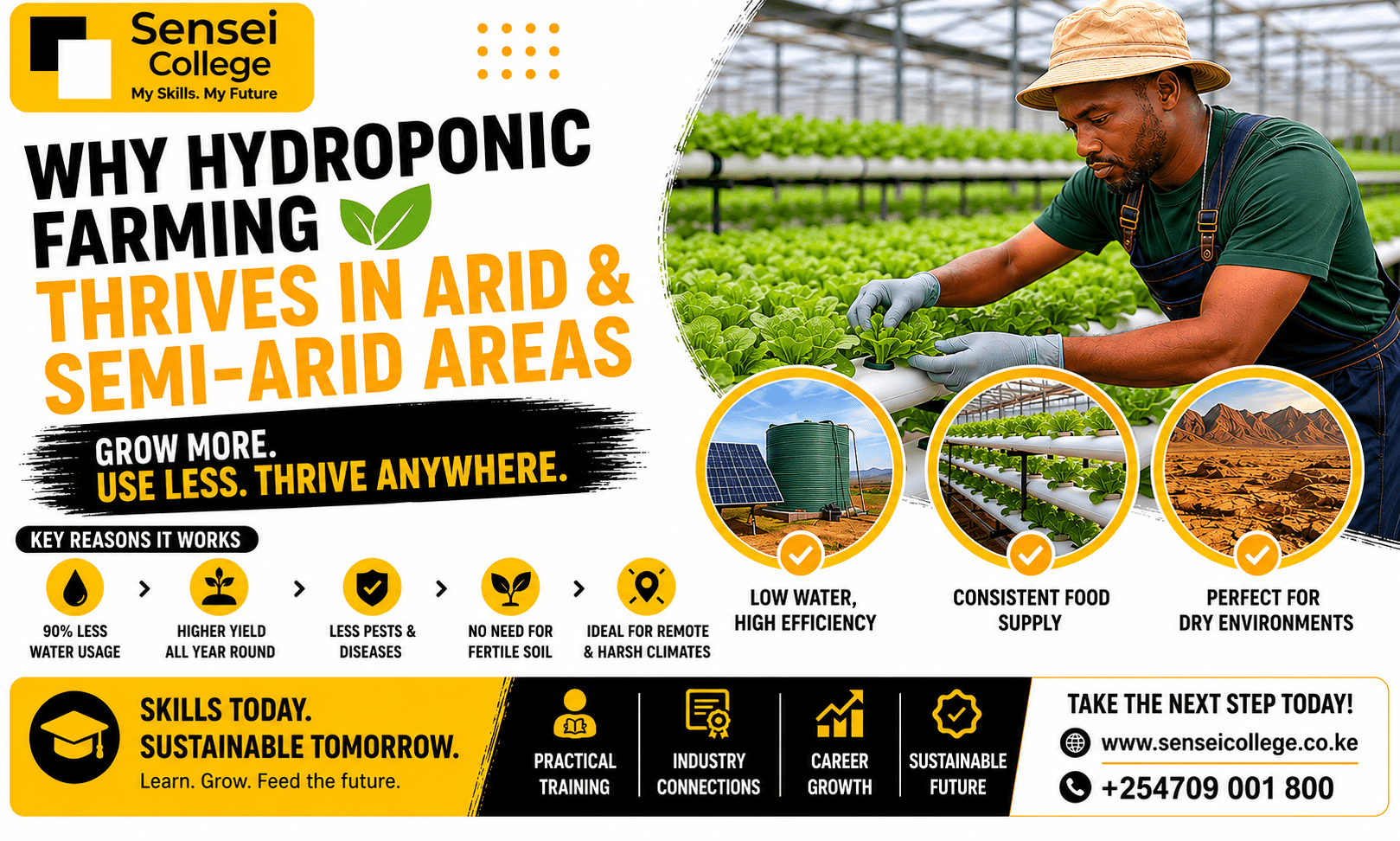
Climate change is pushing rainfall patterns further out of reach. Traditional farming, which has always depended on reliable rain and fertile soil, is becoming an increasingly unreliable way to feed communities in arid and semi-arid regions.
The cost of food is rising, and dependence on supplies trucked in from Nairobi or other parts of the country is making communities vulnerable and food insecure.
Modern farming is offering a real, practical alternative that works even where water is scarce, soil is poor, and space is limited.
This article explains why hydroponics is perfectly suited for arid and semi-arid regions and how a first-time farmer or an experienced agripreneur can use it to grow food reliably, affordably, and sustainably.
What is Hydroponics?
Hydroponics is a method of growing plants without soil.
Instead of drawing nutrients from the soil, plants grown hydroponically receive everything they need through a carefully balanced, nutrient-rich water solution. The roots are either submerged in this solution, misted with it, or have it flowing past them continuously.
For a complete explanation, explore our full guide on hydroponic farming.
Why Hydroponics is Ideal for Water-Scarce Regions
1. It Uses Up to 90% Less Water Than Conventional Farming
Traditional soil farming loses enormous amounts of water to evaporation, runoff, and absorption by the soil itself. Much of the water you pour on a field never reaches the plant roots.
In a hydroponic system, water is delivered directly to the roots, and any excess is collected and recirculated. Studies show that hydroponic systems use up to 80–90% less water than conventional soil-based farming to produce the same amount of food.
For a region where there is limited access to water and every litre of water counts, this is a game-changer.
2. Water is Recycled, Not Wasted
In most hydroponic systems, the nutrient solution that the plant doesn’t absorb flows back into a reservoir and is reused. This closed-loop approach means there is almost no water waste, a critical feature in regions where water must often be purchased, collected, or transported from far distances.
3. No Dependence on Rainfall or Fertile Soil
Hydroponic farming doesn’t need rain. It doesn’t need good soil. It doesn’t even need a farm. A hydroponic setup can be placed inside a shade net structure, a greenhouse, a container, or even a room, completely removing dependence on weather conditions.
This means farming can happen year-round, regardless of what is happening outside.
4. Works in Small Spaces
Land scarcity is not the primary challenge in Northern Kenya; water is. But urban and peri-urban communities in towns like Lodwar, Marsabit, and Garissa may have limited space. Hydroponic systems can be stacked vertically, placed on rooftops, or installed in small plots, making them ideal for space-constrained environments too.
Benefits of Hydroponic Farming
Farming in arid and semi-arid regions comes with serious challenges: unpredictable rainfall, poor soil quality and limited water resources. These conditions often make traditional agriculture difficult and unreliable.
Hydroponic farming offers a smarter alternative by growing crops without soil and using significantly less water while maintaining high productivity.
Discover the key benefits of hydroponic farming and why it’s transforming agriculture in dry regions.
Suitable Crops for Hydroponic Farming in Northern Kenya
Leafy Greens: The Best Starting Point
- Kale (Sukuma Wiki): Kenya’s most consumed vegetable. It grows quickly in hydroponic systems, is highly nutritious, and has strong local demand.
- Spinach: Fast-growing, nutritious, and ideal for NFT systems.
- Lettuce: One of the easiest crops to grow hydroponically. It has a short growth cycle (30–45 days) and sells well in towns and hotels.
Leafy greens are ideal because they grow fast, require relatively low nutrient levels, and are in high demand locally.
Fruiting Vegetables – For Higher Revenue
- Tomatoes: Among the most profitable hydroponic crops globally. They require a more robust system but deliver excellent yields.
- Capsicum (Bell Peppers): High-value crop with long shelf life and good market demand.
- Cucumbers: Fast-growing and high-yielding, with good market prices in local towns.
Herbs – High Value in Small Spaces
- Coriander (dhania): Extremely popular in Kenyan cooking. Short growth cycle and high turnover.
- Mint and Basil: Niche but high-value, especially for restaurants, hotels, and urban markets.
Herbs can generate significant income from very small growing areas, making them ideal for urban or peri-urban setups.
Types of Hydroponic Systems Suitable for Dry Areas
| System | Complexity | Cost | Best For |
| NFT (Nutrient Film Technique) | Moderate | Medium | Leafy greens, herbs |
| Drip System | Low–Moderate | Low–Medium | Tomatoes, capsicum, cucumbers |
| DWC (Deep Water Culture) | Low | Low | Beginners, leafy greens |
| Wick System | Very Low | Very Low | Very small-scale, learning |
NFT – Nutrient Film Technique
Best for leafy greens and herbs. Water flows continuously through shallow channels, keeping roots moist but well-oxygenated. NFT systems are water-efficient and scalable; a strong fit for water-scarce environments. They do require a reliable pump and a small amount of electricity or solar power.
Drip Systems
The most widely used system commercially. Nutrient solution is dripped slowly to each plant, and excess water is either drained or recycled. Drip systems work well with a wide range of crops and are easy to scale. They are forgiving for beginners and can be built relatively cheaply using locally available pipes and containers.
Deep Water Culture (DWC)
Ideal for beginners. Plants sit in net pots above a reservoir of nutrient solution, with their roots submerged. An air pump (similar to a fish tank pump) keeps the water oxygenated. DWC systems can be built from locally available materials: buckets, pipes, and affordable aquarium pumps, making them one of the lowest-cost entry points into hydroponics.
Wick Systems
The simplest system of all, no pump required. A wick draws nutrient solution from a reservoir up to the plant roots through capillary action. While too slow for commercial production, wick systems are excellent for learning the basics or growing herbs on a very small scale.
Cost and Setup Considerations
What Does it Cost to Start?
The cost of setting up a hydroponic system in Kenya varies widely depending on scale, system type, and whether you source materials locally or import them.
Small beginner setup (DWC or drip, ~10–20 plants):
- Estimated cost: KES 5,000 – 15,000
- Suitable for household use or learning
- Can be built using buckets, PVC pipes, a small pump, and nutrient solution
Medium semi-commercial setup (NFT or drip, ~100–300 plants):
- Estimated cost: KES 50,000 – 150,000
- Suitable for generating regular income
- May require a shade net structure or greenhouse
Commercial setup (500+ plants, full greenhouse):
- Estimated cost: KES 300,000 – 1,000,000+
- Suitable for serious agribusiness
- Requires proper infrastructure, automation, and market connections
Key Materials Needed
- Growing channels or containers: PVC pipes, buckets, or purpose-built NFT channels
- Reservoir/tank: For storing and recycling nutrient solution
- Water pump: To circulate the solution (solar-powered options available)
- Growing medium: Coco coir, perlite, or rock wool (instead of soil)
- Nutrient solution: Premixed or separate A and B nutrient concentrates
- pH testing kit and EC meter: Essential for monitoring water quality
- Seeds: High-quality open-pollinated or F1 hybrid seeds
Challenges and How to Overcome Them
No farming method is without challenges. Here is an honest look at the common hurdles in hydroponic farming and practical ways to address them in a Northern Kenya context.
1. Initial Setup Cost
The upfront cost can be a barrier, especially for smallholder farmers with limited capital.
Solutions:
- Start with a very small, low-cost DWC or wick system to learn and demonstrate results.
- Explore grants and subsidies from organisations like the Kenya Climate-Smart Agriculture Project, USAID Feed the Future, or county government agricultural programs.
- Form farmer groups to pool resources and share the cost of a shared setup.
2. Technical Knowledge
Hydroponics requires an understanding of pH, nutrient concentrations, and plant physiology knowledge that many farmers in the region may not have.
Solutions:
- Attend training workshops offered by organisations like Kenya Agricultural and Livestock Research Organisation (KALRO) or local agri-tech NGOs.
- Start with simple systems (DWC or drip) that are forgiving and easier to manage.
- Join online farming communities and WhatsApp groups where Kenyan hydroponic farmers share knowledge.
3. Power Access
Pumps and timers require electricity, and power supply in remote Northern Kenya is often unreliable or unavailable.
Solutions:
- Use solar-powered water pumps, which are increasingly affordable and widely available in Kenya.
- Design passive or gravity-fed systems that require minimal electricity.
- Battery-backed systems can store solar energy to run pumps during nights or cloudy days.
4. Access to Nutrient Solutions and Inputs
Hydroponic nutrients and growing media may not be readily available in remote counties.
Solutions:
- Purchase supplies in bulk from Nairobi-based suppliers and transport to site.
- Some nutrients can be sourced locally or mixed from agricultural-grade salts available at agro-vet shops.
- Partner with suppliers who offer delivery to county towns like Lodwar or Marsabit.
Applications and Potential in Kenya
Household Food Production
A family in Lodwar, Turkana, with a 10-square-metre shade net structure can grow enough kale, tomatoes, and herbs to meet their household vegetable needs year-round and sell the surplus at the local market. This reduces both food insecurity and household spending on vegetables.
Youth Agribusiness Opportunities
Hydroponic farming is attracting young, educated Kenyans who want to farm differently. In towns like Garissa and Marsabit, young agripreneurs are setting up small hydroponic units to supply fresh vegetables to restaurants, hotels, and supermarkets, markets that currently depend entirely on produce trucked from Nairobi, at a significant price.
The opportunity is real: locally grown hydroponic produce can outcompete imported vegetables on both freshness and price, while generating meaningful income for youth in the region.
Schools and Institutions
Schools, hospitals, and government institutions in Northern Kenya spend significant budgets on food. A hydroponic kitchen garden can reduce this expenditure while providing students with hands-on agricultural education, creating a generation of farmers who understand modern techniques.
NGO and Humanitarian Applications
International organisations working in the region are increasingly exploring hydroponics as a food security intervention for displaced communities and refugee settlements, where traditional farming is not possible, but nutritious food is urgently needed.
Insights on how to ScaleUp and Optimise Your System
-
Automation
Manual monitoring and feeding is fine for small setups, but at scale, automation is essential. Invest in:
- Timers to automate pump cycles
- Automated pH and EC dosing systems to maintain optimal nutrient levels without daily manual adjustment
- Environmental sensors to monitor temperature, humidity, and CO₂ levels in enclosed growing environments
-
Nutrient Optimisation
Different crops and growth stages require different nutrient ratios. Advanced growers use two-part or three-part nutrient solutions and adjust the formula as plants move from vegetative to fruiting stages. Detailed nutrient management can significantly increase yield, quality and quantity.
-
Integrating with Greenhouse Farming
Combining hydroponics with a well-designed greenhouse gives you full environmental control, regulating temperature, humidity, light, and pests. This combination is the gold standard for year-round, high-yield production and is particularly powerful in the extreme heat of Northern Kenya, where temperatures can exceed 40°C and damage open-air crops.
-
Commercial Scaling and Market Linkages
Before scaling commercially, secure your market first. Identify off-takers, supermarkets, hotels, restaurants, and institutional buyers, understand their volume requirements, quality standards, and payment terms. A profitable commercial hydroponic operation requires both good production and a reliable sales channel.
Consider value-added products: packaged ready-to-cook vegetables, herb bundles, or subscription boxes for urban households in county towns are growing market opportunities.
Conclusion
Traditional farming methods that rely on rainfall and fertile soil will continue to struggle in arid and semi-arid regions like Turkana, Marsabit, Garissa, and Wajir.
Hydroponic farming offers a practical, proven, and increasingly affordable way to grow nutritious food in places where conventional agriculture has always been difficult. It uses less water, works regardless of soil quality, produces year-round, and generates income even during the driest months.
Whether you are a young entrepreneur in Lodwar, a community group in Mandera, or an NGO looking for scalable food security solutions, hydroponics is a tool worth exploring. Start small, learn consistently, and grow with confidence.