
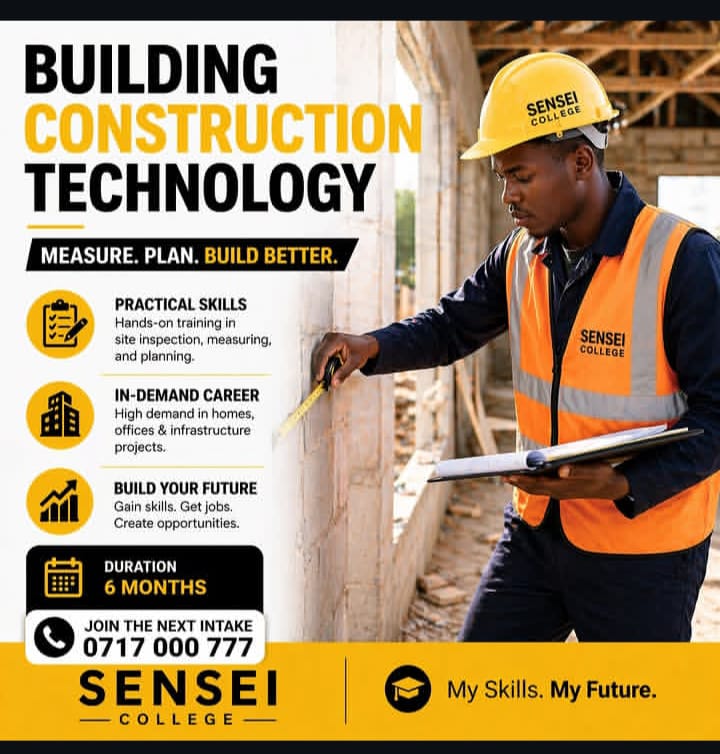
Construction is more than just putting bricks together; it requires technical knowledge, precision, and practical skills. Building and Construction Technology training focuses on hands-on learning, equipping students with the ability to work on real projects, use tools effectively, and understand modern construction techniques. It’s the perfect starting point for anyone who prefers learning by doing.
In this article, we will explore the key concepts behind Building and Construction Technology, from the fundamental principles of construction to the practical skills required on-site.
What is Building Construction Technology?
Building Construction Technology is a technical course that teaches students the practical and theoretical skills needed to plan, build, and maintain structures.
Topics covered in Building and Construction
- Masonry – The art of building with bricks, blocks, and stones. Students learn how to lay foundations, build walls, and construct structures that are strong and durable.
- Carpentry and Joinery – Working with wood to make doors, windows, roofing frameworks, and furniture fittings.
- Site Safety – Learning how to work safely on a construction site, use protective equipment, and follow safety regulations to prevent accidents.
- Drawing Interpretation – Reading and understanding architectural and engineering drawings (blueprints), so students can follow construction plans accurately.
- Concrete Technology – Understanding how to mix, pour, and cure concrete correctly.
- Plumbing and Drainage Basics – Introduction to water systems and drainage in buildings.
- Surveying and Setting Out – Learning how to mark out where a building will stand before construction begins.
Technical courses at Sensei College are designed to support both beginners and experienced learners, offering practical skills for career growth.
Why Choose Sensei College for Construction Courses?
1. Hands-On Construction Training
At Sensei College, learning does not happen only in a classroom. The college places a strong emphasis on hands-on construction training; students spend significant time on actual construction projects and practical exercises. You will handle real tools, mix real cement, and build real structures, giving you confidence before you even set foot on a professional job site.
2. Industry-Relevant Curriculum
The courses at Sensei College are designed with the Kenyan construction industry in mind. The syllabus aligns with standards set by the Kenya National Examinations Council (KNEC) and the National Industrial Training Authority (NITA), ensuring that what you learn is recognized and valued by employers across the country.
3. Certification and Employability
Upon successful completion of your course, you will receive a recognized certificate that opens doors in both formal employment and self-employment. Employers trust Sensei College graduates because they know the training is rigorous, practical, and up-to-date.
4. Supportive Learning Environment
Whether you are fresh out of secondary school or making a career change in your 30s, Sensei College provides a supportive and inclusive environment where every student is given the tools to succeed.
Courses Offered Under Building Construction Technology
Sensei College offers Building Construction Technology courses at different levels to suit students with varying academic backgrounds and career goals.
Artisan Level Courses
Artisan courses are entry-level programs ideal for beginners. These courses are shorter in duration and focus on teaching a specific construction skill to a high standard. Examples include:
- Artisan in Masonry – Brick and block laying, plastering, and tiling.
- Artisan in Carpentry – Basic woodwork, roofing, and formwork.
- Artisan in Painting and Decorating – Surface preparation and finishing.
These artisan and craft courses in construction are perfect for those who want to quickly acquire a marketable skill and enter the workforce.
Craft Level Courses
Craft courses are a step higher than artisan level. They cover a broader range of skills and include more technical content, such as drawing interpretation and basic project supervision. A Craft Certificate in Building Construction Technology is highly respected by contractors and construction companies.
Specialized Short Courses
Sensei College also offers short courses for those looking to upskill or specialize in a particular area, such as:
- Tiling and Waterproofing
- Scaffolding and Formwork
- Construction Site Safety (OSHA)
- Quantity Surveying Basics
These short courses can be completed in a matter of weeks and are ideal for working professionals who want to add new skills to their CV.
Entry Requirements
One of the best things about Sensei College construction courses is that they are accessible to a wide range of people. The building and construction course requirements vary by level:
-
Artisan Level:
- Kenya Certificate of Primary Education (KCPE) or equivalent
- No prior construction experience required
- Minimum age: 16 years
-
Craft Level:
- Kenya Certificate of Secondary Education (KCSE) – typically a D plain or above
- Some programs may require passes in Mathematics or Science subjects
- Prior artisan training is an added advantage, but not always mandatory
Who Can Apply?
- School leavers looking for a practical and affordable path to employment
- Career changers who want to switch from informal or unrelated work into the construction industry
- Entrepreneurs who want to start their own construction business
- Casual construction workers who want to formalize and upgrade their skills with a recognized certificate
Skills You Will Gain
By the time you complete your course, you will have developed a toolkit of skills that employers in the construction industry are actively looking for:
1). Practical Construction Skills
You will know how to lay foundations, build walls, install roofing, mix and pour concrete, and carry out finishing works like plastering and tiling. These are skills you can use from day one on the job.
2). Safety Practices
Construction sites can be dangerous if workers are not properly trained. At Sensei College, safety is taken seriously. You will learn how to identify hazards, use Personal Protective Equipment (PPE), and follow safety procedures that protect both you and your colleagues.
3). Use of Tools and Equipment
From trowels and spirit levels to power tools and scaffolding, you will become comfortable using the equipment of the trade. Knowing how to handle tools correctly makes you faster, safer, and more professional.
4). Teamwork and Problem-Solving
Construction is a team effort. You will learn how to work alongside other tradespeople, communicate effectively on a site, and think on your feet when challenges arise.
Career Opportunities for Building and Construction
- Construction Worker/Artisan – Work for a contractor or construction company as a skilled tradesperson in masonry, carpentry, or another speciality.
- Site Supervisor/Foreman – With experience and further training, progress to supervising teams of workers and managing daily site operations.
- Building Contractor – Start your own contracting business, bidding for and executing construction projects independently.
- Self-Employed Tradesperson – Offer your skills directly to homeowners, landlords, and developers as a freelance mason, carpenter, or painter.
- Quantity Surveyor Assistant – Support quantity surveyors in estimating material costs and quantities.
- Building Inspector – With additional qualifications, work with local authorities to inspect buildings for compliance with safety and building codes.
Many Sensei College graduates have gone on to build thriving businesses of their own, creating employment for others in their communities.
Benefits of Studying Construction in Kenya
-
A Growing Infrastructure Pipeline
The Kenyan government, through initiatives like the Affordable Housing Programme and ongoing road and railway projects, is investing billions of shillings in infrastructure. This creates consistent demand for trained construction workers across the country, not just in Nairobi, but in Mombasa, Kisumu, Eldoret, Nakuru, and beyond.
-
High Demand for Skilled Workers
One of the biggest challenges facing Kenya’s construction industry is a shortage of qualified, skilled workers. Many construction projects struggle to find reliable, well-trained artisans. This means that graduates of construction skills training in Kenya programs are highly sought after and can command better wages than untrained workers.
-
Affordable Training with High Returns
Technical and vocational training at institutions like Sensei College is more affordable than university education and it delivers practical, immediately employable skills. The return on investment is high: you spend less time and money training, and you get to work sooner.
How to Succeed as a Construction Student
- Show Up and Practice – Construction is learned through repetition. The more time you spend doing practical work, the faster your skills improve. Never skip practical sessions.
- Take Safety Seriously – Always wear your PPE and follow site safety rules. A good safety record makes you a more attractive employee.
- Ask Questions – Do not be afraid to ask your instructors when you do not understand something. Construction has many technical terms, and it is better to ask than to guess.
- Observe Experienced Workers – Pay attention to how skilled tradespeople do their work. You will pick up techniques and tricks that textbooks do not always teach.
- Keep Learning – The construction industry is always evolving. New materials, new techniques, and new regulations are introduced regularly. Stay curious and keep upgrading your knowledge even after graduation.
- Build a Network – Get to know your classmates, instructors, and industry contacts. Many job opportunities in come through word of mouth and personal connections.
Conclusion
The construction industry is one of the most exciting, stable, and rewarding sectors you can enter in Kenya today. Whether you dream of building your own home, supervising major projects, or running your own contracting business, it all begins with the right training.
Sensei College’s Building Construction Technology courses give you exactly that: practical, hands-on skills, recognized certification, and a clear pathway to a successful construction career. From artisan and craft level programs to specialized short courses, there is a program for every background and every ambition.