
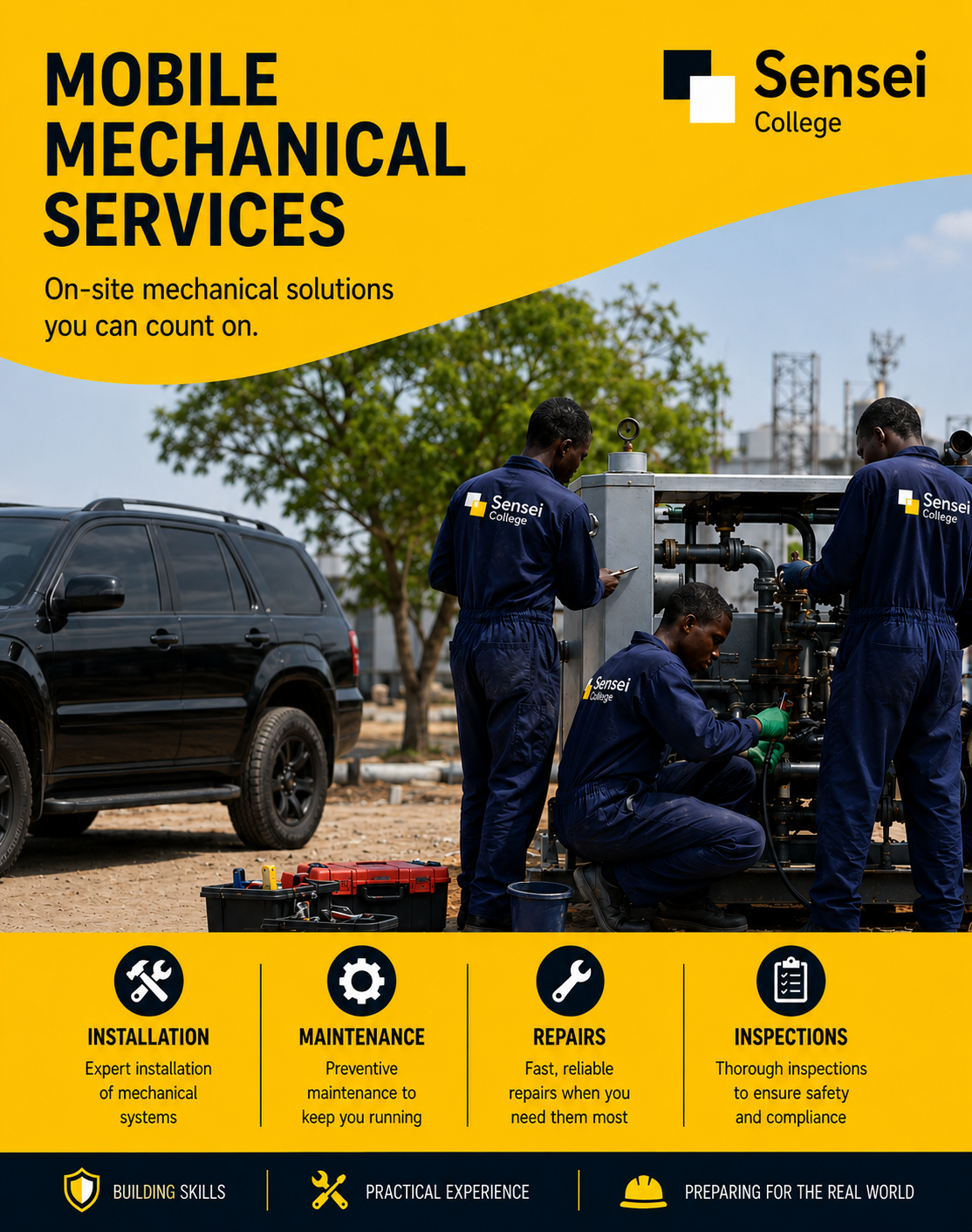
When your vehicle breaks down, the last thing you want is the stress of towing it to a garage. Our mobile mechanic service brings professional, reliable, and affordable vehicle repairs directly to your location: whether you’re at home, at work, or stranded on the roadside.
With hands-on experience in diagnosing and fixing a wide range of mechanical issues, we save you time, money, and inconvenience. From routine servicing and engine diagnostics to emergency repairs, we are committed to getting you back on the road quickly and safely.
This article explores what you need to know about Mobile mechanics as a business.
What Is a Mobile Mechanic Business?
A mobile mechanic is an automotive technician who travels to clients instead of waiting for clients to come to a fixed workshop. You operate from your vehicle, a motorbike, tuk-tuk, or pickup carrying your tools and spare parts to wherever the customer is.
You can offer services at homes, offices, parking lots, highways, and estates. Your ‘workshop’ is wherever the car is parked.
Why Start a Mobile Mechanic Business in Kenya
- Kenya has over 2 million registered motor vehicles, and the number grows every year
- Most car owners dread towing fees and long waits at the garage
- The gig economy and app-based platforms make it easier to find clients
- Fuel prices and traffic mean people prefer services that come to them
- Low startup costs compared to opening a physical garage
- You can earn KES 50,000–150,000 per month once established
Guide to Starting Your Mobile Mechanic Business
-
Get the Right Training and Certification
Before anything else, build your skills. Enroll in a recognized automotive course at institutions like Sensei College or any accredited TVET college near you.
- Courses to consider: Certificate in Motor Vehicle Mechanics, Automotive Electrical Systems, Diesel Engine Technology
- Duration: 3 months to 2 years, depending on the level
- After training, get certified by the National Industrial Training Authority (NITA), which boosts client trust
- Also consider basic first aid training since you’ll often be alone on roadsides
-
Gather Your Essential Tools
You don’t need every tool in the world on day one. Start with a professional starter kit:
- Socket set (metric and imperial) – KES 3,500–8,000
- Combination spanners set – KES 2,000–4,000
- Screwdrivers (flat and Phillips) – KES 800–1,500
- Torque wrench – KES 2,500–5,000
- Hydraulic floor jack + jack stands – KES 5,000–10,000
- OBD2 diagnostic scanner – KES 3,000–8,000
- Jump starter/battery pack – KES 4,000–7,000
- Tyre pressure gauge – KES 500–1,000
- Multimeter (electrical testing) – KES 1,500–3,000
- Tool bag or rolling chest – KES 2,000–5,000
Total estimated starter kit cost: KES 25,000–52,000. Buy quality second-hand tools first, then upgrade as income grows.
-
Register Your Business
- Register a business name at the Registrar of Companies (eCitizen) – KES 950
- Get a Single Business Permit from your county government – KES 2,000–5,000/year
- Open a business bank account: Cooperative Bank, Equity, or KCB have good SME accounts
- Register for KRA PIN and file taxes – it’s a legal requirement
- Consider Public Liability Insurance – protects you if something goes wrong during a repair
-
Set Your Prices
Pricing fairly is key to winning customers. Research what local garages charge, then price 10–20% lower since you have no rent overhead. Sample rates:
- Oil change (labour only): KES 500–800
- Brake pad replacement (per axle): KES 800–1,500
- Battery replacement (labour): KES 300–500
- Alternator replacement (labour): KES 1,000–2,000
- Diagnostic scan: KES 500–1,000
- Emergency call-out fee (nights/weekends): add KES 500–1,000
Always quote before you start. Never surprise the customer with extra charges.
-
Market Your Business
- Create a free Google Business Profile – appear in local searches like ‘mechanic near me Nairobi’
- Join WhatsApp groups in your area (estates, matatu saccos, boda boda groups)
- Create a simple Facebook page with before-and-after repair photos
- Print 500 business cards and flyers – cost around KES 1,500 at any print shop
- List on platforms like Jiji, PigiaMe, or BebaBeba for service providers
Ask satisfied customers for referrals – word of mouth is gold in Kenya
Build a Loyal Client Base
Repeat business is where the real money is. Here’s how to keep customers coming back:
- Send reminder messages when their service is due (‘Your oil change is due in 2 weeks, book now!’)
- Keep a simple Excel or Google Sheets record of every vehicle and service history
- Be punctual, Kenyans value time more and more
- Follow up after every repair to confirm the customer is satisfied
- Offer a small loyalty discount after 5 services
Challenges and How to Overcome Them
- Bad weather: Invest in a portable canopy/tent – KES 3,000–6,000
- Parts availability: Partner with a spare parts dealer who gives you credit
- Customer distrust: Build trust through NITA certification and online reviews
- Complex repairs you can’t do: Build a referral network with specialist garages
- Slow months: Offer discounts, add services like tyre changing or car wash referrals
Tips for Beginners
- Start with one area or estate and dominate it before expanding
- Always carry a liability waiver for customers to sign before major repairs
- Specialize first, e.g., Japanese cars, SUVs, or diesel engines, then diversify
- Invest in continuing education: new car models require new knowledge
- Never buy fake spare parts; your reputation is your business
Frequently Asked Questions
1. How much capital do I need to start?
A realistic budget is KES 40,000–80,000 for tools, registration, and marketing. You can start even as a learner if you already own some tools.
2. Do I need a vehicle to operate?
A motorbike works for smaller jobs. For heavy equipment and parts, a pickup truck or van is ideal. Start with what you have and upgrade.
3. Can I get financing for tools?
Yes. YEDF (Youth Enterprise Development Fund), Women Enterprise Fund, and Uwezo Fund offer low-interest loans for youth starting businesses. Equity Bank and KCB also have SME loan products.
4. What about competition from roadside jua kali mechanics?
Your advantage is professionalism, certification, receipts, diagnosis equipment, and reliability. Charge a premium for that standard.
Conclusion
The mobile mechanic business is one of Kenya’s most underrated opportunities. With a growing vehicle population, urban congestion, and a demand for convenience, the market is wide open. You don’t need a physical garage or massive capital; you need skills and the right tools.
Start small, stay consistent, and let your reputation do the selling. Your garage-on-wheels could be the foundation of a multi-technician enterprise in just a few years.