
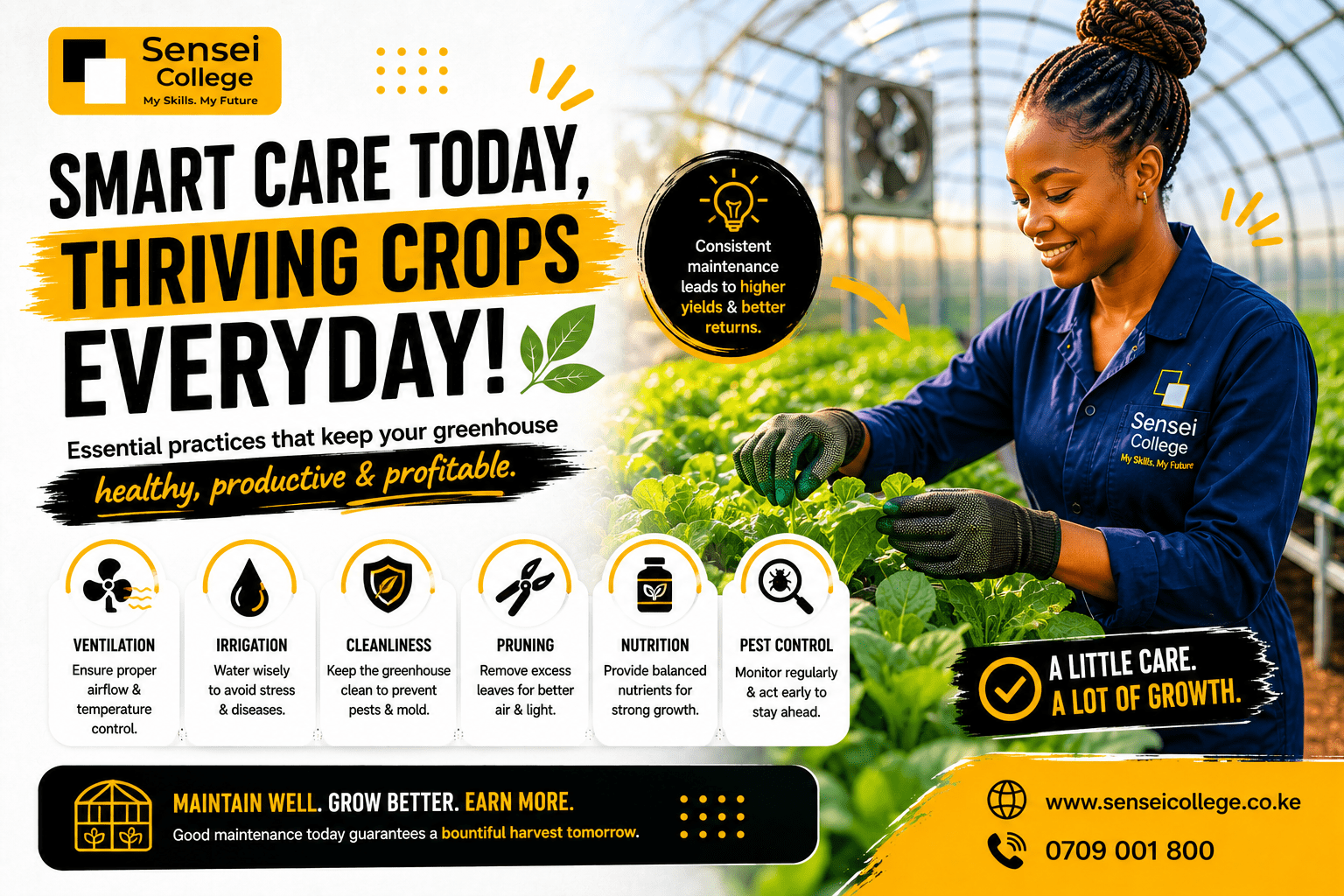
Kenya’s greenhouse farming industry has grown over the past decade. With an increase in greenhouses, a serious shortage of trained maintenance technicians.
Farmers know how to plant and sell. But the specialised skills needed to keep a greenhouse running at peak performance: maintaining drip irrigation systems, repairing polythene covers, managing ventilation, calibrating fertigation equipment, and controlling climate are skills that take formal training to master.
This article covers everything you need to know about the course.
Why Greenhouse Maintenance Skills Matter in 2026
- To keep irrigation and fertigation systems running efficiently
- To identify and fix structural problems before they become disasters
- To monitor and adjust climate conditions for optimal crop performance
- To implement and manage Integrated Pest Management (IPM) protocols
- Train farm workers on correct greenhouse operating procedures
Greenhouse Maintenance at Sensei College
The Sensei College Greenhouse Maintenance Course is a structured, competency-based vocational programme designed to equip students with the full range of technical skills needed to work in modern greenhouse operations.
The course blends classroom instruction with extensive practical training, ensuring graduates are confident and job-ready from the moment they complete the programme.
| Detail | Information |
| Course Name | Certificate in Greenhouse Maintenance |
| Level | Vocational Certificate |
| Duration | 3 Months |
| Mode of Study | Full-time (with weekend options available) |
| Language | English and Kiswahili |
| Certification | Sensei College Certificate of Completion |
| Practical Component | 40% classroom / 60% practical |
| Intake | January, May, September (three intakes per year) |
Who Can Enroll?
This course is designed to be accessible. You do not need a degree or advanced academic qualifications to join.
The Course is ideal for:
- Smallholder farmers who own or manage a greenhouse and want to reduce dependency on external technicians
- Farm workers and supervisors looking to formalise and upgrade their skills
- Recent secondary school graduates who want a practical, fast-track route into agricultural employment
- Agronomists and extension officers who want to add greenhouse technology to their service offering
- Entrepreneurs planning to start a greenhouse installation or maintenance business
- NGO and development programme staff working in agricultural projects
- Anyone curious about smart farming and looking for a practical, marketable skill
Entry Requirements
Sensei College has kept entry requirements accessible to ensure this course reaches the people who need it most.
| Requirement | Details |
| Minimum education | Kenya Certificate of Secondary Education (KCSE) Grade D+ or above |
| Age | 18 years and above |
| Language | Basic English literacy |
| Prior agriculture experience | Not required (but beneficial) |
| Documents needed | KCSE certificate or equivalent, national ID/passport, passport photo |
Students who do not meet the minimum KCSE requirement but can demonstrate practical farming experience may apply for consideration on a case-by-case basis.
Sensei College is committed to keeping vocational training affordable. The Greenhouse Maintenance Course is priced competitively for the quality of instruction offered.
Flexible Payment Option: Students may pay in two instalments, KES 12,000 on registration and KES 13,000 midway through the course. Contact the admissions office for details.
Group Discount: Farmer groups, cooperatives, and NGO-sponsored students enrolling five or more participants qualify for a 10–15% group discount.
Course Duration and Schedule
The full course runs for three months (12 weeks). Classes are held five days a week for full-time students.
A weekend cohort option is available for working farmers and professionals who cannot attend weekday classes. Weekend cohorts run over five months (Saturday and Sunday sessions).
The Greenhouse Maintenance Course is divided into modules that combine theory sessions with hands-on practical work.
Tools and Equipment Students Learn to Use
Graduates of the Sensei College Greenhouse Maintenance Course are trained on the industry-standard tools used daily in professional greenhouse operations:
| Tool/Equipment | Application |
| Tensiometer | Soil moisture measurement |
| EC meter/pH meter | Water and nutrient solution testing |
| Sprayer (knapsack and motorised) | Pesticide and foliar application |
| Pipe cutter and fittings | Irrigation repair and installation |
| Polythene tensioning tools | Cover installation and repair |
| Wire strainer and tensioner | Crop support system setup |
| Digital thermometer/hygrometer | Climate monitoring |
| Scouting magnifier (hand lens) | Pest identification |
| Spray calibration equipment | Ensuring correct chemical dosage |
| Safety PPE (goggles, gloves, overalls) | Safe chemical handling |
Certification and Recognition
Upon successful completion of all modules and the practical assessment, students receive a Sensei College Certificate in Greenhouse Maintenance.
The certificate is accompanied by a detailed transcript listing all modules completed and competency assessments passed. This documentation is recognised by employers in Kenya’s horticultural and agribusiness sector.
Sensei College is in active engagement with the Kenya National Qualifications Authority (KNQA) for formal accreditation of its vocational programmes, which will further enhance the national recognition of the certificate.
Career Opportunities
| Role | Typical Employer | Estimated Monthly Salary (KES) |
| Greenhouse Technician | Commercial flower/veg farms | 25,000 – 45,000 |
| Irrigation Technician | Irrigation companies, farms | 22,000 – 40,000 |
| Farm Supervisor | Horticulture exporters | 35,000 – 60,000 |
| Agri-Input Sales Representative | Input companies | 28,000 – 50,000 |
| Greenhouse Maintenance Officer | NGO/development projects | 30,000 – 55,000 |
| Extension Services Technician | County governments, NGOs | 25,000 – 45,000 |
Self-Employment Opportunities
- Greenhouse Installation and Maintenance Business – Offer end-to-end greenhouse setup and maintenance contracts to smallholder farmers and commercial operations. A technician serving 20 clients at KES 5,000–10,000 per month per client earns KES 100,000–200,000 monthly.
- Irrigation System Installation and Repair – There is extremely high demand for skilled drip irrigation technicians, particularly in peri-urban and rural farming areas. Many farmers own broken systems that they cannot repair.
- Greenhouse Consultancy – Advise farmers on greenhouse crop management, disease control, and system optimisation. Charging KES 3,000–10,000 per consultation visit is realistic for experienced practitioners.
- Agri-Input Supply – Combine your technical knowledge with a small agro-vet or input shop, stocking polythene, irrigation fittings, pesticides, and fertilisers alongside advisory services.
- Training and Demonstrations Experienced graduates can offer paid greenhouse management training to farmer groups, cooperatives, and NGO-funded programmes.
Importance of Greenhouse Maintenance
- Export market growth: Kenya’s horticultural exports, particularly roses, French beans, and avocados, continue to grow. Export farms are scaling up greenhouse capacity, creating demand for skilled maintenance staff.
- Smallholder greenhouse adoption: County governments and NGOs are funding tens of thousands of small greenhouses for rural farmers. Most of these farmers lack technical maintenance knowledge and are eager to hire or consult trained technicians.
- Smart farming technologies: Automated irrigation controllers, climate sensors, and fertigation systems are becoming more common even on medium-scale farms, creating demand for technicians who understand these systems.
- Youth and unemployment dynamics: Kenya has one of the youngest populations in the world, with over one million young people entering the workforce each year. Vocational agriculture skills offer a realistic, relatively fast, and dignified route into employment or self-employment.
- Climate adaptation: As open-field farming becomes less reliable due to rainfall variability, more farmers are turning to protected agriculture. Every new greenhouse is a potential maintenance contract.
Common Questions
1. Do I need any prior farming experience to join?
No. The course starts from the fundamentals. Previous farming experience is helpful but not required. Many of our successful graduates had no formal farming background when they enrolled.
2. Is the course available online?
Currently, the course is offered in-person due to its heavy practical component. Sensei College is developing a hybrid option for certain theoretical modules. Contact admissions for the latest update.
3. What is the minimum age to enroll?
18 years. There is no maximum age; the course regularly attracts farmers in their 30s, 40s, and 50s.
4. Will I get a job after completing the course?
Sensei College does not guarantee employment, but the college actively connects graduates with partner farms and employers. Many graduates secure employment or start their own maintenance businesses within three months of completing the course.
5. Can the fees be paid in instalments?
Yes. A two-instalment payment plan is available. See the fees section above for details, or contact the admissions office.
6. Is there a hostel or accommodation available?
Contact the college directly for current accommodation options. Many students from upcountry counties arrange shared accommodation near the campus.
7. Can farmer groups enroll together?
Absolutely, and they receive a group discount of 10–15%. Several cooperatives and NGO-sponsored groups have enrolled cohorts together.
8. Is the certificate recognised by the government?
Sensei College is in active discussions with the Kenya National Qualifications Authority (KNQA) for formal accreditation. The certificate is currently recognised by employers in the private horticultural sector. Check with admissions for the latest accreditation status.
9. How do I register?
Visit the Sensei College admissions office, call the admissions line, or register via the college website. Early registration is encouraged as cohort sizes are limited to maintain practical training quality.
Conclusion
Greenhouse maintenance technicians urgently and in large numbers. The farms are built. The polythene is going up. The irrigation lines are being laid. What is missing is the skilled, trained human workforce to keep it all running properly.
The Sensei College Greenhouse Maintenance Course gives you that skill set in just three months, at an affordable cost, with a curriculum built for real jobs and real enterprises.