
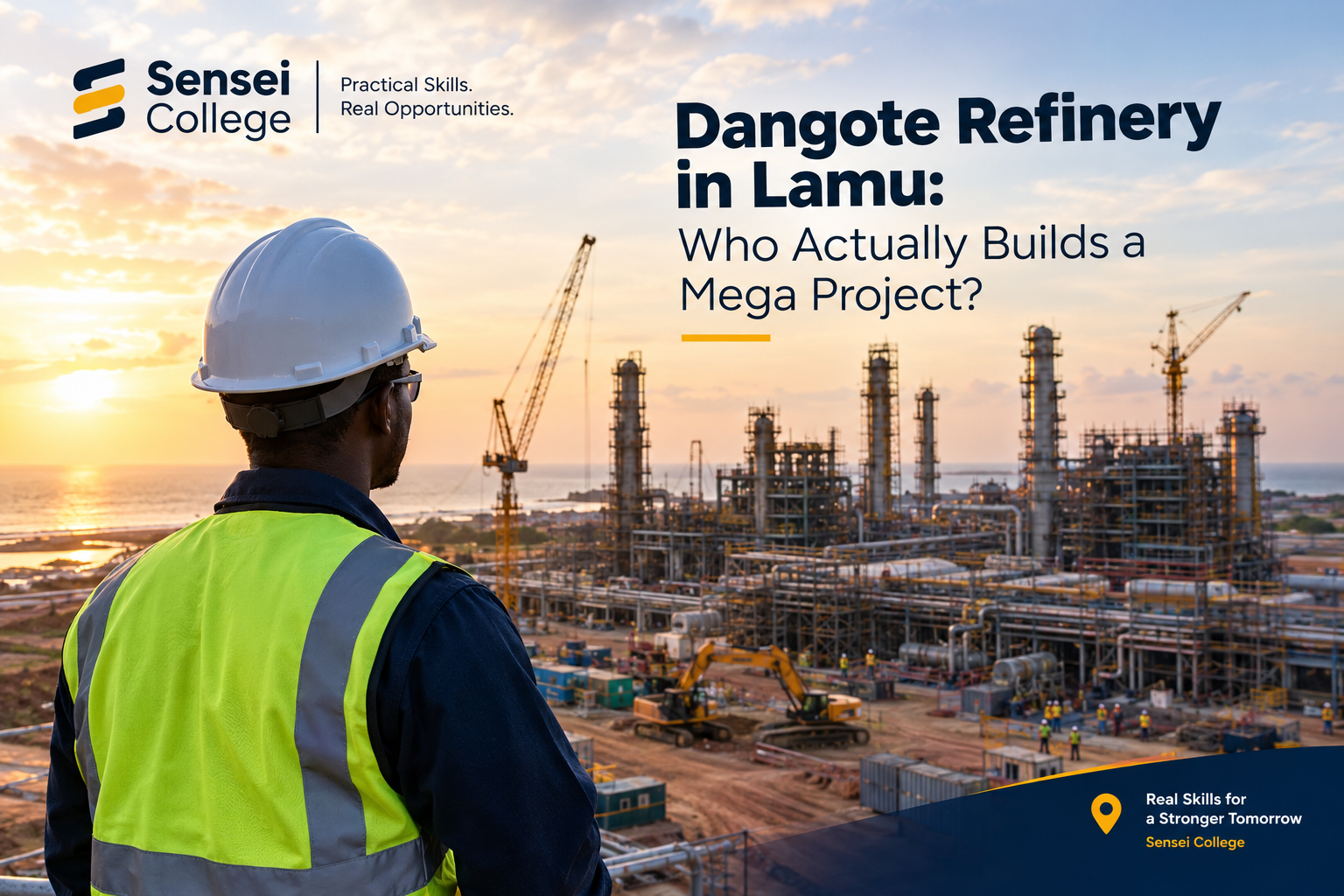
You have probably heard about the Dangote refinery being built in Lamu. You may even have seen pictures of the huge machines on site. But here is an interesting question:
Who actually builds something that big?
The planned Dangote East Africa Refinery is a major industrial development expected to process up to 700,000 barrels of oil per day. Construction began in September 2026, and the project has been associated with an estimated 60,000 jobs as it develops. But those jobs will not all look the same.
Before a Refinery, There Is a Construction Site
Long before the first barrel of oil is processed, there is earth to move, concrete to pour, equipment to install and infrastructure to build. That means you may find people working in areas such as:
Plant operation — operating excavators, graders, bulldozers, loaders, rollers and cranes.
Construction plant mechanics — maintaining and repairing heavy equipment.
Electrical work — helping install and maintain power and electrical systems.
Welding and fabrication — joining and fabricating metal components.
Construction — working on concrete, masonry, drainage, roads and structures.
Driving and logistics — moving workers, materials and equipment.
Technical installations — supporting communication, security and other systems.
The refinery itself is therefore only one part of the story. The bigger story is about the skills required to build and maintain industry.
Look Around Kenya
You do not need to wait for a US$16 billion refinery to see these skills being used. Every new road needs people. Every housing development needs people. Every factory needs people. Every fleet of vehicles requires maintenance. Every construction project uses equipment. Every building requires electrical systems. Every business eventually needs repairs, maintenance and technical support.
This is why learning a practical skill should not be about preparing for one particular employer. A good skill should be useful in many different places.
So What Makes a Skill Valuable?
A useful question for a young person is:
“What problem can I learn to solve?”
Can you safely operate an excavator? Can you repair a faulty machine? Can you install electrical wiring correctly? Can you weld and fabricate? Can you construct something accurately? Can you professionally operate a vehicle?
The more confidently you can answer, “Yes, I know how to do that,” the more useful your skill becomes. Of course, training is only the beginning. Experience, discipline, safety, professionalism and continuing to learn also matter.
Where Are Things Heading?
The Lamu refinery is expected to take several years to develop, with a possible commissioning around 2030. Across Kenya, development is also happening in construction, transport, energy, manufacturing, housing and technology.
No one can guarantee exactly where your future job will come from. But you can prepare yourself with skills that are useful across growing industries. That is a much stronger career strategy than waiting until you see a job advertisement and then asking what qualification you need.
A Career Tip for Young People
If you have just finished Form 4 and are deciding what to study, try this simple exercise. Look at five things you enjoy doing. Then look at five industries that interest you. Where do they meet?
If you love machines and construction, explore Plant Operator or Road Construction training. If you love understanding how things work, explore Construction Plant Mechanics or Vehicle Mechanics. If electricity fascinates you, consider Electrical Installation. If you enjoy making and building things, consider Welding and Construction courses.
At Sensei College, these and other practical technical courses are available at our Nakuru and Nairobi–Kitengela campuses.
Projects will come and go. Technology will change. Employers will change. But knowing how to do something useful, safely and professionally will always matter.
What skill are you building for your future?
Sensei College — My Skills. My Future.