
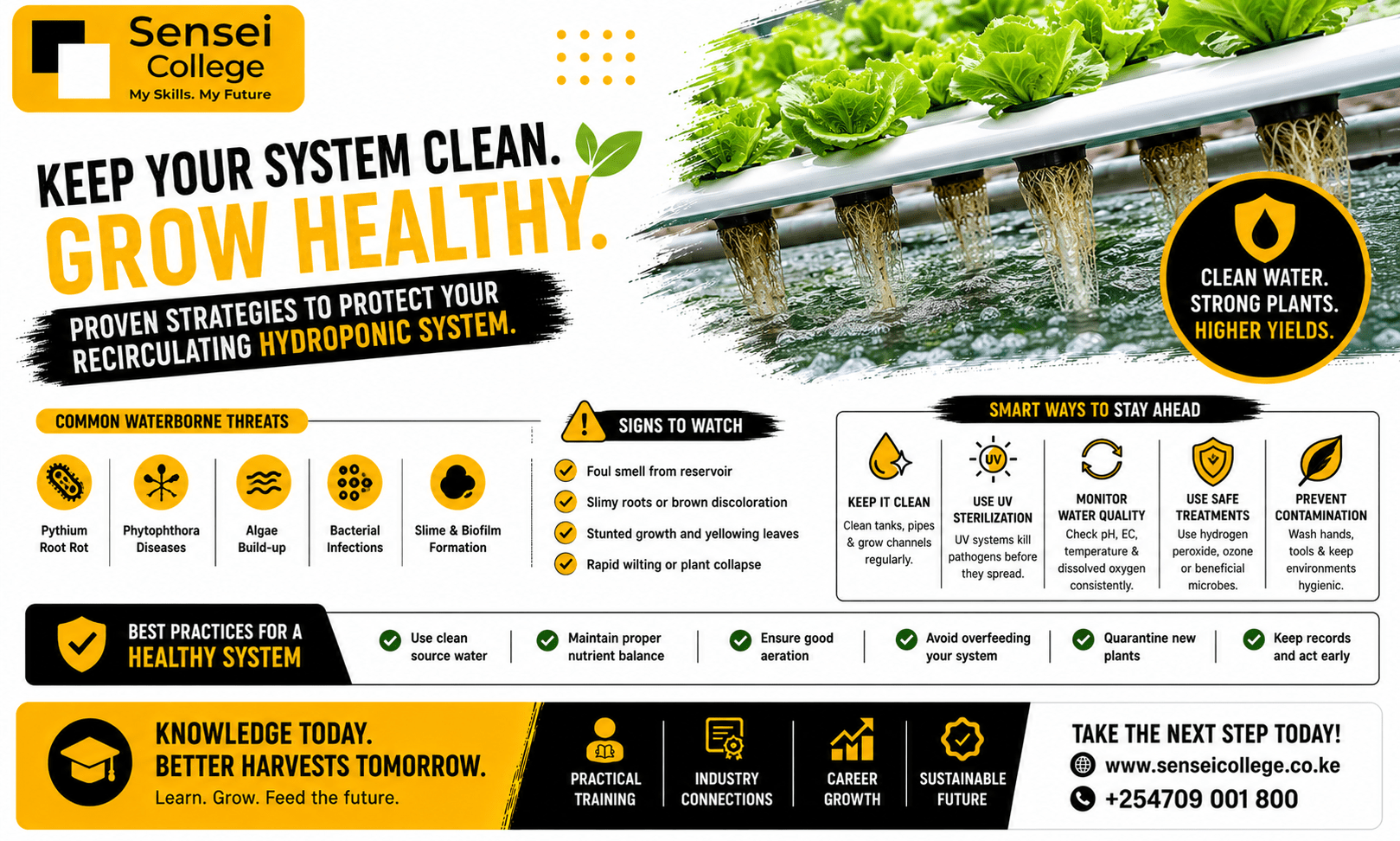
A recirculating hydroponic system is an elegant machine. Nutrient-rich water flows to your plant roots, drains back, and cycles through again, conserving water, nutrients, and labour. But this loop creates a serious vulnerability: if a waterborne pathogen enters your system, it travels everywhere, to every plant, within hours.
Waterborne diseases are the leading cause of catastrophic crop losses in hydroponic farming globally. Unlike soil farming, where diseases are often localised, hydroponics creates a superhighway for pathogens.
This guide explains what you are dealing with, how to stop it, and what to do if your system is already infected.
Common Waterborne Pathogens in Hydroponics
Pythium Species – Water Mould
Pythium is the most destructive waterborne pathogen in hydroponics worldwide. Despite its name, it is not actually a fungus; it is an oomycete, or “water mould.” It thrives in warm, poorly oxygenated water. In Kenya, Pythium outbreaks are most common during the hot, humid months of March to May and October to November.
Signs: Roots turn brown, slimy, and mushy. The plant wilts during the day despite adequate water. A distinctive musty, foul odour develops from the reservoir.
Fusarium oxysporum – Fungal Wilt
Fusarium is a soil fungus that can survive in water and growing media. It blocks a plant’s vascular system, preventing water uptake even when roots appear healthy. Most devastating in tomatoes, lettuce, and basil.
Signs: One side of a plant wilts while the other stays green. Brown streaking is visible when you cut the stem. Yellowing starts from the lower leaves and progresses upward.
Phytophthora Species
Related to Pythium but often more virulent. Phytophthora causes crown and root rot in a wide range of crops. It spreads via zoospores that swim through water at remarkable speeds, making recirculating systems particularly vulnerable.
Signs: Sudden wilting of entire plants. Dark, water-soaked lesions at the base of stems. Roots that disintegrate when touched.
Bacterial Pathogens – Pseudomonas, Erwinia
Bacterial pathogens are less common in pure hydroponic systems but can enter via contaminated water sources, infected tools, or insects. They cause soft rots, leaf spots, and sudden plant collapse.
How Contamination Happens in Hydroponic Systems
-
Source Water Contamination
Many Kenyan farms rely on borehole water, river water, or harvested rainwater. These sources frequently carry naturally occurring Pythium and Phytophthora spores. Even municipal water can carry bacteria if pipes are old or if there is distribution contamination. Never assume your water source is clean; always treat it.
-
Infected Planting Material
Purchasing seedlings from unvetted sources is one of the most common entry routes. A single infected seedling introduces pathogens directly into your nutrient solution. Only buy from reputable nurseries or raise your own seedlings in a separate, sterilized seedling area.
-
Tools and Equipment
Scissors, grafting knives, net cups moved between plants, and gloves worn in soil, then used in the hydroponic system, are all contamination vectors. Establish a strict tool sanitation protocol.
-
Insects and Animals
Birds, insects, rodents, and even workers who have been in soil environments can carry spores into a greenhouse. Greenhouse hygiene and access control matter significantly.
-
Dead Plant Material
Dead roots, fallen leaves, and decaying organic matter in the reservoir are a feeding ground for pathogens. Any organic breakdown in your system is a risk. Clean the reservoir after every crop cycle without exception.
Signs Your System Is Infected
- Isolated plant wilting during the warmest part of the day, even with full nutrient flow
- Roots changing from white or cream to tan, brown, or black
- Roots developing a slimy or mushy texture; healthy roots are firm and white
- A musty, earthy, or foul odour from your reservoir or channels
- Small, brown, water-soaked lesions at the base of plant stems
- Yellowing of leaves starting from the base of the plant and progressing upward
- Multiple plants in the same channel are showing symptoms simultaneously
Prevention Strategies
Water Sterilization Methods
- Chlorination: Adding sodium hypochlorite (to your water source at 2 to 4 ppm (parts per million) kills most bacteria and many spores. Use a dosing pump for consistency. Let chlorinated water stand for 30 minutes, then allow it to off-gas by aerating or by adding sodium thiosulfate to neutralize residual chlorine before it reaches your plants.
- Hydrogen Peroxide (H₂O₂): Food-grade 3% hydrogen peroxide can be added at 3 ml per litre of nutrient solution. It breaks down into water and oxygen, safe for plants and beneficial microbes if used correctly. Particularly effective against Pythium and Phytophthora. Available in Kenya from chemical suppliers and some pharmacies.
- UV Sterilization: A UV sterilization unit installed in your recirculating line destroys pathogens as water passes through ultraviolet light. UV sterilization is the gold standard for professional hydroponic operations.
System Hygiene Practices
- Between crop cycles, drain all water from the system completely
- Scrub all channels, pipes, and the reservoir with a brush and diluted bleach solution.
- Rinse thoroughly with clean water, then flush with a hydrogen peroxide solution
- Leave the system to dry completely in sunlight before refilling. UV light and desiccation kill most pathogens
- Never allow standing water in any part of the system between uses
- Replace any net cups, foam plugs, or growing media that show discolouration or odour
Filtration Techniques
- Install a sediment pre-filter (50 micron) on your water intake to remove particulate matter that harbours pathogens
- For reservoir protection, a fine mesh screen (200 micron) on the reservoir inlet prevents insects and debris from entering
- Consider a carbon filter if using chlorinated municipal water, it removes residual chlorine before the nutrient solution
Treatment Options if Infection Occurs
Step 1 – Isolate and remove: Remove infected plants immediately. Place them in sealed bags. Do not compost them; destroy or bury them away from the farm. Check plants in the same channel; they are likely already exposed.
Step 2 – Drain and flush: Drain the entire reservoir. Do not leave infected water to continue recirculating. Flush the system with clean water until it runs clear.
Step 3 – Apply hydrogen peroxide treatment: Mix 30 ml of 3% food-grade hydrogen peroxide per 10 litres of water. Run this through the entire system for 30 minutes. This kills most Pythium zoospores in the channels and pipes. Drain and flush again with clean water before refilling.
Step 4 – Restart with treated water: Refill with fresh, pH-adjusted, sterilized nutrient solution. Monitor surviving plants daily for the following week.
Step 5 – Identify the source: Where did the infection come from? Check your water source, your seedlings, and your most recent inputs. Fix the entry point before your next crop, otherwise, the same outbreak will recur.
Advanced Practices for Disease-Free Systems
UV Filtration
A UV sterilizer passes water through a chamber containing a UV-C light (254 nanometres wavelength). This wavelength disrupts the DNA of microorganisms, rendering them unable to reproduce. It is effective against Pythium, Phytophthora, Fusarium, and most bacteria.
For Kenyan farms, UV units sized for flow rates of 1,000 to 3,000 litres per hour are available through agricultural suppliers and online platforms for KES 15,000 to 60,000, depending on capacity. The investment pays for itself quickly in avoided crop losses.
Important: UV sterilizers work only on clear water. Turbid or coloured water blocks UV penetration. Always use a sediment pre-filter before your UV unit.
Beneficial Microbes as a Defence Layer
Not all microbes are harmful. Beneficial bacteria such as Bacillus subtilis and Trichoderma harzianum compete with and suppress Pythium and Fusarium. These are sold as biological inoculants under brand names such as Serenade and Trichodex.
Adding beneficial microbes to your reservoir creates a biological defence layer. They colonise root surfaces, producing antifungal compounds and competing for the same ecological niche as pathogens.
Do not use beneficial microbes and hydrogen peroxide at the same time; the H₂O₂ will kill both harmful and beneficial organisms. Choose one approach or alternate them on a scheduled basis.
Environmental Monitoring Systems
Advanced Kenyan hydroponic farms are increasingly deploying low-cost sensors to monitor conditions that promote pathogen growth:
- Dissolved oxygen (DO) sensors: Pythium thrives in poorly oxygenated water. Maintaining DO above 6 mg/L inhibits its growth. Submersible air stones and high-flow pumps raise dissolved oxygen levels.
- Temperature monitoring: Pythium growth accelerates above 24°C water temperature. In hot Kenyan months, insulate your reservoir, paint it white, bury it partially, or shade it to keep water temperature in the safe range.
- pH drift alerts: Rapid, unexpected pH shifts sometimes indicate microbial activity in the reservoir. Automated pH loggers can alert you to unusual patterns before visible symptoms appear.
Common Mistakes Kenyan Farmers Make
- Reusing nutrient solution from an infected batch: After a disease outbreak, always start completely fresh. Pathogens in old solution will reinfect the new crop immediately.
- Not wearing gloves: Human hands carry yeasts and bacteria. Always wear gloves when working inside your reservoir or touching plant roots.
- Skipping between-crop cleaning: This is how most outbreaks happen. Clean thoroughly every single cycle without exception.
- Using river or dam water without treatment: Open water sources in Kenya carry high pathogen loads, especially during and after rains when runoff enters waterways. Always pre-treat source water.
- Over-relying on fungicides: Chemical fungicides have limited effectiveness against oomycetes like Pythium and Phytophthora because these are not true fungi. Products like metalaxyl (mefenoxam) have some efficacy, but resistance is growing, and they do not replace proper sanitation.
- Ignoring air hygiene: Spores travel in air currents. Keep your greenhouse doors and windows fitted with insect mesh. Limit the number of people who enter your growing area.
Conclusion
The most disease-free hydroponic systems in Kenya are not the most expensive; they are the cleanest and most consistently managed.
Prevention costs far less than treatment, and treatment costs far less than losing a crop.
Build your defence system in layers:
- Treat your source water before it enters the system
- Sterilize all equipment and channels between crop cycles
- Control who and what enters your greenhouse
- Monitor water temperature and dissolved oxygen levels
- Act immediately at the first sign of trouble
Kenyan farmers who adopt rigorous sanitation protocols report that major disease outbreaks become rare events rather than regular crises. Monitor consistently and maintain relentless cleanliness, and you will almost always catch problems before they become catastrophes.