
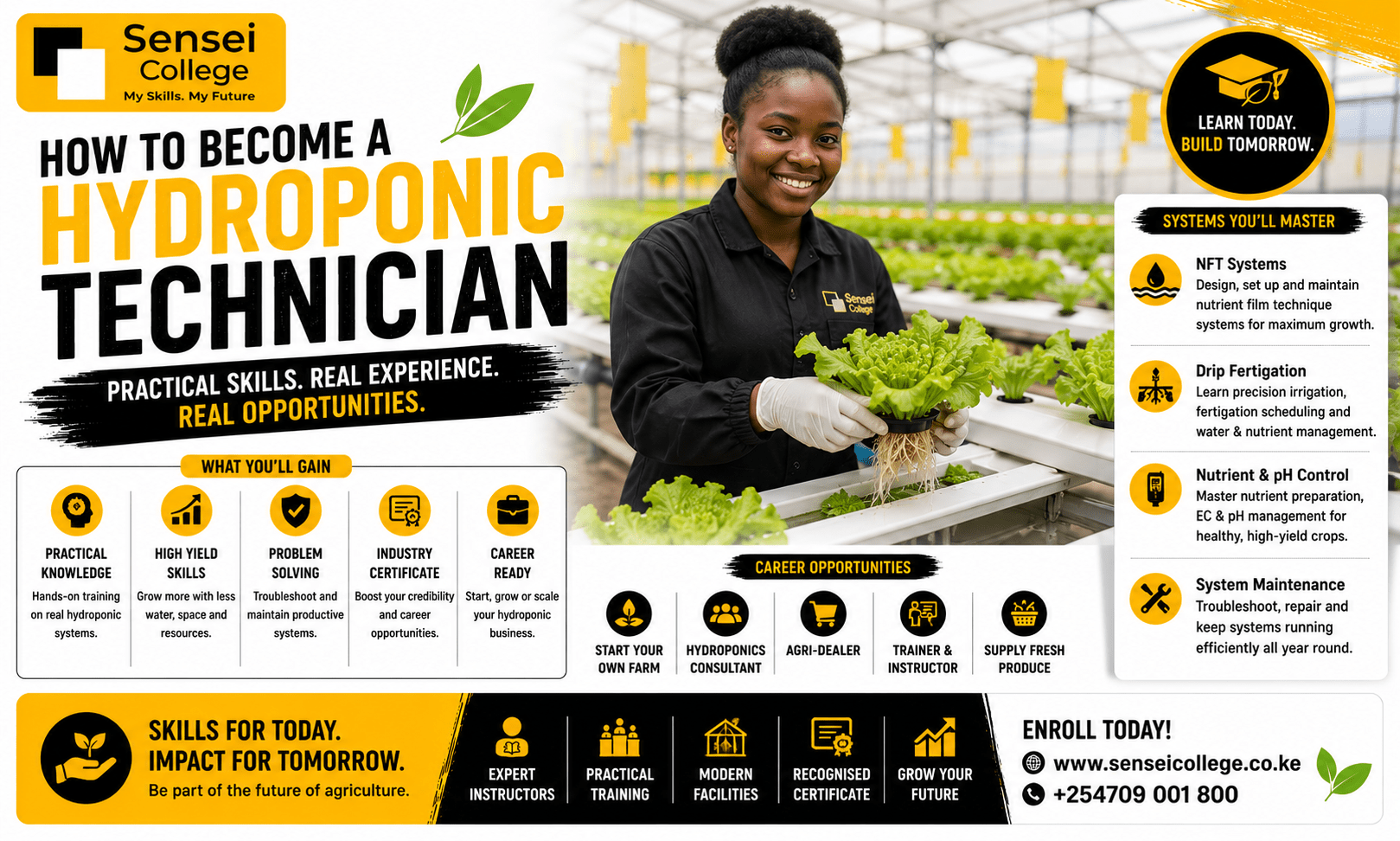
Kenya’s agricultural landscape is changing fast. As land becomes scarcer and food demand rises in cities, more farmers and entrepreneurs are turning to hydroponics, growing plants without soil as a practical, profitable solution.
Most people want to try hydroponics but the struggle with system setup, nutrient management, and crop cycles acts as a barrier. That’s exactly why professional hydroponics training is now one of the most sought-after courses in Kenya’s agri-tech space.
This article covers what Sensei Hydroponics Technician Course covers. Whether you’re a fresh graduate, a practicing farmer, or an agribusiness investor, this can transform your understanding of modern farming.
What is the Hydroponics Technician Course?
It is a structured training program designed to equip participants with both theoretical knowledge and practical skills needed to set up, manage, and troubleshoot hydroponic systems, specifically NFT and drip fertigation.
The program goes deep into the technical side of hydroponics in Kenya, including water management, pH control, nutrient solution preparation, and system maintenance.
Important systems in Hydroponic farming
-
NFT (Nutrient Film Technique) Systems
The term “film” refers to the thin layer of nutrient solution that passes over the roots. It’s shallow enough to expose roots to oxygen, which is critical for healthy plant growth, while still delivering water and nutrients continuously
Benefits of NFT Systems
- Water-efficient – nutrient solution is recirculated, not wasted
- Fast crop growth due to constant nutrient supply and root oxygenation
- Low growing medium costs – no soil or coco coir needed
- Easy to monitor and adjust nutrient levels
- Scalable from a rooftop setup to a large commercial greenhouse
skills
- How to design and set up NFT channels and gutters
- How to maintain a continuous, shallow flow of nutrient solution
- Selecting the right crops for NFT – including lettuce, spinach, kale, and herbs
- Monitoring and adjusting nutrient concentrations
- Troubleshooting common NFT system failures
Drip Fertigation Systems
Drip fertigation combines two processes: drip irrigation (delivering water through small emitters directly to each plant) and fertigation (mixing fertilizers into the water). Instead of watering plants from above, water laced with dissolved nutrients drips slowly and precisely to the root zone of each plant.
The system uses a pump, a tank with dissolved nutrients, a network of pipes and drip lines, and small emitters placed near each plant. A timer controls when and how long water flows, giving farmers precise control over feeding schedules.
Advantages for Kenyan Farmers
- Reduces water usage by up to 60% compared to traditional irrigation
- Delivers nutrients directly where plants need them most
- Reduces labour – once set up, the system does the watering
- Works well in greenhouses, open fields, and vertical systems
- Can be used with a wide range of crops: tomatoes, capsicum, strawberries, herbs
Skills
- Understanding how drip lines and emitters work
- Designing drip layouts for small-scale and commercial setups
- Calibrating fertigation schedules for different crops
- Integrating timers and automation into drip systems
- Managing water and fertilizer efficiently to reduce costs
Career Opportunities After the Course
Completing the course opens up multiple income and career paths in Kenya’s growing agri-tech sector:
- Start your own hydroponic farm and supply vegetables to urban markets, supermarkets, or restaurants
- Work as a hydroponics consultant and help other farmers set up their systems
- Supply hydroponic equipment and growing supplies as an agri-dealer
- Train others as a certified hydroponics instructor
- Supply produce to premium buyers who demand pesticide-free, fresh vegetables
Kenya’s demand for fresh, clean vegetables is growing, especially in cities. Hydroponics in Kenya is moving from a niche experiment to a mainstream agricultural solution, and trained technicians are in high demand.
Who Should Enroll?
The Sensei Hydroponics Technician Course is ideal for:
- Aspiring farmers who want to start a profitable farming business with limited land
- Practicing farmers looking to modernize and diversify their operations
- Agri-business owners interested in adding hydroponics to their portfolio
- Students and graduates in agriculture, horticulture, or environmental science
- Anyone in urban areas who wants to grow fresh food at home or commercially
Conclusion
Across Kenya, farmers who have adopted hydroponics systems are producing tomatoes, lettuce, herbs, and kale without soil, using less water, and earning more per square metre than traditional farms.
The Sensei Hydroponics Technician Course gives you the practical tools, hands-on experience, and industry-recognised knowledge to be part of this movement. Whether you want to start small on a rooftop or build a commercial greenhouse, this course gives you the foundation you need.
Enroll in Sensei College Today! and start building your future in one of Kenya’s fastest-growing agricultural sectors.