
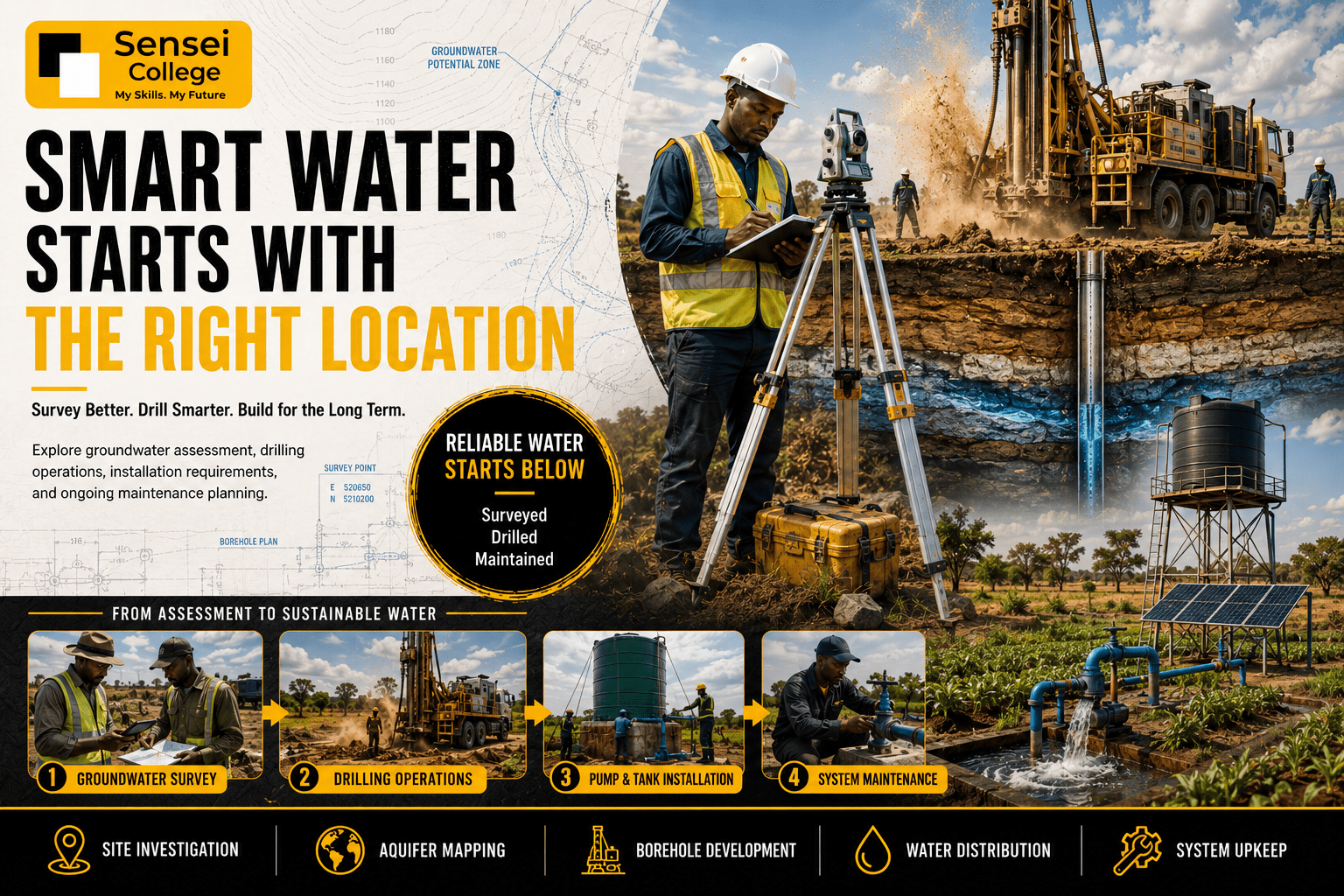
Millions of Kenyans in arid and semi-arid regions like Turkana, Marsabit, Makueni, and parts of the Rift Valley face water scarcity.
Borehole drilling is one of the most powerful solutions to such a water crisis. A well-drilled borehole can supply clean, reliable water to an entire village, a school, a hospital, or a farm for decades. And with the right training in borehole drilling and maintenance, you can be the person who makes that happen.
This guide breaks down what you need to know about borehole drilling and maintenance, and how specialized courses offered at Sensei College can set you on a path to a high-demand, well-paying career.
What Is Borehole Drilling?
A borehole is a narrow, deep hole drilled into the earth to reach underground water sources called aquifers. Borehole drilling is the process of creating a hole using specialized machinery and then installing equipment to pump water from the aquifer to the surface.
Key Terms You Should Know
- Aquifer: An underground layer that holds water, like a sponge, beneath the earth.
- Water table: The upper level of the saturated zone where water is found underground.
- Drilling rig: A large machine used to drill the borehole deep into the ground.
- Casing: Steel or PVC pipes inserted into the drilled hole to prevent it from collapsing.
- Screen: A slotted pipe at the bottom of the casing that allows water in but keeps sand and soil out.
- Gravel pack: Coarse gravel placed around the screen to improve water flow and filter sediment.
- Pump: A device, usually submersible or hand-operated, that draws water from the borehole to the surface.
- Well development: The process of cleaning and testing the borehole after drilling.
- Yield: How much water a borehole can produce per hour, usually measured in liters per hour (L/h) or cubic meters per hour (m³/h).
Why Borehole Drilling Matters in Kenya
Kenya faces serious water challenges. According to the Water Resources Authority, over 40% of Kenyans lack access to safe drinking water. Seasonal rainfall is unreliable, rivers are drying up, and surface water is increasingly contaminated.
Boreholes offer a sustainable, long-term solution because:
- They tap into deep groundwater that is not affected by drought or surface contamination.
- They provide clean water that requires minimal treatment compared to river or surface water.
- They can supply water for drinking, farming, livestock, and industrial use.
- Once installed correctly, a borehole can last 20 to 50 years with proper maintenance.
Economic and Environmental Benefits
- Reduces water-hauling costs for households and farms.
- Boosts agricultural productivity by enabling year-round irrigation.
- Reduces waterborne diseases caused by contaminated surface water.
- Creates employment for drillers, pump technicians, and maintenance crews.
- Reduces environmental stress on rivers and natural water bodies.
How Borehole Drilling Works
Step 1: Hydrogeological Survey
Before a single meter of earth is drilled, experts conduct a hydrogeological survey to locate the best drilling site. This involves:
- Studying geological maps to understand the rock structure.
- Using geophysical methods like Electrical Resistivity Tomography (ERT) to detect water-bearing zones underground.
- Identifying faults, fractures, and rock formations likely to hold water.
Step 2: Mobilization of Equipment
The drilling rig and support equipment are transported to the site.
A typical setup includes:
- The drilling rig (truck-mounted or trailer-mounted).
- Water tankers to supply drilling fluid.
- Fuel tanks for the rig engine.
- Casing pipes, drill bits, and support tools.
Step 3: Setting Up the Drilling Rig
The rig is positioned carefully over the target drilling point.
The mast is erected, and drilling tools are connected.
Step 4: Drilling Begins
Drilling is done using one of several methods, breaking through layers of soil, clay, rock, and eventually reaching the water-bearing zone.
As drilling progresses:
- Drilling fluid is circulated to cool the drill bit, bring rock cuttings to the surface, and stabilize the borehole walls.
- Geologists or technicians monitor the cuttings to understand the underground layers.
- Depth is recorded at regular intervals.
Step 5: Installing the Casing and Screen
Once the aquifer is reached:
- Casing pipes are lowered into the hole to prevent it from collapsing.
- A well screen is placed at the level of the aquifer to allow water entry.
- A gravel pack is placed around the screen.
- The upper part of the hole is grouted to prevent surface water contamination.
Step 6: Well Development
This step clears the borehole of drilling debris, fine particles, and mud. Techniques include:
- Surging: Rapidly moving water in and out of the borehole to dislodge sediment.
- Airlifting: Using compressed air to flush out particles.
- Pumping: Running a pump continuously until the water runs clear.
Step 7: Pump Installation and Testing
A submersible electric pump or a hand pump is installed. The borehole is then pump-tested over several hours or days to measure:
- Yield (how much water it produces).
- Drawdown (how much the water level drops when pumping).
- Recovery rate (how quickly the water level rises after pumping stops).
Step 8: Water Quality Testing
Water samples are sent to a laboratory to test for:
- Bacteria
- Chemicals (fluoride, nitrates, heavy metals).
- pH levels.
Treatment systems (like chlorination or fluoride removal units) are recommended if needed.
Step 9: Commissioning
The borehole is officially handed over for use.
A completion report documenting all details: depth, yield, and water quality, is prepared.
Borehole Drilling Methods
1. Rotary Drilling – Most Common in Kenya
A rotating drill bit cuts through the earth. Drilling fluid is pumped down to cool the bit and bring cuttings to the surface. Fast and effective for most soil and rock types.
2. Air Rotary Drilling
Similar to rotary drilling, but uses compressed air instead of water or mud as the drilling fluid. Ideal for hard rock formations.
3. Percussion (Cable Tool) Drilling
A heavy drill bit is repeatedly dropped to break through rock. Slower, but effective in difficult terrain. Less common today.
4. Reverse Circulation (RC) Drilling
Fluid flows down the outside of the drill rods and up through the center, bringing cuttings up quickly. Used for fast, deep drilling.
Tools and Equipment Required
Basic Equipment
- Drilling rig (rotary or air rotary)
- Drill bits (tricone bits, drag bits, DTH hammer bits)
- Drill rods/pipes
- Casing pipes (steel or PVC)
- Well screen
- Gravel
- Cement for grouting
- Water tankers
- Airlift equipment
Pump and Installation Equipment
- Submersible pump and motor
- Rising main pipes
- Electrical cables
- Control panel and starter
- Pump testing equipment (flow meters, transducers)
Safety Equipment
- Hard hats and safety boots
- Safety harness
- Protective goggles
- First aid kit
Testing Equipment
- Electrical resistivity meter (for surveys)
- Water level meter (dipper)
- Flow meter
- Water quality testing kit
Insights for Experienced Practitioners
-
Hydrogeology and Aquifer Classification
Advanced drillers understand the difference between:
- Unconfined aquifers: Where water rests on an impermeable layer, and the water table fluctuates with rainfall.
- Confined aquifers: Trapped between two impermeable layers. The water is under pressure and may rise on its own (artesian borehole).
- Fractured rock aquifers: Common in Kenya’s crystalline basement rocks. Water is held in cracks and fractures, and locating these requires precise geophysical work.
Drilling Fluid Management
Proper management of drilling fluid is critical in avoiding formation damage, when fine particles clog the aquifer pores and reduce yield.
Advanced practitioners monitor:
- Viscosity
- Density
- pH
- Filtrate loss
Borehole Efficiency Analysis
An efficient borehole minimizes energy cost per liter pumped. Advanced technicians analyze:
- Specific capacity (yield per unit of drawdown).
- Step drawdown tests to identify well losses vs. aquifer losses.
- Long-duration pump tests for sustainable yield estimation.
Remote Monitoring Systems
Modern borehole systems now incorporate IoT-based monitoring, sensors that track water levels, pump performance, and flow rates in real time, sending data to a mobile app or cloud dashboard. This is increasingly relevant for community water systems managed by water utilities and NGOs.
Common Challenges and Solutions
-
Drilling a Dry Borehole
Invest in a proper hydrogeological survey before drilling. A geophysical survey using electrical resistivity tomography (ERT) significantly reduces the risk of missing the aquifer.
-
Borehole Collapse
Solution: Install casing immediately after drilling in unstable formations. Use correct casing material and grouting techniques.
-
High Fluoride Levels
Test water before commissioning. Install defluoridation units – Nalgonda technique or bone char filters if fluoride exceeds 1.5 mg/L, a common issue in parts of Kenya’s Rift Valley.
-
Pump Failures
Use quality pumps from reputable suppliers. Train local pump operators. Schedule regular preventive maintenance every six months.
-
Sand Pumping
This usually indicates a poorly designed or installed screen and gravel pack. Redevelop the borehole or redesign the screen assembly.
-
Borehole Contamination
Ensure proper surface sealing (concrete apron) around the borehole head. Keep latrines and waste pits at least 30 meters away.
Cost Considerations
Borehole drilling costs in Kenya vary depending on depth, location, rock type, and borehole use. Here are rough estimates:
| Component | Estimated Cost (KES) |
| Hydrogeological survey | 30,000 – 80,000 |
| Drilling (per meter) | 4,000 – 8,000 |
| Average borehole (60m deep) | 400,000 – 700,000 |
| Pump and installation | 100,000 – 300,000 |
| Water quality test | 5,000 – 20,000 |
| Annual maintenance | 30,000 – 80,000 |
Total estimate for a complete borehole installation: KES 600,000 – KES 1,200,000+
How to Reduce Costs
- Conduct a thorough survey to avoid dry holes.
- Use locally available casing materials where appropriate.
- Form community water projects to share costs.
- Train local technicians for routine maintenance instead of outsourcing everything.
Career Opportunities and Business Potential
Employment Opportunities
- Borehole driller with drilling companies, NGOs, and county governments.
- Pump technician maintaining borehole pumps for households and institutions.
- Hydrogeologist/borehole consultant advising on drilling sites and borehole design.
- Water quality technician testing and treating borehole water.
Business Opportunities
- Start your own borehole drilling company – demand is consistently high.
- Offer borehole maintenance and rehabilitation services – many old boreholes need reviving.
- Provide pump supply and servicing to rural communities and farms.
- Partner with NGOs and development organizations on water projects.
Tips for Success
- Master the theory first: Understanding hydrogeology and aquifer behavior helps you make better decisions in the field.
- Prioritize safety: Drilling sites are hazardous. Always follow safety protocols and wear protective equipment.
- Learn to interpret geophysical data: This skill separates average drillers from highly paid consultants.
- Keep detailed borehole records: Good documentation helps in troubleshooting and future maintenance.
- Stay updated on regulations: Kenya’s Water Act 2016 and county water regulations govern borehole licensing. Know the law.
- Network with water sector professionals: Join associations like the Kenya Water Practitioners Association.
- Invest in your tools: Quality equipment gives quality results and builds your reputation.
Conclusion
Borehole drilling and maintenance is not just a technical skill, it is a profession that directly changes lives.
In a country where water scarcity affects millions, a well-trained borehole driller is not just an employee; they are a solution provider, a community hero, and a business owner in one of the most stable sectors in Kenya.
Whether you are a school leaver looking for a practical skill, an existing technician wanting to upgrade, or an entrepreneur eyeing the water sector, borehole drilling offers a clear and rewarding path.
With training from institutions like Sensei College and dedication to quality work, you can build a fulfilling career.
Every drop counts. Every borehole matters. And every skilled driller is one step closer to a water-secure Kenya.