
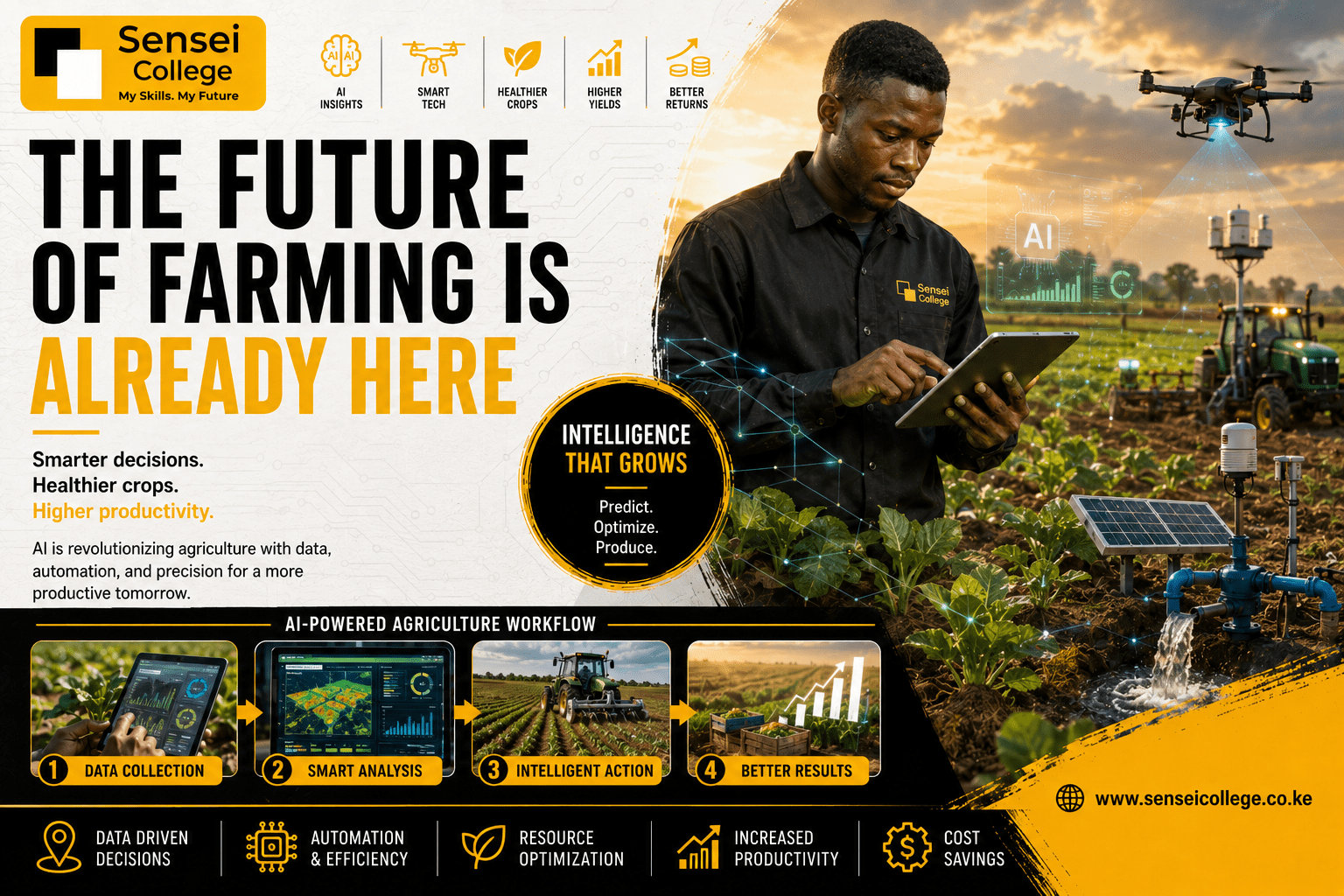
AI in farming is becoming infrastructure, the new backbone of how food is grown, monitored, insured, and sold. And with it comes an entirely new generation of careers that didn’t exist a decade ago.
This article covers what that transformation looks like, which technologies are driving it, and, most practically, what it means to build a career at the intersection of agriculture and technology.
What Is Agri-Tech?
Agricultural technology changes that: Sensors, satellites, machine learning, and mobile platforms make it possible to collect, process, and act on farming information at a speed and scale that no human team could match alone.
How AI is integrated in Agriculture
- A machine learning model trained on thousands of crop disease photos that can identify leaf blight from a smartphone picture with 90%+ accuracy
- A predictive analytics system that looks at historical rainfall, soil data, and market prices to recommend the best crop for a specific plot of land this season
- A computer vision algorithm processing drone footage to count plants, estimate spacing, and flag anomalies in a large farm before a human scout arrives
- A natural language chatbot answering farmers’ agronomic questions via WhatsApp in Swahili
Importance of smart farming in kenya
- Smartphone penetration crossed a threshold that made mobile-based tools practical for rural farmers
- Satellite data became free – platforms like Google Earth Engine opened up decades of imagery at no cost to researchers and developers
- IoT hardware got cheap – a soil moisture sensor that cost $200 five years ago now costs under $20
- Mobile money infrastructure (M-Pesa) created a payment rail for digital agricultural services that didn’t require a bank account
- A large, young, tech-literate population in Nairobi and other urban centres created a talent pool ready to build for this sector
How Data Is Transforming Agriculture
-
Farm Sensors and Smart Monitoring
The most foundational shift in data-driven farming is the ability to know, in real time, what is happening on a farm without being physically present.
Soil sensors measure moisture, temperature, pH, and nutrient levels. They transmit this data over low-power networks to a central platform, where it can be reviewed remotely or trigger automated responses. For a Kenyan horticulture exporter growing French beans in Kirinyaga, this means knowing precisely when to irrigate without wasting water and stressing the crop.
-
Weather Prediction and Climate Tools
Kenya’s rainfall is variable. The difference between a good season and a failed one can be a matter of two weeks’ timing. Traditional weather forecasts from KMC (Kenya Meteorological Department) have improved significantly though, general forecasts for large regions are not enough for a smallholder making planting decisions on a specific slope in Meru.
-
Data-Driven Irrigation
Water is Kenya’s most precious agricultural resource. Irrigation schemes from large government projects in Mwea and Bura to small-scale solar-powered drip systems in Kajiado are increasingly being managed with data.
Automated irrigation systems use soil moisture data and evapotranspiration calculations to determine how much water the crop is losing to the air to decide exactly when and how long to irrigate.
This is not just convenient; it can reduce water use compared to scheduled irrigation while improving yields.
Systems like these are being installed by companies including Aqua Hub Kenya, which supplies smart irrigation equipment, and FarmDrive, which integrates farm data to inform both irrigation decisions and lending products.
-
Soil Analysis Technologies
Understanding what’s in the soil before planting requires sending samples to a laboratory and waiting weeks for results. New technologies are compressing that timeline dramatically.
Handheld NIR (Near-Infrared) spectrometers can analyse soil samples in minutes, measuring organic matter, moisture, and some nutrient levels.
Soil health mapping – using GPS-referenced sampling and interpolation to create a spatial map of soil variability across a farm allows variable-rate fertiliser application, where different sections of a farm receive different amounts of fertiliser based on their specific needs.
-
Crop Disease Detection
One of the most dramatic applications of AI in Kenyan agriculture is automated crop disease identification.
The PlantVillage project, developed in partnership with Penn State University and widely deployed in Kenya, allows a farmer to take a photo of a diseased leaf with a basic smartphone. The AI model returns a diagnosis and treatment recommendation within seconds.
The model has been trained on over 54,000 images of healthy and diseased plants across 14 crop species. In field trials in Kenya, it has achieved diagnostic accuracy comparable to trained agronomists, and it works offline.
-
Mobile Farming Apps and Advisory Platforms
iShamba (Safaricom) reaches over 400,000 Kenyan farmers through SMS, call centre agronomists, and a USSD service that works on basic feature phones. A farmer sends a question: “My tomatoes have brown spots, what do I do?” and receives both an automated initial response and a callback from a trained agronomist.
Apollo Agriculture uses satellite data, AI-based credit scoring, and digital farmer profiles to offer smallholders bundled packages of certified seed, fertiliser, and crop insurance financed on credit and repaid after harvest. Their model uses machine learning to predict which farmers are most likely to have productive seasons, and therefore which loans are most likely to be repaid.
-
Predictive Farming Analytics
Predictive analytics means using historical data: past yields, weather patterns, pest cycles, and market prices to forecast future outcomes and recommend actions.
For a Kenyan cooperative aggregating produce from 500 smallholders, a predictive model can estimate total harvest volume three weeks before picking, allowing them to pre-negotiate contracts with buyers and arrange cold storage or transport in advance. The alternative has historically led to either oversupply or undersupply.
Modern Agricultural Machinery and Automation
Smart Tractors and GPS-Guided Equipment
A conventional tractor requires a skilled operator making constant decisions about direction, depth, and spacing.
A GPS-guided tractor uses satellite positioning to follow pre-programmed paths with centimetre-level accuracy, ensuring rows are perfectly straight and consistent, headlands are turned cleanly, and overlap between passes, which minimises waste fuel and seed.
For young people interested in modern farming equipment in Kenya, tractor GPS systems represent a genuine skills opportunity: installation, calibration, maintenance, and operator training are all services in demand.
Drones in Kenyan Agriculture
Unmanned Aerial Vehicles (UAVs), drones are arguably the most visible symbol of agricultural automation in Kenya today.
Their applications span the entire farming cycle:
- Field mapping and area measurement: A drone can accurately map and measure a farm in under an hour, producing georeferenced images far more accurate than Google Maps for a specific date
- Crop scouting: Flying a grid pattern, a drone equipped with a multispectral camera can detect plant stress, pest damage, or disease patches invisible to the human eye, covering 50 acres in a single flight
- Precision spraying: Agricultural spray drones deliver pesticides or fertiliser to exactly the areas that need them, reducing chemical use by up to 30% and avoiding spray drift into adjacent areas
- Livestock monitoring: On large ranches, drones can locate and count cattle, identify injured animals, and monitor water points and fence lines
Astral Aerial Solutions, based in Kenya, is one of several companies providing commercial drone services across East Africa. The Kenya Civil Aviation Authority (KCAA) now has a drone licensing framework, and a Remote Pilot Licence (RPL) is required for commercial operations.
Automated Irrigation Systems
Beyond sensors and scheduling software, physical irrigation automation includes:
- Solar-powered drip irrigation kits sized for smallholders (0.1 to 2 acres), increasingly common among horticulture farmers in semi-arid counties like Machakos and Kajiado
- Centre-pivot and linear-move irrigators on large farms, increasingly connected to soil and weather sensors to automate start/stop decisions
- Smart valves and controllers that can be operated remotely via smartphone
The technicians who install, commission, and maintain these systems represent a significant employment category, often TVET graduates with skills in plumbing, electrical work, and basic digital controls.
Precision Farming Equipment
Precision agriculture in Kenya at the farm equipment level includes:
- Variable-rate spreaders: Apply different amounts of fertiliser across a field based on a prescription map derived from soil testing data
- Yield monitors: Mounted on combine harvesters, these sensors record yield continuously during harvest, building a spatial map of how productive each part of the field was, data that informs next season’s management
- Auto-steering systems: Retrofit kits that add GPS guidance to existing tractors, reducing the need for highly skilled manual operators
Greenhouse Automation
Kenya’s horticultural export sector: flowers, vegetables and herbs is dominated by greenhouses. Modern commercial greenhouse operations in Naivasha, Thika, and Mt. Kenya integrate:
- Automated climate control – managed by sensors and programmable controllers
- Hydroponic nutrient delivery systems that mix and deliver precise nutrient solutions on schedules
- Environmental monitoring dashboards are viewable remotely
For a technically inclined TVET graduate, greenhouse automation maintenance is a career pathway with real demand, particularly among the horticultural exporters serving European markets.
The Careers in Agriculture
1. Agricultural Data Analyst
They are responsible for collecting, cleaning, and interpreting farm data from soil tests, satellite images, weather records, and yield data to produce insights that help farmers and agribusinesses make better decisions.
They work with Agri-Tech startups, NGOs and research organisations, county government agricultural departments, and commodity trading companies
2. Drone Operator and Remote Sensing Technician
Operate UAVs for agricultural survey, scouting, and spray operations; process imagery using software like Pix4D, DroneDeploy, or AgiSoft Metashape; produce orthomosaic maps and analysis reports.
The KCAA licensing exam has written and practical components. Several institutions in Nairobi and Kisumu now offer structured drone training programmes that include licence preparation.
3. Smart Irrigation Technician
Install, commission, configure, and maintain smart irrigation systems from small solar drip kits to large automated centre-pivot systems. Work includes both physical plumbing and pipe installation, and the digital calibration of controllers and sensors.
Usually work on Irrigation equipment companies, large farms, NGO-funded smallholder irrigation projects, county government water departments
4. Agricultural Software Developer
Build the apps, platforms, APIs, and dashboards that power Kenya’s digital agriculture ecosystem. This includes mobile apps for farmers, analytics platforms for agribusinesses, and backend systems connecting sensors, databases, and user interfaces.
They work on Agri-Tech startups, telecoms, and international development organisations
5. Precision Agriculture Specialist
They advise farmers and agribusinesses on the implementation of precision farming practices combining traditional agronomic knowledge with data tools. This is a hybrid role requiring both deep farming knowledge and technological competence.
6. Farm Automation Technician
Installs and maintains the physical hardware layer of smart farming: sensors, automated feeders, greenhouse controllers, robotic milking systems, and connected equipment on mechanised farms.
Works on Large commercial farms, greenhouse operations, dairy companies and agricultural equipment dealers
7. Agri-Tech Support Specialist
Provides frontline technical support to farmers and field staff using Agri-Tech platforms. This includes training farmers on app usage, troubleshooting connectivity or hardware issues, collecting feedback for product improvement, and escalating technical bugs.
This is often the role that determines whether a technology actually gets adopted or sits unused on a phone screen.
8. IoT Technician in Agriculture
Deploys and maintains networks of connected sensors and devices on farms, including soil sensors, weather stations, livestock trackers, and automated irrigation controllers. Includes hardware installation, network configuration, and basic data pipeline troubleshooting.
Works on Agri-Tech hardware companies, large farms, irrigation scheme management, and livestock monitoring companies
Skills Needed in Agri-Tech
- Digital literacy – Being comfortable with smartphones, cloud platforms, basic data management, and online tools is assumed in this sector.
- Data analysis – understanding how to work with spreadsheets, how to spot patterns in numbers, and how to turn data into a recommendation is the single most transferable skill in Agri-Tech today.
- Communication across audiences – The best Agri-Tech professionals can explain a data insight to a smallholder farmer in simple terms and then turn around and write a technical report for a donor or investor. This skill is rare and extremely valuable.
Technical Skills by Career Path
| Career Direction | Priority Technical Skills |
| Data and analytics | Python/R, Excel, SQL, GIS basics |
| Drone and remote sensing | KCAA RPL licence, Pix4D/DroneDeploy, GIS |
| Software development | Python/JavaScript, mobile dev (Flutter), APIs |
| Irrigation and hardware | Electrical systems, plumbing, IoT basics |
| Precision agronomy | Soil science, GIS/QGIS, data interpretation |
| Field agent/support | Digital platforms, communication, local languages |
Challenges of using AI in Agriculture
-
Cost of Equipment
A quality agricultural drone costs KSh 200,000–800,000. A soil sensor network for a mid-sized farm can run KSh 50,000–200,000. A smart irrigation system for 2 acres starts at KSh 30,000 and goes significantly higher with automation.
For career builders, this means understanding not just the technology but the economics. Engineers who can design cheaper, more field-durable hardware for the Kenyan context, and business models that make technology affordable, are solving the sector’s hardest problem.
-
Internet Connectivity
Kenya’s mobile data coverage is excellent in urban areas and along major roads. In rural farming areas, precisely where the technology is needed most, connectivity is unreliable.
The best Agri-Tech tools in Kenya work offline and sync when connectivity is available. Building for offline-first is a specific technical discipline, and developers who understand it are in demand.
-
Training Gaps and Technology Awareness
A good app that a farmer doesn’t know how to use helps no one. One of the most consistent findings from Agri-Tech deployments across Kenya is that technology adoption correlates strongly with the quality of training and ongoing support provided.
-
Resistance to Change
Farming is deeply traditional, and that’s not irrational.
A farmer who tries a new technique and fails loses their family’s food for the season. Adoption of new technology requires trust, demonstrated results, and patience. Technology that isn’t explained in the local context and language will be rejected.
This argues for careers that combine technical knowledge with communication skills, local language fluency, and genuine respect for farmer knowledge and experience.
The Future of Agri-Tech Careers
Climate-Smart Agriculture Is Becoming Central
Climate change is not a future threat for Kenyan farmers; it is a present reality. Rainfall seasons are shifting. Temperatures are rising. Extreme weather events are more frequent. Adapting agriculture to this reality is one of the defining challenges of the next two decades.
For Agri-Tech professionals, climate adaptation is a growth area with long-term funding from international climate finance, including instruments like the Green Climate Fund, the Africa Climate Change Fund, and private voluntary carbon markets.
AI-Powered Food Systems
AI is shaping:
- Supply chain traceability: Blockchain and IoT-based systems that track food from farm to consumer, assuring quality and reducing fraud
- Market matching platforms: AI-powered systems connecting farmers directly with buyers, eliminating costly intermediaries
- Nutritional prediction: Models that estimate the nutritional content of crops based on soil data and growing conditions, relevant for food fortification programmes
- Post-harvest intelligence: Sensors in storage facilities that monitor grain temperature and humidity to prevent mycotoxin contamination a significant food safety issue in Kenya
Organisations from the Kenyan government to the World Bank to the African Development Bank are investing specifically in programmes that connect young people with Agri-Tech careers. The Ajira Digital Programme, the Kenya Youth Employment and Opportunities Project (KYEOP), and various county government digital literacy initiatives are all active pathways.
Conclusion
Kenyan farming is undergoing transformation. The problems that were considered unsolvable, real-time disease detection, precision water management, and smallholder credit scoring, are being cracked by teams working right now in Nairobi, Eldoret, Kisumu, and beyond.
AI in Kenyan farming is not about technology replacing farmers. It is about farmers gaining tools that amplify their knowledge, reduce their risk, and raise their incomes and about a new generation of Kenyan professionals building and operating those tools.