
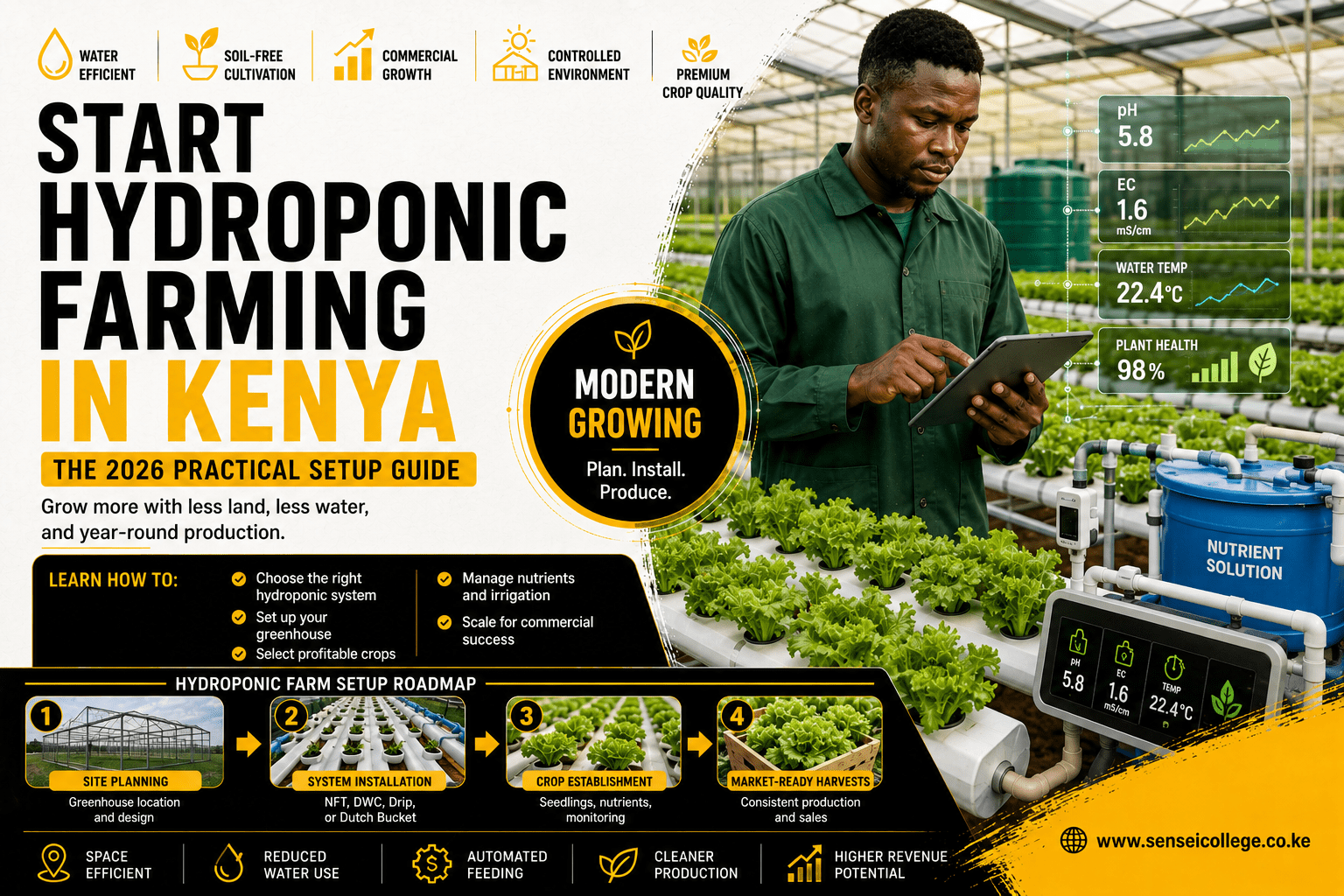
What if you could grow fresh vegetables in a small room in Nairobi, on a rooftop in Mombasa, or in a drought-prone region where the soil is too poor to farm and produce more food per square metre than a traditional farm ever could?
Kenya faces pressures that make hydroponics increasingly essential: rapid urbanization, shrinking farm sizes, unreliable rainfall, soil degradation, and a growing urban middle class that demands fresh, clean, locally grown food year-round. Hydroponics addresses all of these challenges at once.
This guide will walk you through what you need to know about hydroponic system setup, from the very basics to advanced production techniques.
What Is Hydroponics?
Hydroponics is a method of growing plants without soil.
Instead of soil, plants are supported in a growing medium or directly in water and are fed a precisely mixed, water-based nutrient solution that delivers all the minerals a plant needs directly to the roots.
Plants grown in soil spend enormous energy developing long root systems to search for water and nutrients. In hydroponics, water and nutrients are delivered directly to the roots so the plant redirects that energy into growing bigger, faster, and producing more fruit or leaves.
How Do Plants Grow Without Soil?
Soil serves two purposes for plants: it physically supports the plant and it supplies nutrients. In hydroponics:
- Physical support is provided by growing media like perlite, coconut coir, rockwool, or clay pebbles, or by holding the plant in a net pot or basket.
- Nutrients are dissolved in water and delivered directly to the roots in a perfectly balanced solution.
Plants in hydroponics grow up to 50% faster and produce 2–3 times more yield per square metre than in traditional soil farming.
Key Terms You Should Know
- Nutrient solution: A carefully balanced mix of water and dissolved plant nutrients (nitrogen, phosphorus, potassium, calcium, magnesium, and trace elements).
- EC (Electrical Conductivity): A measure of how concentrated the nutrient solution is. Plants need different EC levels at different growth stages.
- pH: A measure of acidity or alkalinity. Most hydroponic plants grow best at pH 5.5–6.5.
- Growing medium/substrate: The material that physically holds plant roots in place anddoes not supply nutrients.
- Reservoir: The tank that holds the nutrient solution.
- Net pots: Small mesh containers that hold the plant and growing medium while allowing roots to reach the water.
- NFT (Nutrient Film Technique): A system where a thin film of nutrient solution flows continuously over the roots.
- DWC (Deep Water Culture): Roots are suspended directly in a tank of oxygenated nutrient solution.
- Photoperiod: The number of hours of light a plant receives per day, which influences growth and flowering.
Why Hydroponics Matters in Kenya
Solving the Land Problem
Kenya’s average farm size is shrinking as land is subdivided through inheritance. For the millions of Kenyans who do not have enough land for traditional farming, hydroponics offers a way to grow significant quantities of food in small spaces: indoors, on rooftops, or in greenhouses.
Solving the Water Problem
This may surprise you: hydroponics uses up to 90% less water than conventional soil farming. In a closed hydroponic system, water is recirculated continuously rather than being absorbed by soil or lost to evaporation. For a water-scarce country like Kenya, this is transformative.
Solving the Soil Problem
Large parts of Kenya’s arid and semi-arid lands have soils that are too poor, too saline, or too rocky for conventional farming.
Hydroponics bypasses soil entirely, making it possible to grow food in places where it was previously impossible.
Meeting Urban Food Demand
Kenya’s urban population is growing rapidly. Urban consumers demand fresh, chemical-free vegetables year-round. Traditional supply chains from rural farms to urban markets involve long journeys that cause post-harvest losses and reduce freshness. Hydroponic farms located within or near cities can supply ultra-fresh produce to urban markets within hours of harvest.
High-Value Crops
Hydroponics is especially well-suited to high-value crops like:
- Leafy greens: Spinach, kale, lettuce, herbs (basil, coriander, mint).
- Fruiting vegetables: Tomatoes, cucumbers, capsicum (bell peppers).
- Strawberries and other high-value fruits.
- Microgreens: Tiny, nutrient-dense seedlings sold to restaurants and health-conscious consumers.
These are crops that command premium prices in Kenyan urban markets and among exporters.
Fewer Pests and Diseases
Soil is home to many of the pests and pathogens that attack plants: root rot, nematodes, fungal infections, and more. By removing soil from the equation, hydroponic farming significantly reduces exposure to many common plant diseases. Crops grown in controlled environments also have fewer pest problems, reducing the need for expensive pesticides.
Setting Up a Hydroponic System
Types of hydroponic system
i). Deep Water Culture (DWC)
DWC is the simplest hydroponic system.
Plants are suspended in net pots above a reservoir of oxygenated nutrient solution. Roots hang in the solution.
Materials Needed:
- Opaque container or tank (dark colour to prevent algae)
- Net pots (5cm or 10cm)
- Air pump with airstone and tubing
- Growing medium – clay pebbles, rockwool, or perlite
- Hydroponic nutrient solution
- pH meter and EC meter
- pH-adjusting solutions – pH Up and pH Down
- Seeds or seedlings
Step 1: Prepare the Tank
- Drill holes in the lid of the container to fit your net pots snugly.
- Clean and rinse the tank thoroughly.
Step 2: Mix the Nutrient Solution
- Fill the tank with clean water, preferably with an EC below 0.5, i.e., relatively low mineral content.
- Add hydroponic nutrients according to the manufacturer’s instructions.
- Mix thoroughly.
- Adjust EC to the target level for your crop and growth stage (typically 1.2–2.5 mS/cm for leafy greens).
- Adjust pH to 5.5–6.5 using pH Up (potassium hydroxide) or pH Down (phosphoric acid).
Step 3: Set Up the Air Pump
- Place the airstone at the bottom of the reservoir.
- Connect the airstone to the air pump with tubing.
- The air pump keeps the water oxygenated; without oxygen, roots rot.
Step 4: Prepare the Growing Medium
- Rinse clay pebbles or perlite thoroughly to remove dust.
- Soak rockwool cubes in pH-adjusted water (pH 5.5) for 1 hour before use.
Step 5: Germinate Seeds or Prepare Seedlings
- Germinate seeds in moist rockwool cubes or paper towels until roots are visible (2–5 days).
- Alternatively, start seeds in a seedling tray with a soil-less medium before transplanting.
Step 6: Place Seedlings in Net Pots
- Place the seedling in the net pot.
- Surround roots with your growing medium.
- Ensure the seedling is stable and upright.
Step 7: Insert Net Pots and Begin
- Place filled net pots in the holes in the lid.
- Initially, ensure the water level is high enough to touch the bottom of the net pots (roots will grow down into the solution).
- As roots establish, you can lower the water level slightly and allow an air gap; roots exposed to both air and solution absorb more efficiently.
Step 8: Maintain the System
- Check and adjust pH daily (pH can drift significantly).
- Check EC every 2–3 days. Top up with water when EC rises (evaporation) or with nutrient solution when EC drops.
- Change the full nutrient solution every 1–2 weeks.
- Monitor for pests and disease.
- Harvest when ready!
(ii). Nutrient Film Technique (NFT) – Most Popular Commercially
NFT is widely used for leafy greens in Kenya’s commercial hydroponic farms. A thin film of nutrient solution flows continuously along the bottom of a slightly sloped channel (gutter), over the roots of plants.
Components:
- Growing channels (PVC gutters or channels, typically 10–15cm wide)
- Header tank/reservoir
- Water pump
- Return pipe (solution flows back to reservoir by gravity)
- Net pots
- Timer (optional – many NFT systems run pumps continuously)
- Nutrient solution
- pH and EC meters
Setup Steps:
- Build or install a sloped frame: Channels should slope at 1:30 to 1:50 (a gentle slope so solution flows slowly).
- Drill holes in channels at the correct spacing for your crop (15–25cm for lettuce, 30–45cm for tomatoes).
- Connect channels to the reservoir: The pump sends solution from the reservoir to the high end of each channel. Solution flows along the channel, over the roots, and drains back to the reservoir at the low end.
- Mix and add the nutrient solution to the reservoir.
- Adjust pH and EC.
- Start the pump and verify flow in all channels.
- Insert plants in net pots in the holes.
- Monitor and maintain as described for DWC.
iii). Dutch Buck System – Best for Fruiting Crops
For tomatoes, cucumbers, and capsicum plants that grow large and need more support, the Dutch bucket system is ideal.
- Each plant grows in its own bucket filled with substrate (usually coconut coir).
- Nutrient solution drips in from above (dripper system) and drains out the bottom through a pipe.
- Excellent for vine crops that are trained vertically.
iv). Vertical Tower Systems
Perfect for urban rooftop farms and small spaces.
Plants grow in pockets or cups arranged vertically on a tower structure. Nutrient solution is pumped to the top and trickles down through each level.
Excellent for herbs, strawberries, and leafy greens.
Very space-efficient, you can grow 40–60 plants in the space of 1 square metre.
Hydroponic Nutrients
Macronutrients
These are nutrients plants need in large amounts
- Nitrogen (N): Drives leafy green growth.
- Phosphorus (P): Supports root development and flowering.
- Potassium (K): Fruit quality, disease resistance, water regulation.
- Calcium (Ca): Cell wall strength; its deficiency causes blossom end rot in tomatoes.
- Magnesium (Mg): Central component of chlorophyll.
- Sulfur (S): Protein and enzyme function.
Micronutrients
These are nutrients plants need in tiny amounts
Iron, manganese, zinc, copper, boron, and molybdenum are all essential in small quantities.
In Kenya, complete pre-mixed hydroponic nutrients are available from agricultural suppliers, making it easy to get started without mixing from scratch.
Tools and Equipment Required
Beginner Setup (Small DWC or NFT)
- Reservoir/tank(s)
- Air pump, airstone, tubing
- Water pump (for NFT/Dutch bucket)
- PVC channels or gutters
- Net pots and growing medium
- pH and EC meters are essential
- pH Up and pH Down solutions
- Hydroponic nutrients (2-part or 3-part formula)
- Seeds and seedling trays
- Thermometer
Intermediate/Commercial Setup
All of the above, plus:
- Greenhouse structure (for climate control)
- Timer-controlled pumps
- Shade netting or grow lights (for indoor systems)
- CO₂ supplementation (for indoor growing)
- Water filtration system
- Data logger (temperature, humidity)
- Drip irrigation manifolds (for Dutch bucket)
- Vertical grow towers
Advanced/Professional Setup
- Automated nutrient dosing systems
- Climate control system (ventilation, cooling, heating)
- LED grow lights (for fully indoor production)
- Reverse osmosis water purification
- Automated pH and EC monitoring and control
- CCTV and remote management systems
Insights for Experienced Growers
-
Optimizing the Root Zone
Experienced hydroponic growers know that healthy roots are the key to high yields. Signs of a healthy root zone:
- White, dense, well-branched roots.
- Slight musty smell is normal; a foul odor indicates root rot (Pythium infection).
- Good air:water ratio at the root zone.
Mycorrhizal inoculation – is adding beneficial fungi to hydroponic systems to improve nutrient uptake and plant resilience, even without soil.
Lighting for Indoor Systems
In Kenya, most hydroponic farms use natural sunlight inside a greenhouse or on a rooftop. For indoor systems or to extend the growing day:
- LED grow lights are now the industry standard, energy-efficient, full-spectrum, long lifespan.
- PPFD (Photosynthetic Photon Flux Density) – a measure of light intensity at the plant level. Most leafy greens need 200–400 µmol/m²/s; fruiting plants need 400–1000 µmol/m²/s.
- Photoperiod management: Most vegetables need 14–18 hours of light. Basil and lettuce can be grown under 24-hour light in some systems.
Integrated Pest Management (IPM) for Hydroponics
Hydroponic systems are cleaner than soil farming but not pest-free.
Common pests include:
- Whiteflies and aphids are especially in greenhouses.
- Spider mites (in hot, dry conditions).
- Fungus gnats (in substrate-based systems).
- Pythium (root rot disease, the most serious threat in hydroponic systems).
Advanced IPM includes: biological controls (predatory insects), physical barriers, UV sterilization of recirculated water, and strict hygiene protocols.
Crop Scheduling and Succession Planting
Professional hydroponic farms maintain continuous production using staggered planting schedules. New seedlings are transplanted on a fixed schedule so that harvests happen week after week, not all at once. This ensures steady cash flow and a consistent supply to buyers.
Common Challenges and Solutions
-
pH Fluctuations
Always check and adjust pH daily. Calibrate your pH meter weekly. Use a buffered nutrient formula to slow pH drift.
-
Root Rot (Pythium)
Prevent by keeping the reservoir dark, maintaining good oxygenation, and keeping water temperature below 22°C. Treat with beneficial bacteria (Trichoderma or Bacillus) as a preventive. Hydrogen peroxide (3%) can treat early infections.
-
Nutrient Deficiencies
Learn to read visual deficiency symptoms: yellowing patterns, spots, curled leaves. Adjust nutrient formula accordingly. Most deficiencies in well-maintained systems are actually caused by pH being too high or too low, which locks out nutrients even when they are present.
-
Power Outages
Kenya’s power supply can be unreliable. Install a backup generator or solar-powered pump. Systems with continuous pump operation (NFT) are most sensitive to power cuts roots can dry out quickly. DWC systems are more resilient.
-
High Water Temperature
In hot Kenyan climates, reservoir water can get too warm, reducing oxygen levels and encouraging disease. Use insulated or underground reservoirs, shade the reservoir, or use a chiller in high-value commercial setups.
-
Finding Markets
Approach supermarkets, restaurants, hotels, and health-food stores directly. Urban consumers and high-end buyers pay premium prices for clean, fresh, locally grown produce. Consider packaging with your farm brand to build loyalty.
Cost Considerations
Small Home or Pilot System (20–50 plants)
| Item | Estimated Cost (KES) |
| Reservoir, net pots, growing medium | 3,000 – 8,000 |
| Air or water pump | 2,000 – 5,000 |
| pH and EC meters | 3,000 – 8,000 |
| Nutrients (per month) | 1,000 – 3,000 |
| Seeds | 500 – 2,000 |
| Total setup | 9,500 – 26,000 |
Small Commercial NFT System (500–1,000 plants, greenhouse)
| Item | Estimated Cost (KES) |
| Greenhouse structure (6m × 15m) | 150,000 – 300,000 |
| NFT channels and frame | 50,000 – 120,000 |
| Reservoir, pump, plumbing | 20,000 – 50,000 |
| Meters, nutrients, seedling supplies | 15,000 – 30,000 |
| First crop seed/seedlings | 5,000 – 10,000 |
| Total setup | 240,000 – 510,000 |
Revenue Potential
A well-managed 6m × 15m NFT greenhouse growing lettuce or spinach can produce:
- 500–800 plants per cycle (25–35 days for leafy greens)
- 10–12 harvests per year
- KES 50–150 per plant (wholesale to supermarkets)
- Estimated annual gross revenue: KES 300,000 – KES 1,440,000
Career Opportunities and Business Potential
Employment Opportunities
- Hydroponic farm technician: Operating commercial hydroponic farms.
- Nutrient management specialist: Advising farms on nutrient solutions and crop optimization.
- Greenhouse systems installer: Setting up hydroponic systems for clients.
- Urban agriculture consultant: Helping city dwellers, schools, and hotels set up food production systems.
Business Opportunities
- Commercial hydroponic farm: Produce high-value vegetables for urban supermarkets, hotels, and restaurants.
- Seedling supply business: Produce and sell high-quality hydroponic seedlings to other farmers.
- System installation and supply: Set up and supply hydroponic systems to clients, growing demand as awareness increases.
- Value-added processing: Wash, package, and brand your produce for premium retail.
- Training and consulting: Teach others to grow hydroponically in-person workshops or online courses.
Tips for Success
- Start small and learn: Begin with a 20–30 plant DWC system before investing in a large commercial setup. Understand your system before scaling.
- Invest in your meters: A good pH meter and EC meter are non-negotiable. Guessing nutrient concentrations and pH causes crop failure.
- Use quality nutrients: Cheap or poorly balanced nutrients give poor results. Invest in a reputable hydroponic nutrient formula.
- Keep meticulous records: Track what you planted, when, with what nutrient solution, at what EC and pH, and what the results were. Data drives improvement.
- Study plant nutrition: Understanding what plants need at each growth stage transforms your ability to optimize yields.
- Find your market before you scale: Know who will buy your produce and at what price before expanding. Production without a market leads to losses.
- Join hydroponic networks: Connect with other hydroponic farmers in Kenya. There are active online communities and farmer groups sharing experience and markets.
- Keep the system clean: Hygiene prevents most diseases. Clean reservoirs regularly, sterilize equipment between cycles, and remove dead plant material promptly.
Conclusion
In Kenya, land is scarce, water is precious, and urban food demand is exploding, hydroponics is a necessary evolution.
Whether you are growing kale on your Nairobi apartment balcony, building a commercial greenhouse in Kiambu, or setting up a community food garden in Kisumu, hydroponics gives you the tools to produce clean, fresh, nutritious food with a fraction of the land and water of traditional farming.
The knowledge is accessible. The technology is affordable. The market is hungry. And the future of food in Kenya will increasingly be grown without soil in systems built and operated by skilled, trained, forward-thinking farmers.
The soil is just one way to grow food. Discover the future.