
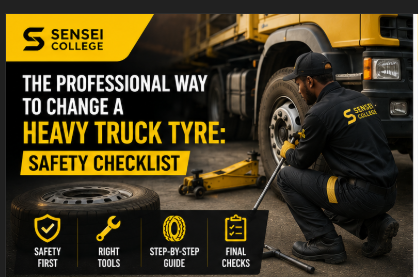
A tyre blowout is one of the most common and potentially dangerous situations a truck driver can face. Heavy trucks travel tens of thousands of kilometres per year. Tyres wear down, pick up nails and debris, or suffer blowouts. When it happens, the driver must know exactly what to do.
Changing a heavy truck tyre safely and correctly is not the same as changing a tyre on a private car. Truck tyres are large, heavy (often 50–80kg each), and mounted at significant height.
If done incorrectly, the process can result in the jack slipping, the truck rolling, or the tyre being reassembled without proper torque – all of which can cause serious accidents.
Reasons why this skill is essential
- It is a core competency for all Class C and D truck drivers in Kenya
- Employers and fleet managers trust drivers who can handle roadside emergencies competently
- A driver who changes a tyre correctly and safely is far safer and more employable than one who cannot
- It reduces vehicle downtime and prevents costly towing
Tools and Equipment You Will Need
Most commercial trucks in Kenya carry a standard toolkit in the cab or behind the cab. Before any long-distance journey, confirm these are present:
Standard Truck Tyre-Change Kit:
- Spare tyre in good condition and correctly inflated, check regularly
- Hydraulic or mechanical bottle jack
- Jack stands / axle stands – to support the truck safely while the tyre is off
- Wheel brace or pneumatic impact wrench (for loosening and tightening wheel nuts)
- Torque wrench for correctly tightening wheel nuts to the manufacturer’s specification
- Rubber mallet or hammer
- Tyre lever bars (2–3) for removing the tyre from the rim
- Wheel chocks (4–6 minimum)
- High-visibility warning triangles ( minimum 3 required by Kenyan traffic law)
- High-visibility jacket (reflective vest, mandatory on the roadside)
- Work gloves
- Flashlight or headlamp
- Breaker bar (for stubborn, over-torqued wheel nuts)
How to Change a Heavy Truck Tyre
Step 1: Bring the Truck to a Safe Stop
- Reduce speed gradually and smoothly
- Put on your hazard lights immediately
- Steer the truck to the side of the road, as far off the carriageway as possible
- If there is a layby, emergency stop area, or wide shoulder, use it
- If you are on a slope, try to get to flat ground before stopping; changing a tyre on a slope is extremely dangerous
- Once stopped, put the gear lever in the lowest gear and engage the parking brake fully
Never stop on a bend or at the top or bottom of a hill. Other vehicles approaching cannot see you in time. If you must stop in a dangerous spot, put on hazards and get all passengers out of the vehicle and away from the road before doing anything else.
Step 2: Make the Scene Safe
Before touching the truck:
- Put on your high-visibility vest immediately
- Place warning triangles on the road behind the truck at a minimum distances:
- First triangle: 10 metres behind the truck (on the edge of the road)
- Second triangle: 50 metres behind the truck
- Third triangle: 100 metres behind the truck (especially on fast roads like the A109)
- This gives approaching drivers maximum warning time to slow down and pass safely
Step 3: Chock the Wheels
Place wheel chocks firmly against the tyres that will remain on the ground, both sides if possible.
- For a flat rear tyre: place chocks on the front tyres (both sides) and the other rear tyres
- The truck must be completely unable to roll before you jack it up
A 15-tonne truck that rolls off a jack can kill instantly. Never skip chocking, even on what looks like flat ground.
Step 4: Loosen the Wheel Nuts Before Jacking
This is an important step, and skipping it causes problems later.
- Using the wheel brace or impact wrench, loosen all the wheel nuts by approximately half a turn before the tyre leaves the ground
- Do not remove them, just break their initial resistance
- This is much easier to do when the tyre is still on the ground and cannot spin
Heavy trucks in Kenya use either 6-stud, 8-stud, or 10-stud wheels. Loosen nuts in a cross pattern (opposite pairs), not in a circle, to avoid distorting the wheel.
Step 5: Position the Jack Correctly
- Locate the correct jacking point for that axle; check the truck manual if unsure. For most trucks:
- For a rear single axle: jack under the axle housing, not the spring
- For a rear dual axle (tandem): jack at the axle differential
- For the front axle: jack under the axle beam, not the steering component
- Place the hydraulic jack on firm, level ground directly under the jacking point
- If the ground is soft or muddy, place a thick wooden plank under the jack base to prevent sinking
- Raise the jack until it makes firm contact with the truck frame, but do not start lifting yet
Step 6: Jack Up the Truck
- Slowly raise the jack – watch the jacking point and the truck for any signs of instability
- Raise the truck until the flat tyre clears the ground by approximately 150–200mm (enough to fit the inflated spare)
- Immediately place an axle stand under a solid, manufacturer-approved support point next to the jack
- Lower the truck gently onto the axle stand – the axle stand now carries the weight, not just the jack
- Leave the jack in place as a secondary support
Never work under or beside a truck supported only by a jack. Jacks can slip. Axle stands must be used. This is not optional.
Step 7: Remove the Wheel Nuts and Flat Tyre
- Remove all wheel nuts and place them somewhere clean and safe (back in the wheel nut bag or in your pocket)
- The flat tyre on a heavy truck can weigh 50–80kg. Do not try to lift it alone
- Roll it away from the work area
For tubeless tyres, the wheel and tyre come off as one unit.
For tube-type tyres, the tyre, tube, and rim are separate; this requires additional steps with tyre levers to dismount the tyre from the rim if replacing the tube.
Step 8: Mount the Spare Tyre
- Roll the spare into position and align the stud holes with the wheel studs on the hub
- Lift the wheel onto the studs, get help if needed; never strain your back on a heavy wheel
- Hand-tighten the wheel nuts in a cross pattern to seat the wheel evenly
- Tighten the nuts by hand until snug. Do not fully torque yet
Step 9: Lower the Truck and Fully Torque the Wheel Nuts
- Raise the jack slightly to take weight off the axle stand, remove the stand, then slowly lower the truck until the tyre is fully on the ground
- Remove the jack
- Now, torque the wheel nuts to the correct specification using a torque wrench. Consult the truck manual (typical torque for heavy trucks: 400–600 Nm, depending on stud size)
- Tighten in a cross pattern, going around the wheel at least twice
- Give each nut a final check
Undertorqued wheel nuts work loose, and the wheel can detach at high speed, causing a catastrophic accident. Overtorqued nuts stretch or break the studs. Use a torque wrench.
Step 10: Final Checks Before Moving
- Collect and stow all tools, the flat tyre, and the jack
- Retrieve your warning triangles, starting with the farthest first, working back toward the truck.
- Check the spare tyre visually, no visible damage, tyre seated evenly on the rim
- Check tyre pressure when possible at the next stop. Roadside inflation with a foot pump is difficult; plan to stop at a petrol station or garage to check and adjust pressure
- Note the kilometre reading. Have the flat tyre repaired and return the spare to its proper storage place as soon as possible
- Check wheel nut torque again after driving 50–100 km. Nuts often need re-tightening after the wheel beds in
Safety Tips and Best Practices
- Always carry serviceable wheel chocks, wooden blocks or commercial rubber chocks
- Replace worn spare tyres before they are needed; a flat spare is useless in an emergency
- Never drive on a spare for extended distances; spares are emergency-only
- Check tyre pressures weekly. Correct inflation dramatically reduces blowout risk
- Have the repaired tyre returned to service as soon as possible – driving without a spare is a legal and safety risk
- After a blowout, have the wheel and hub inspected – blowouts can damage the hub, studs, and brake drum
Common Problems and Troubleshooting
| Problem | Likely Cause | Solution |
| Wheel nuts won’t loosen | Over-torqued at last service | Use a breaker bar; apply penetrating oil if available |
| Jack sinks into soft ground | Ground too soft | Use a wooden plank under the jack base |
| Spare tyre too flat to use | Not regularly checked | Always check spare pressure monthly |
| Wheel won’t seat on the hub | Rust or debris on the hub face | Clean hub face with a wire brush before mounting |
| Tyre re-inflates but goes flat again | Puncture or bead damage | Full repair needed – do not continue driving |
| Truck rolls despite parking brake | Brake not fully engaging | Use more wheel chocks; get the brake system checked |
The biggest danger is not the tyre itself, it is the passing traffic. Before anything else, get your triangles out and your vest on. Be visible, be safe, then change the tyre.
Frequently Asked Questions (FAQs)
1. Is it legal to change a truck tyre on a Kenyan highway?
Yes, it is sometimes unavoidable. However, the law requires warning triangles to be placed correctly, and the vehicle must be moved as far off the road as possible. Kenya Traffic Act regulations specify the exact distances for warning devices.
2. How often should truck tyres be inspected in Kenya?
Tyre condition should be checked by the driver at every pre-trip inspection. Pressure should be checked weekly with a proper tyre gauge. Full professional inspection (including mounting, condition of beads, and inner liner) should be done at every service.
3. What causes most truck tyre blowouts in Kenya?
The most common causes are: under-inflation, overloading beyond the tyre’s rated load capacity, tyre damage from poor road surfaces (potholes and debris), and worn tyres that should have been replaced.
4. Do I need to know how to use a torque wrench as a truck driver?
Yes, professional truck drivers should know the correct torque for their vehicle’s wheel nuts. Many roadside wheel departures happen because wheel nuts were tightened “by feel” rather than to specification.
5. How much does a truck tyre cost in Kenya?
Prices vary by size and brand. Commercial truck tyres (common sizes like 11R22.5 or 10.00R20) range from approximately KES 15,000 to KES 45,000 per tyre for standard brands. Premium brands (Michelin, Bridgestone) cost more but last longer.
Conclusion
Changing a heavy truck tyre correctly is a systematic, team-aware process. The steps must all be followed in order, every time.
For structured Class C and D truck driver training, including tyre changing, vehicle inspection, defensive driving, and NTSA licensing preparation, enrol in a certified driving school with experienced commercial vehicle trainers.