
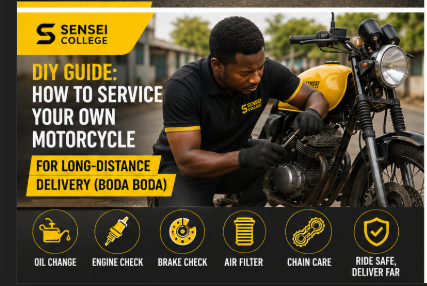
In Kenya, the boda boda motorcycle is more than just a vehicle; it is a business, a livelihood, and often a family’s primary source of income. And yet, many operators neglect regular servicing either to save money in the short term or because they do not know how.
Learning how to service your own motorcycle is one of the smartest investments a boda boda operator can make. It saves money, keeps you on the road, and signals to employers and fleet owners that you are a responsible, professional operator.
Why regular motorcycle servicing matters:
- A well-maintained engine uses less fuel, saving you money every single day
- Regular servicing prevents expensive breakdowns that can take you off the road for days
- A reliable motorcycle keeps customers coming back; it is part of your business reputation
- Motorcycle mechanics who can service professionally earn KES 20,000–60,000 per month
- NTSA and police checkpoints include roadworthiness inspections, a well-maintained bike avoids fines
Tools and Materials You Will Need
Basic Tools:
- Combination spanner set (8mm–19mm)
- Socket set with ratchet
- Flathead and Phillips screwdrivers
- Spark plug socket and ratchet (specific size for your engine, commonly 18mm or 21mm)
- Feeler gauge (for checking valve and spark plug gaps)
- Chain brush and lubricant
- Drain pan (for collecting old engine oil)
- Funnel
- Clean rags
- Torque wrench (for correct bolt tightening)
Consumables and Spare Parts:
- Engine oil (check your motorcycle manual – most common in Kenya: 10W-40 4-stroke engine oil for bikes like Honda CG125, TVS Star, Bajaj Boxer)
- New spark plug (correct type for your engine – check manual or old plug markings)
- New air filter (or cleaning materials for a foam type)
- Chain lubricant spray or grease
- Brake fluid (DOT 3 for most Kenyan motorcycles)
- New oil filter (if applicable – some bikes have an internal screen rather than a filter)
- Contact cleaner or WD-40 spray
Safety Equipment:
- Work gloves
- Safety glasses
- Secure motorcycle stand (centre stand or paddock stand – do not work on a bike balanced on its side stand only)
Understanding Your Service Intervals
Most motorcycles common in Kenya (Honda, TVS, Bajaj, Boxer, Yamaha) require:
| Service Type | Interval |
| Oil check | Every 500 km or weekly (whichever comes first) |
| Basic service (oil change, spark plug check, chain) | Every 3,000 km or monthly |
| Full service (all filters, valve clearance, brake check) | Every 6,000 km or 3 months |
For boda boda operators covering 80–120 km per day, a full service every 2–3 months is appropriate given the heavy usage, dusty conditions, and stop-start riding style.
Motorcycle Service Guide
Step 1: Park the Motorcycle Safely and Gather Everything
- Park on a flat, stable surface and use the centre stand (if fitted) – this is more stable than the side stand for servicing
- Allow the engine to cool for 20–30 minutes if it was running, hot oil burns skin and the exhaust will burn you
- Gather all your tools and consumables before starting
- Clean the exterior of the bike with a rag. Working on a clean bike prevents dirt from entering engine openings
Step 2: Change the Engine Oil
Engine oil is the life of your motorcycle engine. Old, dirty oil does not lubricate properly and causes wear.
- Place your drain pan under the engine drain plug (at the bottom of the engine; usually on the left or right underside
- Unscrew the drain plug using the correct spanner. Oil will flow out immediately
- Let all the old oil drain completely (5–10 minutes)
- While draining, check the oil’s condition: black and thin is normal; milky/creamy oil means water contamination (a serious problem investigate before continuing)
- Clean and reinstall the drain plug tighten firmly but do not overtighten
- Using a funnel, pour in fresh engine oil of the correct grade and quantity
- Honda CG125, TVS Star City, Bajaj Boxer: typically 1.0–1.2 litres of 10W-40 4-stroke oil
- Always check the manual for your specific model
- Check the oil level using the sight glass (small window on the right engine cover) or dipstick; it should be between MIN and MAX marks
Dispose of used engine oil responsibly. Collect it in a sealed container and take it to a garage for recycling. Pouring it on the ground harms the soil and the water.
Step 3: Inspect and Replace the Spark Plug
The spark plug ignites the fuel in the engine. A worn or fouled plug causes poor starting, rough running, and higher fuel consumption.
- Locate the spark plug at the top or side of the engine cylinder head
- Disconnect the spark plug cap (the rubber cover connected by a wire)
- Use the spark plug socket to unscrew the plug anti-clockwise – turn slowly to avoid cross-threading
- Inspect the old plug:
- Light brown/tan colour – Engine running well
- Black and sooty – Rich fuel mixture or oil burning – check air filter and carburettor
- White/blistered – Engine running too lean or overheating
- Worn electrode gap – Replace regardless of colour
- If replacing the gap, the new spark plug uses a feeler gauge – the correct gap for most Kenyan boda boda models is 0.6–0.8mm. The spec will be in the manual.
- Install the new plug by hand first (finger-tight), then tighten with the socket; usually about 1/4 to 1/2 turn after finger-tight (do not overtighten, it can crack the cylinder head)
- Reconnect the plug cap firmly
Step 4: Service the Air Filter
In Kenya’s dusty road conditions, especially on murram roads, air filters block up fast. A blocked filter makes the engine run on too much fuel, wastes petrol, and reduces power.
Foam air filter:
- Remove the air filter cover, usually on the right side of the bike
- Remove the foam element
- Wash in clean petrol or kerosene – gently squeeze, do not wring or tear
- Rinse with clean water if available, then squeeze dry
- Very lightly oil with clean engine oil – then squeeze out the excess (the foam should be barely damp, not dripping)
- Reinstall securely
Paper/dry air filter:
- Tap gently on a hard surface to remove loose dust
- Replace if very dirty paper filters cannot be washed
Never run a motorcycle without the air filter fitted, even to “test” the engine. Even a short run without a filter can score the cylinder walls and ruin the engine.
Step 5: Inspect and Lubricate the Drive Chain
The chain transfers power from the engine to the rear wheel. A dry, loose, or worn chain reduces power, causes noise, and can snap, which is extremely dangerous at speed.
Chain inspection:
- With the bike on the centre stand, rotate the rear wheel slowly and inspect the chain links for:
- Rust or corrosion
- Stiff or kinked links that don’t flex freely
- Missing or worn O-rings (on O-ring chains
- Excessive stretch measured at the bottom run of the chain – consult manual for maximum allowed sag; typically 20–30mm for most boda boda bikes
Chain lubrication:
- Clean the chain with a chain brush and paraffin (kerosene) and let it dry
- Apply chain lubricant spray evenly to the inner side of the chain while slowly rotating the rear wheel
- Allow 5 minutes for the lubricant to penetrate before riding
Chain adjustment (if loose):
- Loosen the rear wheel axle nut
- Adjust the chain adjusters (at the rear axle) equally on both sides, and turn clockwise to tighten
- Check that the chain has the correct sag (slack) as per the manual
- Re-tighten the axle nut to the correct torque
A chain that snaps or comes off the sprocket at speed can lock the rear wheel or damage the engine casing. Never ride with a stretched, dry, or visibly worn chain.
Step 6: Check and Adjust the Brakes
- Front brake (disc or drum): Squeeze the lever and check that it is firm excessive travel before braking. Resistance indicates worn pads or low brake fluid
- Rear brake (drum on most boda boda bikes): Press the pedal and check for firm resistance and appropriate travel
- Check brake fluid level (front disc brakes only) – look at the reservoir on the handlebars. Add DOT 3 brake fluid if below the minimum line
- Check brake pad thickness – pads below 2mm must be replaced immediately
- Adjust brake lever/pedal freeplay using the adjuster nuts; the front lever should have 2–5mm freeplay; the rear pedal slightly more
Brakes are your most critical safety system. If you notice any sponginess in the brake lever, grinding sounds from disc brakes, or dramatically increased stopping distance, stop riding and get the brakes inspected immediately.
Step 7: Check Tyres, Lights, and Controls
Tyres:
- Check front and rear tyre pressure (use a pressure gauge, commonly recommended pressure: front 28–30 PSI, rear 30–35 PSI for typical boda boda loads – check your manual)
- Inspect for cuts, bulges, or worn tread
- Replace tyres when tread depth is below 1mm or if there are sidewall cracks
Lights:
- Test the headlight (high and low beam), tail light, brake light, and indicators
- Replace any blown bulbs. Riding without lights in Kenya is an offence and extremely dangerous at night
Controls:
- Check throttle – it should open smoothly and snap shut immediately when released
- Check clutch lever operation – smooth engagement and disengagement
- Check all cables for fraying or kinking
Step 8: Start the Engine and Final Check
- Start the engine and let it warm up for 2–3 minutes
- Check for any oil leaks around the drain plug or oil filter
- Rev gently and listen for any unusual noises – knocking, tapping, or rough running
- Test ride slowly in a safe area – check brakes, gears, and smooth power delivery
- After the test ride, check the oil level again with the sight glass
Safety Tips and Best Practices
- Wear a helmet even during a short test ride after servicing
- Never test ride without insurance – confirm your motorcycle insurance is current
- Keep a service logbook – record every service with the date and odometer reading
- Use genuine or quality replacement parts – cheap spark plugs and filters cause more problems than they solve
- Check tyre pressure weekly – it is the single fastest maintenance check and directly affects fuel consumption and handling
Common Problems and Troubleshooting
| Problem | Likely Cause | Solution |
| Hard to start after service | Spark plug not properly gapped or fitted | Re-check and re-gap the plug |
| Engine smokes black after service | Air filter not fitted correctly | Check air filter is sealed in housing |
| Chain noise after lubrication | Chain too tight or worn | Adjust chain sag; inspect for worn links |
| Brakes feel spongy | Air in brake fluid or low fluid | Top up fluid; bleed brakes if needed |
| High fuel consumption despite service | Air filter still dirty, carburettor dirty | Clean carburettor jets; replace air filter |
| Engine oil leaking after drain | Drain plug not tightened or missing washer | Check and retighten plug with washer |
A clean air filter and fresh oil will keep your engine running for years. Neglect them, and you will be buying a new engine within a year.
Frequently Asked Questions (FAQs)
1. How often should I service my boda boda motorcycle in Kenya?
For a boda boda covering 80–120 km daily, change the engine oil every 3,000 km or 4–6 weeks. Do a full service, including air filter, spark plug, chain, and brake check every 6,000 km or 2–3 months.
2. What engine oil should I use for a Honda, TVS, or Bajaj motorcycle in Kenya?
Most boda boda motorcycles in Kenya use 10W-40 4-stroke engine oil (API SL or higher). Always verify with your specific model’s manual. Avoid 2-stroke oil in a 4-stroke engine – it causes serious damage.
3. Can I service my motorcycle myself without a mechanic?
Yes, basic servicing (oil change, spark plug, air filter, chain lubrication) is straightforward enough for a careful beginner to do at home with the right tools and this guide. More complex work (valve clearance adjustment, carburettor tuning, brake bleeding) is better done by or with a trained mechanic until you build experience.
4. How much does a motorcycle service cost at a garage in Kenya?
A standard service (oil change, spark plug, chain lubrication) at a local garage typically costs KES 500–1,500 for labour plus parts. Doing it yourself costs only the parts (approximately KES 800–1,500) and saves the labour cost.
5. Is motorcycle mechanics a good career in Kenya?
Yes. Qualified motorcycle mechanics earn KES 20,000–60,000 per month and there is strong demand across the country given Kenya’s enormous boda boda fleet. Many mechanics eventually open their own workshops.
Conclusion
Your motorcycle is your business. Servicing it regularly and correctly protects your investment, keeps you on the road, and prevents the costly breakdowns that kill income.
For structured training in motorcycle mechanics, boda boda operation, or professional vehicle maintenance, consider enrolling in a certified motorcycle mechanics or automotive engineering TVET programme like Sensei College and get certified.