
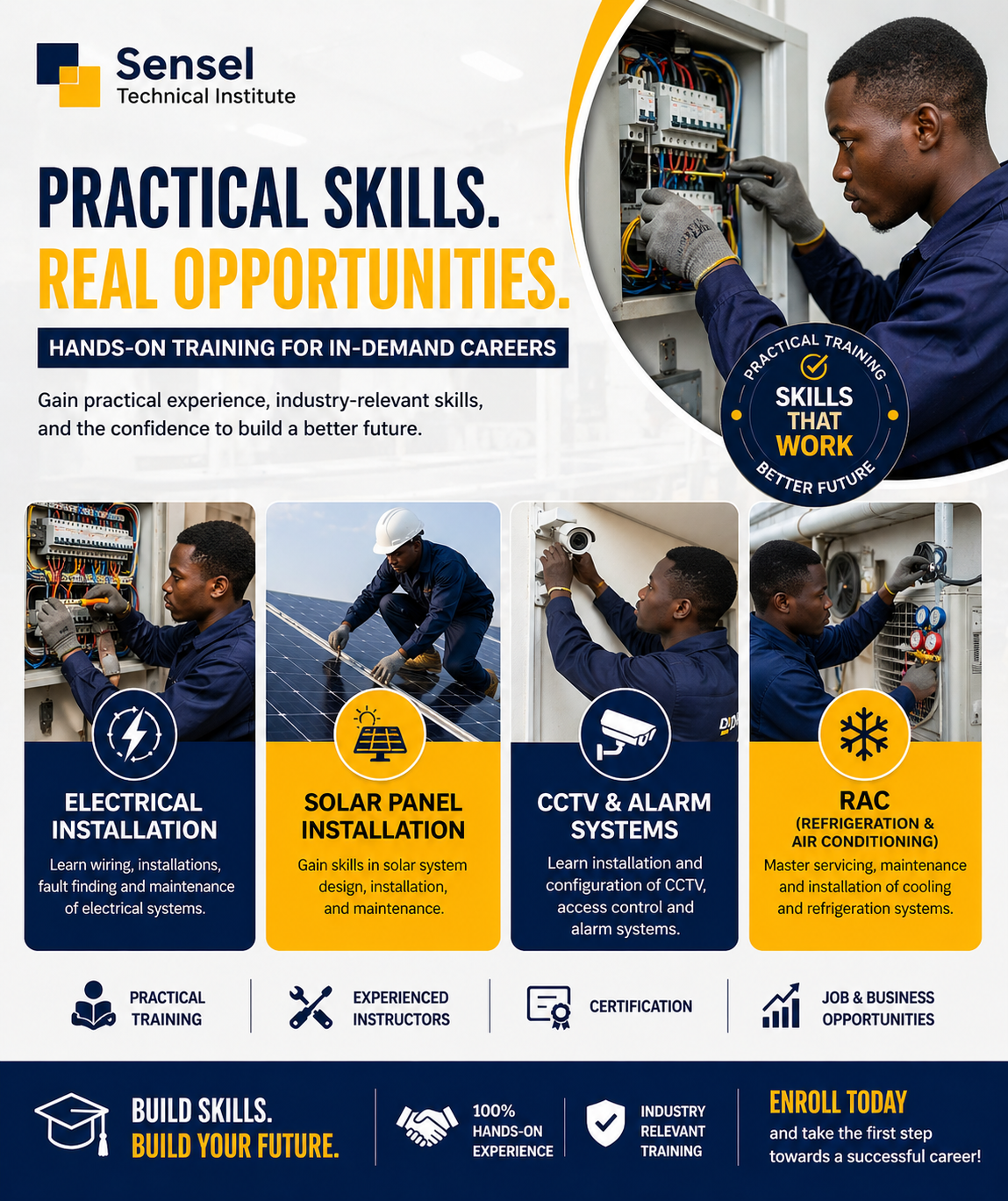
Kenya is growing fast. Cities are expanding, new homes are being built every day, and businesses are investing in security, energy, and technology. This growth has created a massive demand for skilled electricians and electronics technicians.
Whether you are a school leaver looking for your first career, a job seeker wanting to upgrade your skills, or someone dreaming of running your own business, a practical technical course in electrical and electronics could be your best investment in 2026.
Sensei College offers a range of electrical and electronics training courses designed to get you job-ready quickly. These are not just classroom lessons, they are hands-on, practical programs where you actually work with real tools, real equipment, and real-world scenarios.
In this guide, you will learn about every electrical and electronics course available at Sensei College, what skills each program teaches, what jobs and businesses are possible after training, and how much you can expect to earn.
Electrical Installation Training at Sensei College
The electrical installation course at Sensei College is the foundation of all electrical careers. It teaches you how electricity works, how to wire a building safely, and how to install and maintain electrical systems in homes and businesses.
What You Will Cover
- How to read and interpret electrical wiring diagrams
- Safe wiring practices for residential and commercial buildings
- Installing switches, sockets, circuit breakers, and distribution boards
- Fault finding and electrical troubleshooting
- Kenya Power connection procedures and safety standards
- Earthing and bonding for electrical safety
This course is perfect for beginners; you do not need any prior experience. By the end of the program, you will have the confidence to wire a house or small office on your own.
Without qualified electricians, no building’s power can function safely; therefore, electrical training is a valuable investment.
Domestic vs. Industrial Electrical Specialization
Once you complete your basic electrical installation training, you can choose to specialize. Sensei College offers training in both domestic and industrial electrical work.
Domestic Electrical Work
Domestic electricians focus on homes, apartments, hostels, and small shops. They install lighting, wiring, sockets, and consumer units.
This is the most common starting point for new electricians in Kenya.
- Work on residential housing projects, estates, and rentals
- Low setup cost if starting your own business
- High demand in cities like Nairobi, Mombasa, Kisumu, and Nakuru
Industrial Electrical Work
Industrial electricians work in factories, warehouses, manufacturing plants, and large commercial buildings. They handle high-voltage systems, motors, transformers, and control panels.
- Higher salaries compared to domestic work
- More technical knowledge is required
- Strong demand from manufacturing and industrial sectors
If you are just starting out, begin with domestic electrical training. It is easier to understand, requires less capital to start a business, and gives you a solid foundation. You can always upgrade to industrial work after gaining experience.
Solar Panel Installation Training in Kenya
Solar energy is no longer a luxury in Kenya; it is a necessity. With rising electricity costs, frequent blackouts, and millions of homes still off the national grid, solar power is growing at an incredible pace.
Sensei College offers a solar PV installation training program that equips you with the skills to design, install, and maintain solar power systems for homes, schools, hospitals, and businesses.

What You Will Learn in Solar Training
- How solar panels, batteries, inverters, and charge controllers work together
- Designing a solar system to match a customer’s energy needs
- Safe mounting of panels on rooftops
- Wiring solar systems and connecting to appliances
- Troubleshooting and maintenance of solar installations
Why Solar Installation is a Future-Proof Career
The Kenyan government has committed to expanding renewable energy to rural communities. NGOs, government projects, and private investors are all funding solar expansion. This means demand for solar installation training in Kenya is growing every year.
Solar technicians in Kenya can earn anywhere from KES 35,000 to over KES 80,000 per month, depending on experience and whether they are employed or self-employed.
CCTV and Alarm Systems Training in Kenya
Security is a growing concern for Kenyan businesses, schools, hospitals, and homeowners. The demand for CCTV installation and alarm systems has exploded, and skilled technicians are in demand.
The CCTV installation course in Kenya at Sensei College teaches you everything you need to install, configure, and maintain professional security systems.

Skills Covered in the CCTV and Alarm Systems Course
- Types of CCTV cameras and how to choose the right ones
- Installing indoor and outdoor cameras with proper cable routing
- Setting up Digital Video Recorders (DVRs) and Network Video Recorders (NVRs)
- Connecting cameras to remote monitoring apps on smartphones
- Installing burglar alarms, motion sensors, and access control systems
- Troubleshooting camera faults and signal problems
Business Opportunities in Security Systems
After completing the alarm systems training in Kenya, you can offer your services to supermarkets, banks, offices, schools, petrol stations, and residential estates. Many graduates start their own security systems businesses, handling installation and annual maintenance contracts.
A single CCTV installation job in Nairobi can earn a technician between KSh 15,000 and KSh 80,000, depending on the size of the project. Repeated maintenance contracts make it an excellent recurring income business.
Refrigeration and Air Conditioning (RAC) Training at Sensei College
Kenya’s warming climate and growing middle class have made air conditioners and refrigerators more common. From restaurants and supermarkets to hospitals and hotels, refrigeration and air-conditioning systems are everywhere, and they all need regular servicing.

What the RAC Course Covers
- How refrigeration cycles and air conditioning systems work
- Installation of split air conditioners, window units, and industrial chillers
- Gas charging and refrigerant handling
- Diagnosing and fixing common faults like poor cooling and gas leaks
- Servicing fridges, freezers, and display coolers for businesses
Career and Income Opportunities for RAC
RAC technicians are in demand across Kenya’s hospitality, healthcare, retail, and domestic sectors. The combination of electrical and RAC skills makes you an extremely versatile technician.
In that one can:
- Work with air conditioning companies, hotels, hospitals, and supermarkets
- Start your own appliance repair and servicing business
- Contract work with property management firms
Many experienced RAC technicians in Kenya earn between KES 30,000 and KES 70,000 monthly, with self-employed technicians often earning much more during hot seasons.
Mobile Phone Repair as a Business Opportunity
There are over 60 million mobile phone subscriptions in Kenya. People depend on their phones for everything: money transfers, business, communication, and entertainment. When a phone breaks, people need it fixed immediately.
This constant demand makes mobile phone repair one of the best low-capital business ideas in Kenya today.
Sensei College’s mobile phone repair course gives you the technical skills to diagnose and fix smartphones and feature phones professionally.
Concepts You Will Cover
- Hardware repair: screens, batteries, charging ports, cameras, and speakers
- Software repair: flashing, unlocking, and fixing software errors
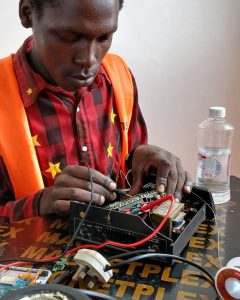
- Circuit board repair and component-level soldering
- Diagnosing water-damaged phones
- Business management: pricing, customer service, and sourcing spare parts
Why This Is One of the Best Startup Businesses in Kenya
i). Very low startup capital – a small repair shop can be started with as little as KES 20,000–50,000
ii). No need for a large space – a table and tools are enough to begin
iii). Constant, reliable demand from students, business people, and households
iv). Opportunity to scale into selling phones and accessories
Career Opportunities and Earnings in Kenya
What you earn after course completion depends on your specialization, your experience, and whether you choose employment or self-employment.
Expected earnings depending on specialization table
| Specialization | Monthly Earnings in (KSh) |
| Electrical Installer (Employee) | 25,000 – 50,000 |
| Solar PV Technician | 35,000 – 80,000 |
| CCTV / Alarm Systems Technician | 30,000 – 60,000 |
| RAC Technician | 30,000 – 70,000 |
| Mobile Phone Repair (Own Business) | 20,000 – 100,000 |
| Self-Employed Electrician | 50,000 – 200,000 |
Employment vs. Self-Employment
Employment gives you stability, a regular salary, experience, and on-the-job learning. Self-employment offers unlimited earning potential, but requires business skills and client-building.
Many Sensei College graduates start by working for an employer to gain experience, then launch their own businesses within two to three years. Others go straight into self-employment using the practical skills they gained during training.
Local and International Opportunities
Qualified Kenyan electricians and solar technicians are increasingly finding opportunities in East Africa, the Middle East, and beyond. Countries like Saudi Arabia, UAE, and Qatar have a strong demand for certified electrical technicians.
Why Choose Sensei College for Your Electrical Training?
-
Hands-On, Practical Training
At Sensei College, you do not just sit and listen to lectures. You work with real tools, real equipment, and real installations from day one. This practical approach means you leave with confidence and competence.
-
Industry-Relevant Curriculum
The courses are designed to match what employers and clients actually need in Kenya’s current job market. You will learn the specific skills that are in demand right now, not outdated theory.
-
Multiple Specializations Under One Roof
Rather than attending different colleges for electrical installation, solar, CCTV, RAC, and mobile repair, you can access all these specializations in one institution. This makes it easy to combine skills and increase your earning potential.
-
Increased Employability and Entrepreneurship
Sensei College’s focus on practical skills means graduates are immediately employable. More importantly, the training gives you everything you need to start your own business and build a sustainable income.
Sensei College electrical courses are designed for people who want results. If you’re serious about wanting a career or starting a business, Sensei College gives you a foundation for it.
Frequently Asked Questions (FAQs)
1. How much does an electrical course cost in Kenya?
Fees vary depending on the specific program and duration.
At Sensei College, fees are structured to be affordable for students and job seekers.
2. How long does it take to become an electrician in Kenya?
Short technical courses can take anywhere from a few weeks to several months, depending on the program. The electrical installation course typically takes 3 to 6 months. Solar, CCTV, and RAC courses can be completed in shorter periods.
3. Is solar installation a good career in Kenya in 2026?
Yes, absolutely. Kenya’s push for renewable energy, combined with unreliable grid electricity in many areas, is making solar installation one of the fastest-growing technical careers in the country.
4. Can I start my own business after completing a course?
Yes. This is one of the primary goals of the course.
The practical, hands-on nature of the courses means you graduate with real skills you can immediately use to offer services and charge clients. Many graduates start their own businesses in electrical installation, solar installation, CCTV setup, mobile phone repair, or RAC servicing.
5. Do I need a certificate to work as an electrician in Kenya?
Having a recognized training certificate significantly improves your chances of employment and helps you win client trust when operating independently. For certain formal employment positions, you may also need to register with the Energy and Petroleum Regulatory Authority (EPRA) after gaining experience.
6. Which electrical course is best for a complete beginner?
The electrical installation course is the best starting point for beginners. It covers fundamental concepts, safety, and practical wiring skills that form the base for all other specializations. Once you have completed the basics, you can then add solar, CCTV, RAC, or mobile phone repair to your skill set.
7. Can I study CCTV installation if I have no electrical background?
Yes. The CCTV installation course at Sensei College is designed to be accessible to beginners. You will be taught everything from the ground up, including basic electrical concepts relevant to security system installation. No prior experience is required to enroll.
Conclusion
The economy is built on construction, technology, security, and energy. Every one of these sectors depends on skilled electrical and electronics technicians. These are skills you can learn in months not years, and start earning from almost immediately.
Whether you want to wire houses, install solar panels, set up CCTV systems, service air conditioners, or repair smartphones, Sensei College has a practical course that will get you there.